Why a controlled torque tool matters more than many buyers think
An ATsafepro torque wrench is the kind of tool people usually buy after they have already felt the cost of a bad fastener decision. Too loose and a joint can work itself apart; too tight and threads, gaskets, brake components, or lightweight alloy parts can be damaged in a way that is not obvious right away. That is why torque control is not just a nice workshop feature. It is a practical safeguard for assembly quality, serviceability, and safety.
For engineers, sourcing managers, and maintenance teams, the real question is not whether a torque wrench exists in the toolbox. It is whether the wrench is readable, consistent, suited to the job, and supplied with enough documentation to make it usable in a production or service environment. The product shown here points to a mechanical torque wrench set with a hard case, a calibration document, a 3/8 in drive, and a marked torque range of 10–110 ft-lb. That combination makes it relevant for automotive work, machinery service, and other tightening tasks where repeatability matters.
What this type of torque wrench is designed to do
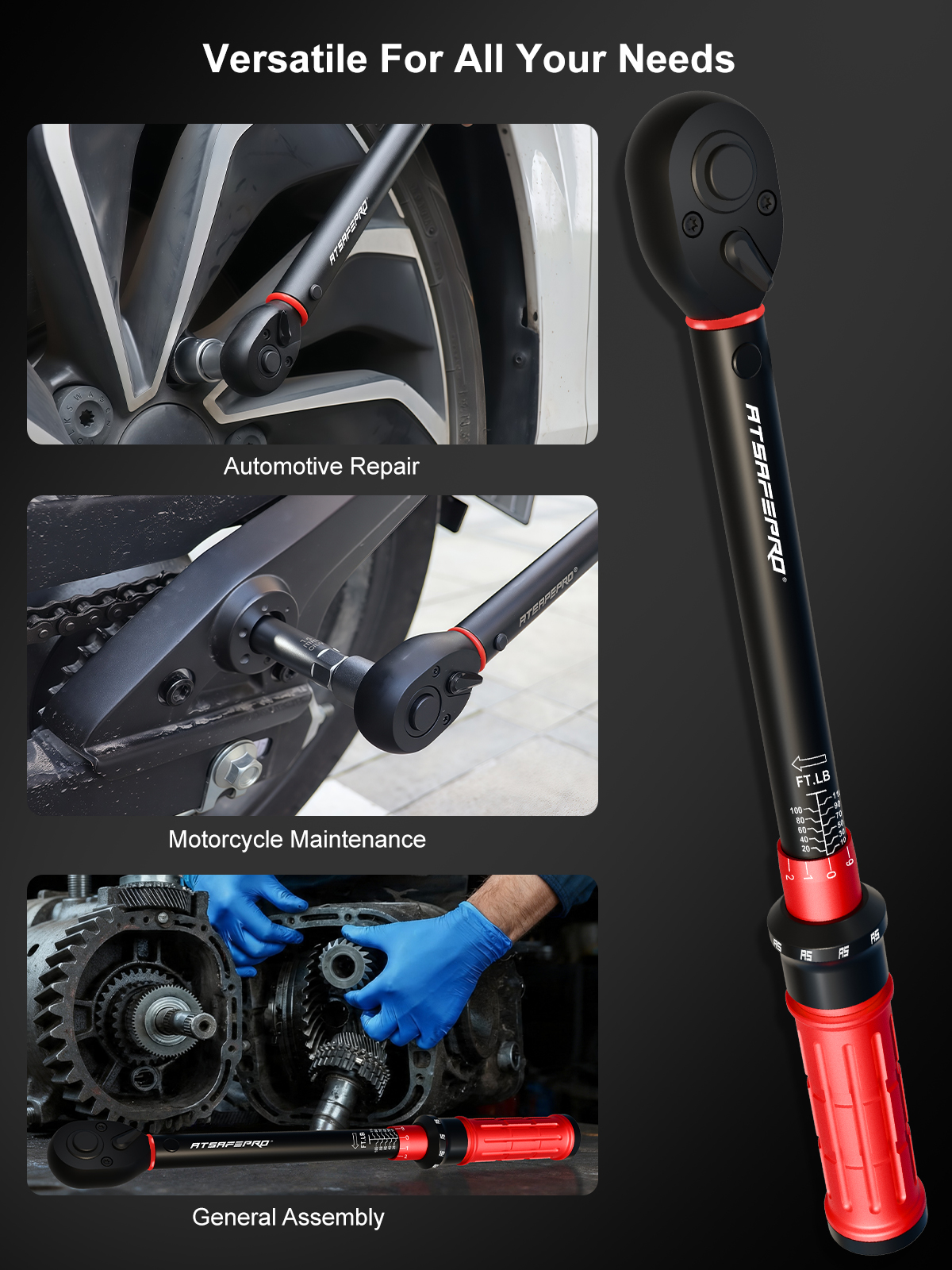
At its core, a mechanical torque wrench is a controlled hand tool. You set a target torque, apply force to the fastener, and the wrench signals when the target is reached. In a click-type tool, that signal is usually a tactile or audible release. The visible configuration here suggests an adjustable wrench with a long body, a ratcheting head, a scale on the neck or adjustment area, and a red adjustment grip. That is a familiar layout for technicians because it balances reach, visibility, and one-hand adjustment.
The long handle is not cosmetic. It helps users apply force more steadily, which is especially useful when working on fasteners that need a specific final load rather than “tight enough by feel.” The ratcheting head also matters in tight engine bays or machine frames where the socket cannot be fully removed between strokes. For field service, that can save time and reduce awkward wrist angles, though it is still worth remembering that torque accuracy depends on the wrench being used within its intended range and handled properly.
Quick buyer reference: what stands out from the supplied product details
If you are screening tools for procurement or workshop use, these are the concrete points supplied with the product:
• Torque range shown on the certificate: 10–110 ft-lb
• Drive size shown on the certificate: 3/8 in
• Included items visible: wrench body, metal extension/accessory bar, two socket adapters or drive reducers, and a hard plastic storage case
• Documentation visible: calibration certificate / inspection sheet with an error table
That package suggests the tool is being positioned as more than a loose hand wrench. The case and paperwork are important in any environment where tools are tracked, issued, or verified before use. In practice, buyers often underestimate that point. A torque wrench without a storage case tends to get dropped, borrowed, or left under load, all of which can shorten its useful life.
Construction details that matter in daily use
The visible wrench body appears to be metal with a black coated finish, while the grip section uses a red molded sleeve with ribbing for hold. That is a sensible combination. The black finish helps the tool look clean in service and may offer basic surface protection, while the red grip gives technicians a clear hand position. In a greasy shop, ribbed grip surfaces are not luxury features; they are what keep the tool from feeling slippery after a long shift.
The head and accessories appear to be polished metal. That does not tell us the exact grade or treatment, and it would be wrong to guess. But polished accessory surfaces generally make it easier to spot wear, contamination, or burrs. The included extension bar and reducers/adapters also expand the set’s usefulness. Just be cautious here: adapters can be handy, but they can also complicate torque transfer depending on the setup. If the joint is critical, the final arrangement should be checked against the assembly procedure rather than assumed.
A small but important caution on extensions and adapters
Some buyers treat every accessory as interchangeable. It is not always that simple. Using extensions or reducers can change the effective setup and, in some cases, the torque delivered at the fastener. The exact effect depends on geometry and how the tool is applied. For noncritical service work that may be acceptable; for production assembly or safety-related joints, the procedure should be explicit.
Where this tool fits best
The most obvious use cases are automotive repair and maintenance, motorcycle service, bicycle assembly, and general machinery fastening. Those are all settings where threads can be damaged by over-tightening and where under-tightening can be just as problematic. A 3/8 in drive is a practical middle ground for many medium-duty jobs. It is not the biggest shop drive, but it is often the most versatile for technicians who need one wrench to cover a broad range of fasteners without moving to heavier equipment.
For sourcing teams, this makes the product easier to slot into a standard tool kit. It is not specialized in the sense of a factory-grade production torque system, but it is also more serious than a casual household wrench. That middle space is often where the volume is, especially for dealers, service centers, and workshops that need dependable general coverage rather than a single application tool.
Why calibration paperwork changes the buying decision
The presence of a calibration certificate or inspection sheet is one of the more useful details in the supplied data. It suggests the wrench is not being sold as a bare commodity item only. The certificate shows a calibration error table, which is a good sign that the tool has been checked rather than simply packaged. I would still avoid making broad claims about long-term accuracy without more evidence, because any mechanical torque tool can drift with use, drops, or rough storage. But for first-use confidence and internal quality records, the document adds value.
In a workshop or service organization, that paper trail matters for two reasons. First, it gives supervisors something to file or cross-reference when a tool is issued. Second, it helps technicians trust the wrench at the moment they need to make a controlled tightening call. If a tool arrives without clear documentation, people tend to either ignore it or use it casually. Neither is ideal.
How to choose the right torque wrench for your job
When comparing this kind of set against alternatives, start with the fasteners you actually tighten. If most of your work sits in the medium-torque band, a 10–110 ft-lb range is useful. If your work includes very small or very large fasteners, you may need a different wrench to stay in the proper working range. Accuracy is not just a certificate issue; it is also a range issue. A wrench used constantly at the bottom or top edge of its range is rarely the best choice.
Next, check the drive size. A 3/8 in drive is common and flexible, but it should match the sockets and service environment you already have. Then look at the case and accessories. For mobile technicians or shared shop tools, a rigid case is not optional. It keeps the wrench from being stored under load and reduces the odds of missing parts. Finally, confirm the documentation requirements of your own operation. Some teams only need a simple inspection sheet; others need a calibration record for incoming quality control.
Common mistakes buyers and users still make
One common mistake is buying a torque wrench only by range and ignoring readability. If the scale is hard to see or the adjustment feel is poor, the tool will be misused. Another is leaving the wrench set to a high torque value in storage. That shortens the life of the internal mechanism on many mechanical tools. The safe habit is to back it down after use, following the tool’s own instructions.
Another easy mistake is treating the included adapters as proof that every fastening situation is covered. They are helpful, but they do not remove the need to match sockets, fasteners, and access requirements properly. In field work, awkward setups are often where torque errors creep in. A wrench that is technically capable can still be used badly if the operator has to fight the geometry.
Practical advice for procurement and shop managers
If you are buying for a team, think beyond the purchase order. Decide who will own the wrench, where it will be stored, and whether the calibration paperwork will be logged on receipt. Those steps take little time, but they preserve the value of the tool. Also consider whether you want a set, not just the wrench body. The hard case and accessories may be the difference between a tool that is issued properly and one that ends up mixed into a general drawer.
For service businesses, this kind of tool also benefits from simple user rules: keep it clean, do not use it as a breaker bar, and return it to a known setting after use. None of that is glamorous, but it is how mechanical torque tools stay useful.
What this product appears to offer, in plain terms
The supplied details suggest a straightforward, workshop-ready mechanical torque wrench kit with a useful medium-duty torque span, a common 3/8 in drive, accessory pieces, and included calibration documentation. That makes it suitable for buyers who need controlled tightening without jumping to a more complex electronic tool. It is the sort of purchase that pays off when the job is repetitive, the fasteners matter, and the team needs a tool that can be stored, issued, and used with a little discipline.
Next step for buyers
If you are evaluating this ATsafepro torque wrench for procurement or shop use, compare the marked torque range, drive size, included accessories, and calibration paperwork against your own fastening list. If the range fits your jobs and the documentation meets your internal process, it is worth shortlisting. If you need a different drive size or a narrower range, it is better to discover that before the wrench lands in the toolbox.