Why a quick-connect fitting matters more than it looks
A GODESON air fitting is the kind of small shop component people usually notice only when it slows them down. In a compressed-air setup, the fitting is not just a connector; it is the part that decides how quickly a tool can be swapped, how neatly a hose can be routed, and how much annoyance leaks or loose threads will create over time. For engineers, sourcing managers, and product teams, that makes a humble quick-connect pneumatic fitting worth a closer look.
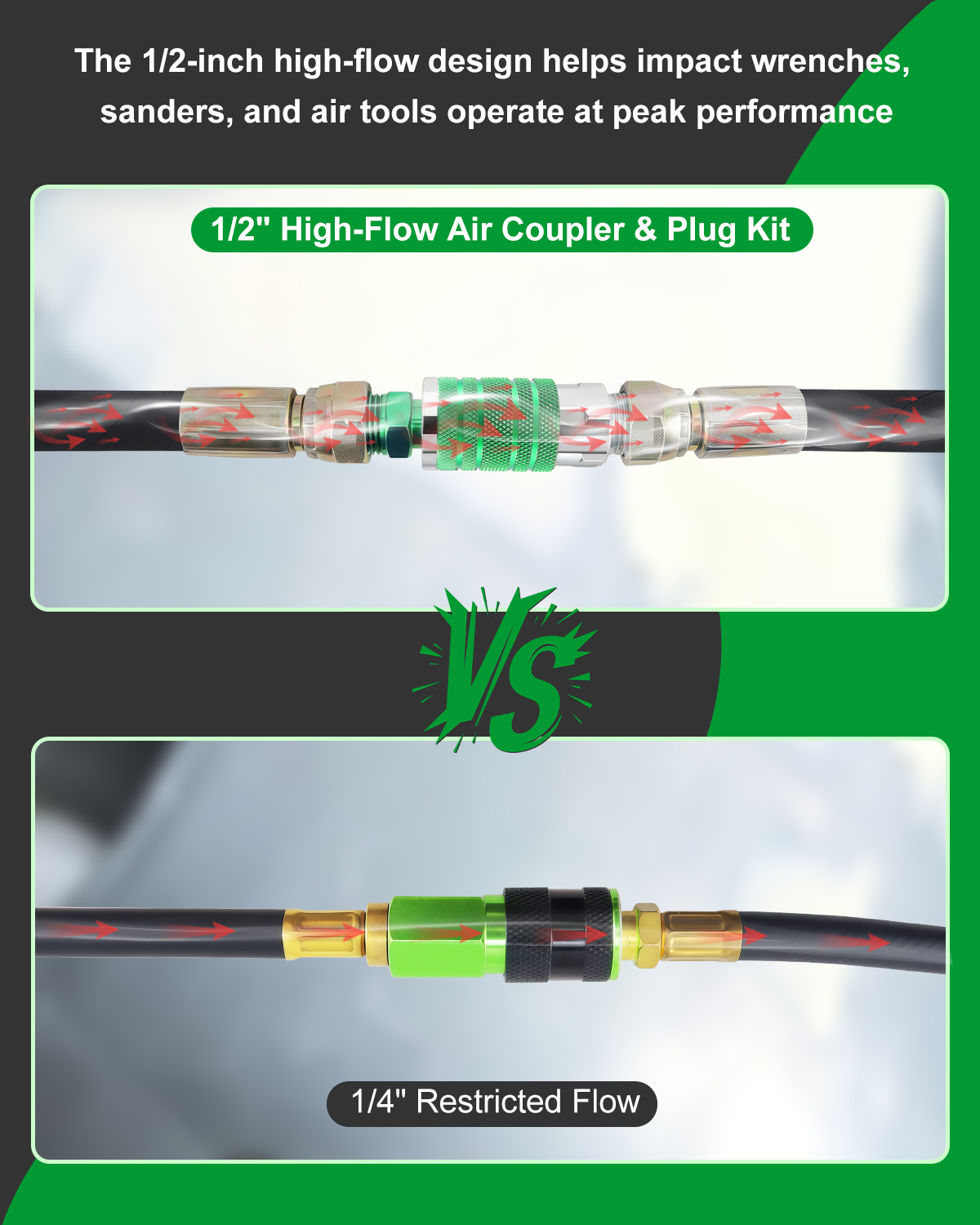
The image shows a compact air hose coupler set with a larger coupler body, two smaller threaded plug/adapters, and a separate sealing insert. The overall form suggests a manual quick-release style connection for pneumatic lines or air tools. That sounds straightforward, but the details matter: threaded ends, wrench flats, a knurled grip, and anodized metal surfaces all point to a fitting designed for practical shop use rather than decorative hardware.
What the set appears to include
Based on the visible components, this is not a single fitting but a small adapter set for building or modifying a pneumatic connection. The larger piece has a silver metal body with a green knurled section, while the smaller parts are green anodized metal plugs with hex shoulders and male threads. A white-and-red plastic or PTFE-like sealing piece is shown separately.
That combination suggests a few possible uses. It may be intended for replacing worn connectors, adapting a hose end to a different manifold, or assembling custom air lines where standard off-the-shelf lengths are inconvenient. In real shop work, that flexibility is often more useful than a fixed hose assembly, especially when space is tight or equipment changes frequently.
Visible features that are worth paying attention to
The coupler body uses a knurled sleeve, which usually improves hand grip during connection and release. The smaller male adapters have hex flats, so they can be tightened with a wrench rather than relying on hand force alone. The threaded bases indicate the parts are meant to screw into another component, not simply clamp onto a hose.
These are not glamorous details, but they tell a sourcing team a lot. A fitting that offers both hand operation and wrench-tightened installation is usually easier to service in the field, and easier to install consistently on the production side. That said, the exact thread standard is not visible here, so compatibility still needs to be verified before anyone orders in volume.
Why materials and finish are part of the buying decision
The fittings appear to be machined metal with an anodized finish on several pieces. Anodizing is often chosen for aluminum components because it adds surface hardness, corrosion resistance, and a cleaner visual appearance. The bright green finish also makes the parts easy to identify in a mixed inventory, which is a small but real benefit in a maintenance cabinet or prototype lab.
Whether the base metal is aluminum or another alloy is not confirmed, so it would be unwise to overstate the material. Still, the sharp machining marks, visible threading, and crisp hex geometry all suggest a CNC-machined fitting rather than a cast low-cost part. That usually improves consistency, though buyers should remember that appearance alone is not a substitute for tested pressure ratings or actual compatibility data.
How quick-connect pneumatic fittings are typically used
In compressed-air systems, a quick-connect fitting solves one simple problem: people need to disconnect a tool or hose without spending time on wrenches, sealant cleanup, or full disassembly. That is why these fittings show up on workshop air lines, industrial equipment, test rigs, and custom hose assemblies. They are especially common where operators swap tools often, or where a setup must be reconfigured between jobs.
In practice, the fitting choice affects more than speed. It can influence airflow resistance, sealing behavior, and how often the connection has to be checked for wear. On a prototype rig, a convenient fitting can save hours during setup changes. On a production line, the same fitting can reduce downtime. But if the connector standard is wrong, or if the sealing element is mismatched, the convenience disappears quickly.
Selection points that matter in procurement
If you are evaluating a GODESON air fitting or a similar quick-connect set, the first question is compatibility. Thread size and thread standard are not visible in the photo, and that is where many buying mistakes begin. A fitting can look right and still fail to mate correctly with the existing manifold or hose end. The second question is the coupling standard, because pneumatic connectors are not universally interchangeable just because they look similar.
Then come the service conditions. Buyers should confirm whether the fitting is intended strictly for air, what pressure range it is designed for, and whether any temperature or environment limits apply. Those details are not supplied here, so they should be treated as open items rather than assumptions. For industrial users, that caution is not optional; it is what keeps a convenient component from becoming a maintenance headache.
Practical questions to ask before ordering
What exact thread does the fitting use? Does the coupler standard match the rest of the plant? Is the sealing insert meant to be reusable or replaced during maintenance? Does the knurled sleeve provide the level of grip your technicians need with gloves on? Those questions sound basic, but they save time later.
It is also worth checking whether the adapter set includes everything needed for installation or only the visible pieces. A small sealing ring can be easy to overlook, yet it may be essential to the assembly. Buyers who work from a bill of materials should confirm every subcomponent instead of assuming the kit is complete for every use case.
Common mistakes with air hose coupler sets
The most common error is treating all quick-connect fittings as interchangeable. They are not. Even when the outer shape is similar, differences in thread pitch, seal profile, and internal geometry can cause leakage or partial engagement. Another mistake is selecting a fitting solely on appearance or color. The green anodized finish is useful for identification, but it does not tell you the full performance story.
A second mistake is over-tightening threaded fittings without considering the sealing method. If the fitting relies on an insert or a specific seal type, too much torque can distort the joint or complicate service later. In a workshop, that may mean an annoying leak. In a production setting, it can mean unplanned downtime. A small caution, but a worthwhile one: pneumatic fittings are simple only after they are specified correctly.
What the design suggests about use and service
The knurled larger coupler body suggests frequent human interaction. That usually means the fitting is intended for applications where operators connect and disconnect by hand, not just once during installation and then forget about it. The hex shoulders on the smaller adapters suggest the opposite: they are meant to stay put once installed, with periodic service handled by a wrench.
That mix of hand-grip and wrench-fit design is sensible. It gives users a quick-release interface without sacrificing installation security. In a custom manifold or compressed-air distribution panel, that balance can be exactly what a buyer wants. It is a small design choice, but it often separates a tidy serviceable system from one that gets awkward after the first maintenance cycle.
Buyer takeaway: where this kind of fitting fits best
A set like this is best suited to compressed-air applications where modularity matters. Think workshop tools, test fixtures, retrofit air lines, or replacement parts for custom pneumatic assemblies. It is less about novelty and more about making the system easier to live with.
If your team is sourcing parts for a recurring build, the main decision is not whether the fitting looks sturdy. It is whether the thread standard, sealing arrangement, and coupling type match the rest of the system. That compatibility question is the one worth solving first. Once that is settled, the rest of the selection becomes much simpler.
FAQ
Is this fitting suitable for compressed air only?
Based on the available information, it appears intended for pneumatic air use. Other gases or fluids should not be assumed without verified material and sealing data.
Can I identify the thread size from the image?
No. The threads are visible, but the exact size and standard are not supplied. That needs to be checked against measurements or product documentation.
Why are there multiple pieces in the set?
It looks like an adapter set for building or modifying air connections, which can be useful for custom hose or manifold assemblies.
What should I verify before buying in quantity?
Confirm thread compatibility, coupling standard, sealing method, and intended pressure range. Those details matter more than the finish color or general shape.
A sensible next step
If you are considering a GODESON air fitting for a workshop, test fixture, or production-air setup, start with the interface points already in service: the thread standard, the connector family, and the seal style. Once those are matched, the decision becomes a practical one rather than a guess. If those basics are unclear, ask for dimensional and compatibility details before placing the order. That is usually the cheapest time to discover a mismatch.