What buyers usually mean when they search for a GODESON air fitting
When someone searches for a GODESON air fitting, they are usually not looking for a generic connector tutorial. They are trying to solve a practical problem: how to connect an air line, swap a tool, or replace a worn coupler without introducing leaks, mismatch, or downtime. In workshops and light industrial settings, that matters more than it sounds. A poorly matched fitting can waste compressed air, annoy operators, and turn a simple service job into a parts chase.
The product image suggests a compact quick-connect fitting set with a knurled main body, threaded end, and matching plug pieces. That combination points to a system built for fast attachment and removal, with enough surface detail to tighten by hand or with a wrench where needed. Buyers often use parts like this in pneumatic tooling, maintenance kits, instrumentation lines, and other compressed-air applications where convenience and repeatability matter.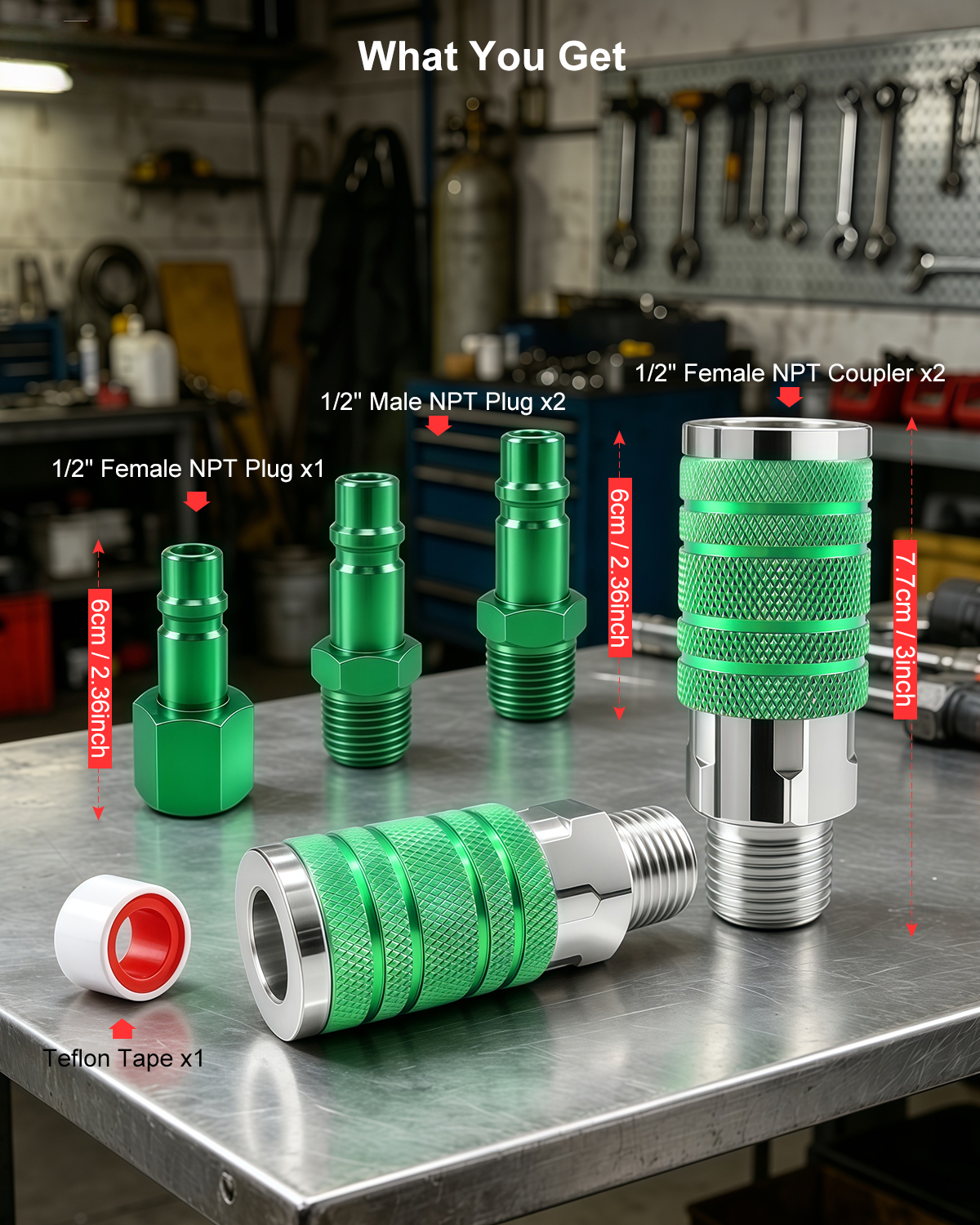
Why the fitting details matter before you buy
Air fittings look simple until they are installed in the wrong place. Then the questions start: Does the thread match the manifold? Is the plug profile compatible with the existing coupler? Is the seal seating correctly, or is the connection just snug enough to fool a quick inspection?
That is why the visible geometry in a fitting set is more important than the marketing label. The knurled grip on the main connector suggests hand-friendly handling. The hex section on one of the smaller parts suggests wrench tightening for a more secure installation. The separate white ring with a red inner element looks like a sealing or insulating component, which is a reminder that the connection is only as reliable as the seal stack behind it.
For engineers and sourcing teams, the real decision is not “which fitting looks best,” but “which fitting matches the thread, the connector family, and the service conditions already in the system.” That is especially true if you are replacing a part in an existing air line where the original standard is not always obvious from the outside.
What is visible in this fitting set
The product appears to include multiple connector pieces rather than a single standalone fitting. That is useful because buyers often need a matching family of components instead of one isolated piece.
Main connector body
The left-side connector has a large knurled grip area. That usually helps with handling, assembly, or removal in a shop environment where gloves, oil residue, or vibration can make smooth surfaces difficult to turn. The lower end shows a threaded male connection, so this part likely interfaces directly with a port, manifold, or adapter.
Smaller male plug components
The two green components appear to be matching male plugs or nipples, each with stepped cylindrical geometry. One includes a hex section, which is a practical clue that it is meant for tool-assisted tightening. The other has a slimmer profile, which may be intended for tighter packaging or a different mating interface. Without the exact standard, it is safest to treat them as related connector pieces rather than assume universal compatibility.
Sealing ring or bushing
The white ring with a red inner insert is likely a sealing or protective element. In air systems, a small seal can make a big difference. A connector may look perfectly machined, but if the seal material is not appropriate for the service environment, the assembly will still leak or degrade early.
Quick buyer takeaways
If you are evaluating this type of industrial fluid/gas quick-connect fitting, the first things to confirm are straightforward:
Thread compatibility with your existing equipment
Connector family or mating standard
Whether the application is pneumatic, low-pressure fluid transfer, or something else entirely
Seal material and any visible wear points
Assembly method: hand-tightened, wrench-tightened, or both
That short checklist saves time. It also prevents the common mistake of ordering fittings by appearance alone, which is how a lot of maintenance inventories end up with bins full of almost-right parts.
Likely manufacturing approach and finish
Based on the visible surfaces, this looks like a machined metal fitting rather than a molded consumer part. The metallic sheen, knurled grip, and crisp step geometry suggest CNC machining or a similar precision metalworking process, followed by surface finishing. The green parts appear anodized or otherwise coated, while the silver component has a polished or chrome-like look.
That does not tell us the exact alloy, and it would be irresponsible to guess. But from a buyer’s perspective, the important point is that the parts seem engineered for repeated use rather than disposable service. In industrial air systems, that usually translates into better dimensional consistency, cleaner threads, and a more reliable mating surface. Still, finish quality alone does not guarantee suitability. The internal specification is what ultimately decides whether the fitting belongs in your system.
Selection criteria for engineering and procurement teams
A sourcing manager will typically want to compare fittings on a few practical axes, not just price or appearance.
Compatibility first
The fitting has to match the existing connector ecosystem. If the thread, plug profile, or locking behavior differs, the part may become a one-off item that creates more inventory complexity than it solves.
Service environment
Pneumatic lines in a controlled workshop are not the same as connections on mobile maintenance equipment or vibration-prone machinery. Temperature swings, shop contamination, and repeated cycling all affect service life. A fitting that is acceptable in one environment may be a poor choice in another.
Ease of maintenance
The knurled grip and hex surfaces visible here suggest the design anticipates real maintenance work. That matters. The best fitting in a catalog can become a nuisance if technicians need special tools, awkward access, or extra downtime to replace it.
Seal integrity
Seals are where many air systems quietly fail. If you are buying for a plant, do not treat the seal as an accessory. Confirm that the insert, ring, or O-ring style is appropriate for the service and that replacement parts are available when the first one wears out.
Common mistakes buyers make with air fittings
The first mistake is assuming all quick-connect fittings are interchangeable. They are not. Even within the same broad category, the plug profile or thread form may differ enough to create a poor connection.
The second mistake is overfocusing on the outer body and ignoring the seal. A machined body with a bad internal seal is still a leak source.
The third mistake is buying a fitting for the current job but not the next five maintenance events. In industrial settings, standardization matters. If this GODESON air fitting is part of a kit, that may be a plus because it can help a team keep compatible spares together. If it is a one-off replacement, procurement should verify whether the rest of the line is standardized around the same interface.
Practical advice for installation and use
A few shop-floor habits can make a big difference.
Keep mating surfaces clean before assembly. Dust and thread debris are common causes of imperfect sealing.
Do not assume hand-tight is enough just because a fitting has a knurled body. Some connections are meant to be secured with a wrench section, and the visible hex on one component suggests that may be relevant here.
Inspect seals during routine maintenance, especially if the line is frequently disconnected. Small seal damage often starts as a minor leak and then turns into pressure loss over time.
If the fitting will be used on portable equipment, check for vibration loosening. Compact fittings often work well in tight spaces, but vibration can expose marginal assembly choices very quickly.
When this kind of fitting is the right choice
This type of connector is a good fit when you need fast line connection, a compact footprint, and service-friendly hardware. It suits workshops, maintenance carts, compressed-air tools, and certain low-pressure fluid or instrumentation uses where quick disconnect behavior is useful.
It is less suitable when the application demands full specification transparency and the exact standard is unknown. In that case, the buyer should verify dimensions, pressure handling, and media compatibility before installing anything. That is not a weakness of the product category; it is just the reality of industrial plumbing. A fitting can only be trusted once the spec sheet, not the photo, has been checked.
FAQ
Is this definitely an air fitting?
The product appears to be an industrial quick-connect fitting used for air or other low-pressure fluid/gas transfer, but the exact media compatibility is not confirmed from the image alone.
Can it be used with hydraulic systems?
Possibly, but that should not be assumed. Hydraulic use depends on internal construction, pressure rating, seal material, and application requirements, none of which are confirmed here.
Why are there multiple pieces shown?
It looks like a compatible fitting family or kit, which is common when buyers need a main connector, mating plugs, and a seal component together.
What should I verify before ordering?
Check thread size, connector standard, intended media, seal configuration, and whether you need a single fitting or a matched set.
What to do next
If you are sourcing a GODESON air fitting for maintenance or production use, start by matching the connector standard to your existing line and confirming the seal and thread details. If you are replacing a worn part, compare the old fitting side by side with the new one rather than relying on appearance alone. That small step avoids a lot of unnecessary rework.
For teams building a spare-parts list, the safest approach is to document the fitting family, the thread interface, and the service location now, before the next leak or tool swap forces a rushed order.