What buyers really want from a GODESON air fitting
If you are looking at a GODESON air fitting, you are probably not shopping for a decorative part. You need a connector that handles daily hose changes, holds up under repeated use, and does not turn a simple tool swap into a leak hunt. In workshops, automation cells, and test benches, the fitting is a small component that can create a large amount of downtime when it is poorly made or badly matched to the system.
The image suggests a metal quick-connect or push-to-connect style pneumatic fitting set, along with a few adapter-like pieces. That matters because buyers rarely need only one geometry. Real systems mix hose ends, equipment ports, threaded interfaces, and hand-serviceable couplers. A good fitting set is less about one clever part than about giving the user a practical connection path between components that were not designed to meet each other directly.
Why this kind of fitting matters in production and maintenance
Compressed air is one of those utilities people tend to take for granted until a connector starts weeping, loosening, or wearing out. Then the whole line becomes suspect. In pneumatic tooling, even a minor leak can affect tool performance, cycle consistency, and energy use. In testing fixtures, a loose adapter can make results unreliable. In a shop environment, a connector that is hard to grip encourages over-tightening with pliers, which usually leads to the next problem instead of the last one.
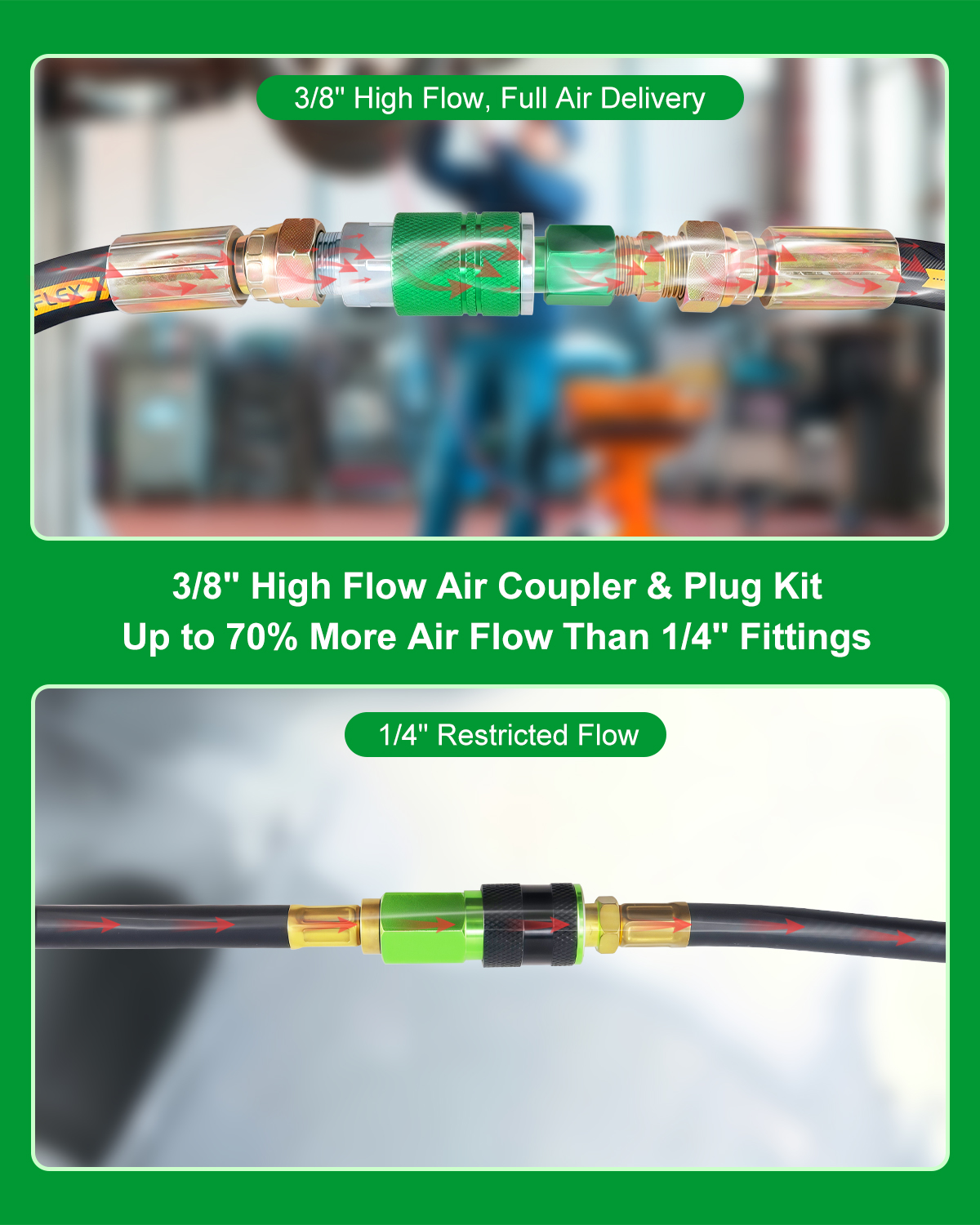
The visible design cues in this fitting set point to usability. Knurled grip bands on the larger body suggest hand operation. Hex flats on the smaller pieces suggest wrench tightening where needed. Threaded male ends indicate direct interface with ports or mating hardware. Those are not glamorous features, but they are exactly the details that separate a convenient fitting from one that becomes annoying after the first week.
What appears to be in the set
Based on the visible geometry, the set seems to include a larger cylindrical body with multiple knurled sections, at least two smaller machined adapters with hex flats, and a separate red-and-white ring or sleeve. The larger piece looks like a manual grip/release component, while the smaller green pieces appear to be male connector nipples or adapters with different end shapes. The ring may be a seal, bushing, or protective insert, though that cannot be confirmed from the image alone.
This variety is useful because connection work in the field is rarely neat. A technician may need one fitting that can be swapped by hand, another that can be tightened securely against a port, and another that transitions between threads or socket styles. Buying a small set instead of a single fitting is often the more practical choice when you are trying to keep a bench, compressor line, or fixture from getting boxed in by one rigid interface.
Material and finish: what the image suggests, and why it matters
The green components appear to be machined metal, likely with an anodized or coated finish. The larger silver-toned part has a polished look, and the overall presentation suggests CNC turning, knurling, and a finishing step such as anodizing or plating. That is an inference, not a confirmed specification, but it is the kind of construction buyers often expect in compact pneumatic hardware.
Why care about finish? Because finish is not just appearance. It affects grip, corrosion resistance, wear behavior, and how the fitting feels after repeated handling. A knurled band that is too sharp can chew up gloves. A soft coating can mark easily and make the part look tired long before it fails. In a production setting, the part does not need to be pretty, but it should keep its shape and function after dozens of connection cycles.
Where a fitting like this tends to fit best
These parts are most at home in compressed-air systems, shop air lines, pneumatic tooling, and industrial automation setups where connectors are handled often. They also make sense in test fixtures or maintenance work where equipment gets reconfigured regularly. If a line is permanent, a simple threaded adapter may be enough. If the setup changes frequently, quick-connect behavior and wrench-friendly geometry become more important.
That said, no fitting should be treated as universal just because it looks robust. Air systems are full of standards, thread forms, and mating profiles that are easy to confuse. A fitting can be beautifully made and still be the wrong choice if it does not match the port style, sealing method, or intended medium. This is where buyers need discipline, not optimism.
Selection criteria buyers should check before ordering
Thread compatibility
The image shows threaded male ends, but the exact size and standard are unknown. That is not a small detail. Before purchasing, confirm the thread form, pitch, and whether the application expects taper seal behavior or a flat-face sealing arrangement. An adapter that almost fits is not useful; it is a leak waiting to happen.
Pressure and media suitability
Do not assume a compact metal fitting is automatically suitable for every pneumatic or fluid-transfer job. Buyers should verify whether the part is intended for air only or for another medium as well. If the system sees pressure spikes, vibration, or repeated connection cycles, the margin matters more than the catalog photo.
Service method
The knurled sleeve suggests hand grip and manual release on one component. That is convenient, but it also changes how operators interact with the line. In a clean bench setup, hand-release is ideal. In a greasy shop corner, a wrench-flat adapter may be the safer choice. Choose the service style based on how the fitting will actually be used, not how it looks in a tray.
Material and corrosion environment
If the parts are anodized aluminum or a similar lightweight alloy, they may be a good fit for many indoor industrial uses. If the application involves moisture, aggressive cleaning, or outdoor exposure, buyers should be more cautious and review material compatibility carefully. The wrong finish can become the weak point long before the rest of the system wears out.
Common mistakes when sourcing pneumatic fittings
One mistake is buying for the port and forgetting the hose. Another is assuming all quick-connect styles are interchangeable. A third is overfocusing on price while ignoring whether the fitting is actually ergonomic enough for the people who will handle it every day. A connector that requires a struggle each time is a workflow problem, not a minor inconvenience.
There is also the classic trap of mixing shiny appearance with proven compatibility. A machined, anodized fitting can look more “industrial” than a plain brass part, but appearance alone tells you very little about sealing performance. The practical buyer asks better questions: what thread, what seal, what load, what mating profile, what environment, and how often will it be disconnected?
Practical buyer advice for engineering and sourcing teams
If you are sourcing for a maintenance stockroom, keep the selection broad enough to cover the most common interfaces in the plant. If you are sourcing for a product or test fixture, narrow the field quickly and lock down the mating details before approving a purchase. In both cases, ask for drawings or a dimensional callout when compatibility is not obvious. A clear fit check saves more time than any field workaround.
For teams that care about operator experience, the visible knurling and hex flats are worth noting. Those are small features, but they can reduce slip, speed installation, and make troubleshooting easier. That is often the difference between a fitting that people trust and one they replace at the first opportunity.
FAQ: a few questions buyers usually ask
Is a GODESON air fitting only for compressed air?
From the image alone, that cannot be confirmed. The visible construction looks suitable for pneumatic use, but buyers should verify the intended medium before placing it into service.
Why include multiple adapter shapes in one set?
Because real systems are messy. Different ports, hoses, and tools often need different connector geometries. A mixed set gives more flexibility during setup and maintenance.
What is the red-and-white ring for?
It may be a seal, bushing, or protective insert, but the exact function is not clear from the image. Treat it as an important component until verified, not as a throwaway accessory.
What decision this article should help you make
If you are deciding whether a GODESON air fitting style set belongs in your inventory, the answer depends on the job. For quick-service pneumatic connections, compact adapter work, and shop-level flexibility, this kind of metal fitting set looks well suited in principle. For any critical application, though, the final decision should rest on compatibility data, not the photo. Confirm the thread standard, sealing method, medium, and pressure requirements before you commit.
When those details line up, a well-machined fitting earns its place quietly. It tightens without drama, releases without abuse, and keeps the rest of the system doing its real work. That is usually what buyers want most from a small part that never gets much attention until it fails.