GODESON air fitting: what buyers usually want to know first
If you are looking at a GODESON air fitting, you are probably not shopping for decoration; you are trying to solve a connection problem. In a plant, garage, or maintenance shop, the real issue is usually the same: how to join hoses, tools, manifolds, or equipment ports quickly without creating a leak, a weak point, or a maintenance headache. The fittings in this category are small, but they sit at the center of compressed air reliability.
The photo shows a set of metal quick-connect style parts with male threaded ends, hex flats, and one knurled body for hand handling. That combination tells a useful story. This is the kind of hardware that is meant to be installed, removed, and adjusted in the field rather than hidden away. For engineers and sourcing teams, the question is not only whether the fitting will connect, but whether it will stay tight, stay accessible, and fit the way your system is actually built.
Quick buyer takeaways
- These are compact metal pneumatic fittings suited to compressed air and similar industrial line connections.
- Several pieces appear to use male threaded bases, which makes them easier to integrate into ports, manifolds, and adapters.
- Hex sections suggest wrench installation where hand tightening is not enough.
- The knurled body points to a part meant for easier gripping during assembly or service.
- The white/red ring looks like a seal or insert component, but its exact purpose cannot be confirmed from the image alone.
That may sound basic, yet in procurement it often decides whether a fitting is useful or merely compatible on paper. A shop can tolerate many things; it rarely tolerates air loss, awkward access, or repeated rework.
What is visible in this fitting set
The visible parts are machined metal fittings with a few different interface styles. Some have plug-like stems. Others have threaded male ends and hex shoulders. One larger piece includes knurled grip sections, which usually make a part easier to tighten by hand or hold during installation. The overall geometry is compact and standardized, which is exactly what people expect from industrial quick-connect hardware.
There also appears to be a small white-and-red ring or bushing. Without more context, it is safest to call it a polymer insert or sealing component rather than claiming a specific function. In practical buying terms, that matters because seal-related parts often determine long-term performance more than the shiny body does. A strong metal shell cannot compensate for a poorly matched seal.
Why compressed air buyers care about small fitting details
Air fittings live in an unglamorous part of the bill of materials, but they are one of the easiest places to create recurring trouble. A fitting that is difficult to wrench in place may be fine during the first installation and irritating forever after. A fitting with poor thread engagement can become a maintenance nuisance. A fitting that is too bulky can block neighboring ports on a manifold or make a service panel harder to close.
For plant engineers, the issue is usually system behavior. For sourcing managers, the issue is consistency. For product teams, it is packaging, assembly time, and serviceability. That is why a part like a GODESON air fitting deserves more attention than its size suggests.
Common fitting styles shown here
1. Threaded male fittings
Several visible parts have threaded male bases. That is the most direct way to install a fitting into equipment ports or adapter blocks. It also gives you a clean path for integration when you are working with manifolds, couplers, or fixed compressed air lines. Threaded parts are common because they are simple, but simple does not mean trivial; the thread type, sealing method, and mating surface all matter.
2. Hex-body fittings
The hex flats visible on some pieces suggest wrench tightening. That is usually the right choice where repeated access is limited or where hand torque is not enough. In real factory conditions, hex heads are practical. They are easier to service with standard tools and less likely to be overtightened than a design that invites improvised grips.
3. Knurled body fittings
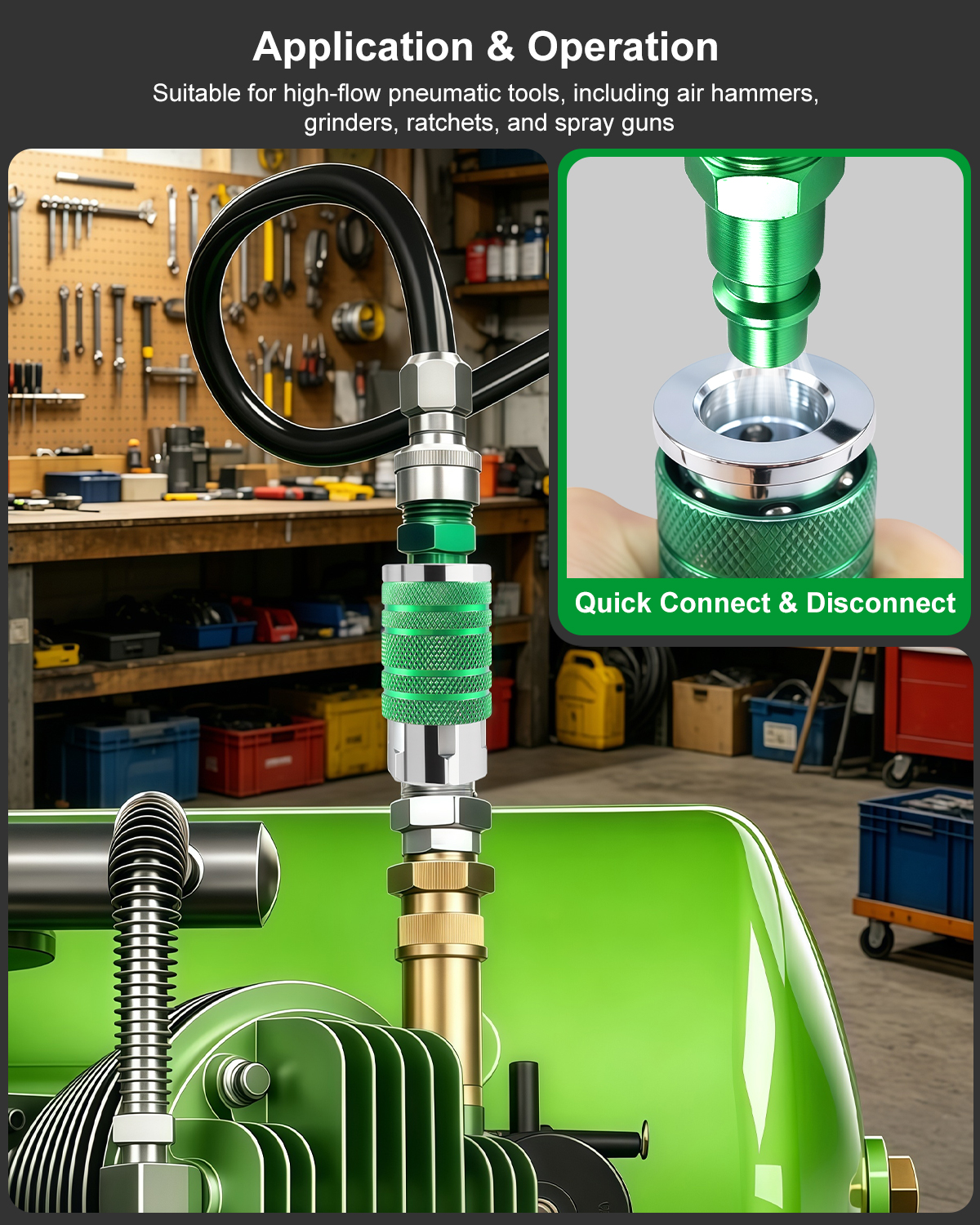
The larger silver-green part has knurled sections, which make it easier to grasp by hand. Knurling is not just cosmetic. It can speed up installation and reduce slippage when an operator is working in a tight space. Still, buyers should be careful not to assume every knurled part is meant for the same service role. Some are for quick adjustment; others are simply easier to handle during assembly.
4. Plug-style stems
The plug-style parts are typical of quick-connect systems. Their job is to interface with a coupling body or a mating socket. In compressed air work, the plug and socket relationship is the whole point: disconnect fast, reconnect cleanly, and avoid unnecessary downtime. The key is making sure the connector style matches the coupler family already in use on the line.
What to check before buying
Most fitting mistakes happen before anyone notices the leak. The part looked right. The thread seemed close. The body seemed compact enough. Then the line arrives on the bench and the mismatch shows up. To avoid that, buyers should work through a short but disciplined check:
- Confirm the thread size and thread standard before ordering.
- Verify whether the seal is handled by an O-ring, a thread sealant, or a metal-to-metal interface.
- Check the available wrench clearance around the port or manifold.
- Match the fitting style to the existing coupler system instead of mixing families casually.
- Consider whether hand-tight, hex-tight, or tool-tight installation makes sense for the application.
That last point is worth a pause. A fitting that is easy to install is not automatically better if the system sees vibration or repeated hose movement. Convenience matters, but retention and sealing matter more.
Material and finish considerations
The fittings shown appear to be machined metal, possibly aluminum alloy or plated steel/stainless steel, but the exact material cannot be confirmed from the image. The green finish suggests an anodized or similarly treated surface, while the silver sections look more like a different base metal or plated surface. Either way, the finish is part of the performance story, not just the appearance.
In industrial air systems, surface finish affects corrosion resistance, handling, and thread durability. It can also help buyers sort similar parts visually during assembly. That said, a nice finish is not a substitute for the right base material. If the fitting will live in a humid shop, outdoors, or near oils and coolants, material choice deserves careful review rather than a quick purchase decision.
Typical use cases for this kind of air fitting
- Compressed air systems
- Pneumatic tooling and equipment
- Industrial hose and line connections
- Adapters for manifolds or equipment ports
- Quick-coupler assemblies for service access
Those applications sound broad because they are broad. That is also the reason buyers should avoid assuming one fitting covers every scenario. Air tools, fixed plant lines, and mobile service kits all stress connectors differently.
Selection tips for engineers and sourcing teams
When comparing a GODESON air fitting with alternatives, it helps to think in terms of system fit rather than part fit. A fitting may be technically compatible and still be the wrong choice if access is poor or if the connection will be serviced frequently. On the engineering side, look at how the fitting affects airflow path, stacking space, and maintenance reach. On the procurement side, ask whether the same geometry can be standardized across multiple assemblies to reduce inventory variation.
Also pay attention to assembly repeatability. If one part in the family uses hand grip features, another uses hex flats, and another uses a plug stem, that can be useful—or it can create confusion on the shop floor if part numbers are not clearly controlled. Small connectors are where documentation saves time later.
Common mistakes buyers make
- Assuming all quick-connect parts use the same thread and sealing style.
- Ignoring wrench clearance until the manifold is already assembled.
- Choosing the wrong interface family because the part looks similar.
- Overlooking the role of seals, inserts, or small polymer components.
- Buying for nominal compatibility instead of maintenance reality.
That last item comes up constantly. A fitting that works on day one may still be a poor choice if the next service technician cannot reach it without removing surrounding hardware.
Practical buyer questions to ask the supplier
If you are sourcing this type of fitting, the most useful questions are direct ones. What is the exact thread form? What sealing method is used? Is the body material aluminum, plated steel, or stainless steel? Which quick-connect family does the plug or coupler follow? Is the knurled part intended for hand adjustment or only as a grip feature? The answers should be specific. If they are vague, that is a signal to slow down.
One more practical caution: do not assume the small red-white component is interchangeable with every similar-looking seal. In fitting systems, tiny differences often produce the biggest headaches.
FAQ
Is a GODESON air fitting only for compressed air?
The visible product category strongly suggests compressed air and pneumatic use, but without confirmed specifications, it would be unsafe to claim broader media compatibility.
Can these fittings be installed by hand?
Some appear to have knurled surfaces that help with handling, but others clearly have hex flats, which implies wrench installation is also expected.
Are the green parts anodized aluminum?
They may be, but the image alone does not confirm the exact material or finish. Treat that as an informed inference, not a specification.
What matters most when choosing one?
Thread compatibility, sealing method, and service access usually matter more than appearance. After that, material and surface finish become important for durability.
Where this leaves the buyer
A GODESON air fitting is the kind of component that can make a system easier to service or more annoying to live with. The visible design cues—threaded ends, hex sections, plug-style stems, and a knurled grip—suggest a practical industrial fitting family meant for compressed air and related line connections. For buyers, the right decision comes from matching the geometry to the application, not from assuming one shiny metal fitting will solve every connection problem.
If you are comparing options for a new build or a replacement order, start with the connection standard, the sealing method, and the physical space around the port. Those three checks eliminate most headaches. If needed, bring the supplier into the conversation early and ask for the exact interface details before the order is locked. That is usually less expensive than finding out the mismatch on a crowded production floor.