Why a Tire Pressure Gauge Still Matters in 2026
An ATsafepro tire pressure gauge may look like a simple workshop accessory, but in practice it sits at the center of tire safety, fuel economy, and day-to-day vehicle reliability. For engineers, sourcing teams, and product managers, the real question is not whether a gauge is useful. It is whether the design is suited to the job: quick tire checks, repeated inflation cycles, and enough durability to survive a garage bench or service van.
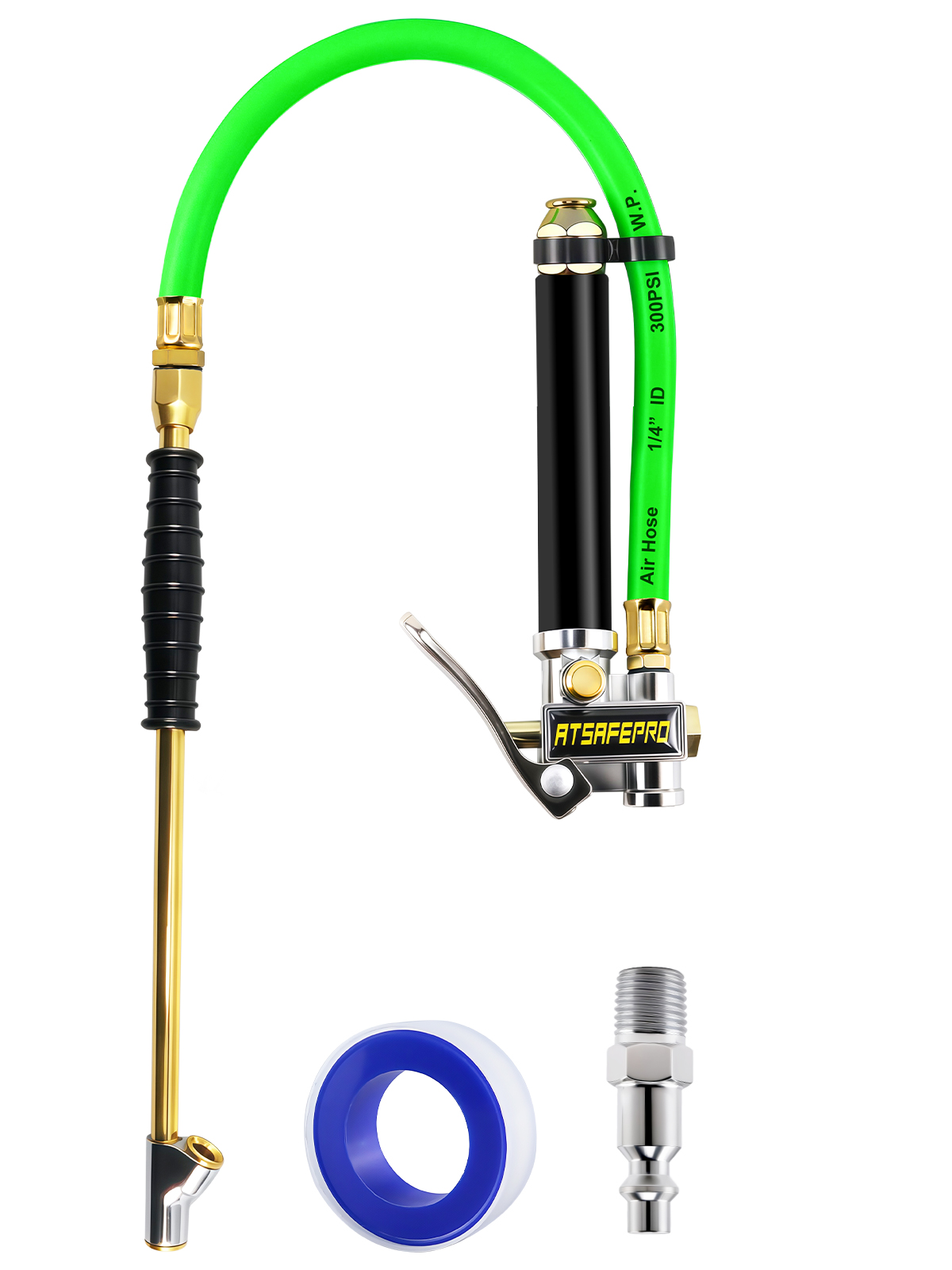
The image of the product points to a combined tire inflator and air chuck gauge assembly rather than a plain pocket gauge. That distinction matters. A hand-held gauge tells you pressure; a connected inflator tool helps you measure and add air in one motion. In a busy service setting, that saves time. In a maintenance environment, it also reduces the number of separate tools an operator needs to keep track of, which is not a small thing when tools are shared between shifts.
What the Product Appears to Be
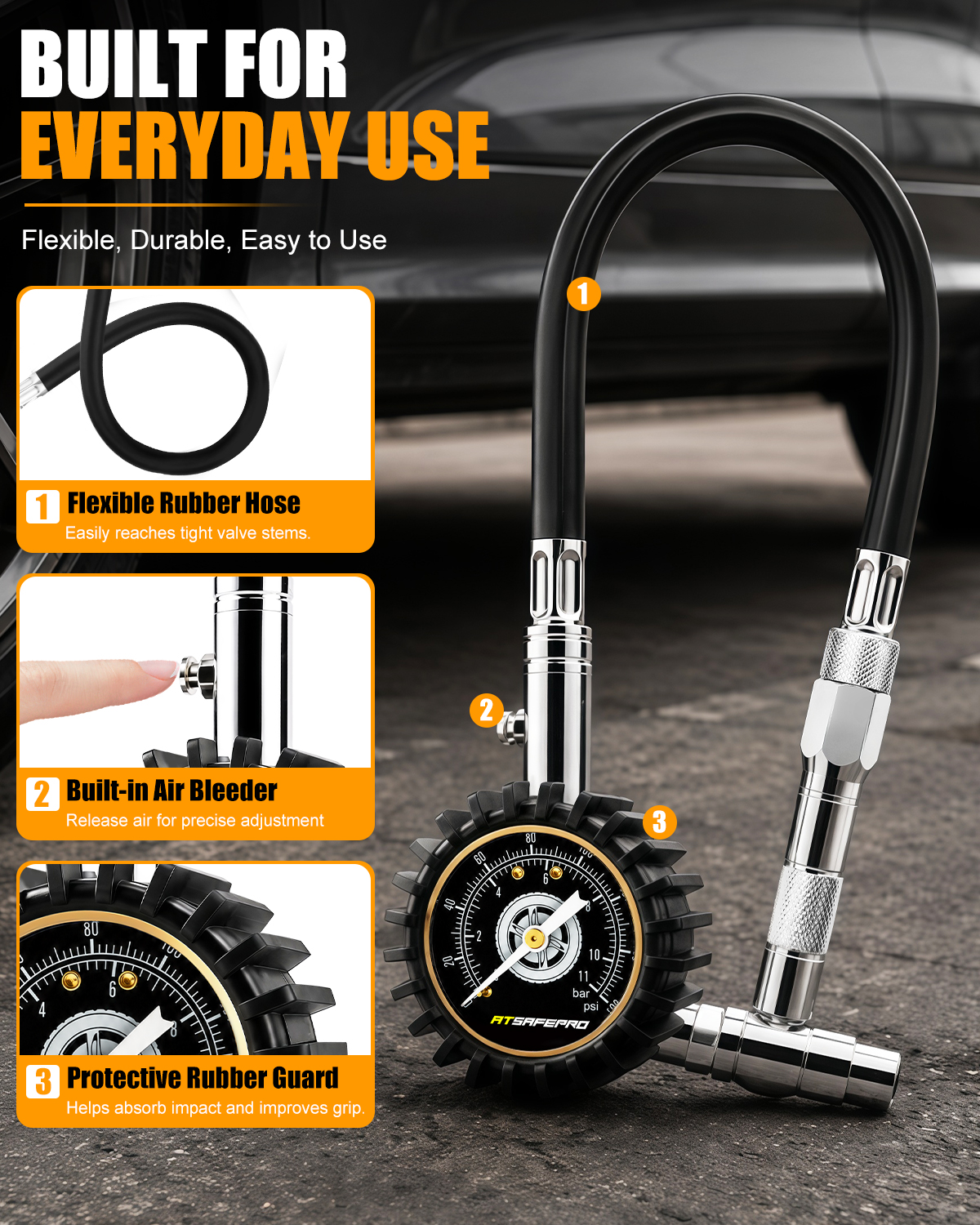
Based on the visible structure, this tool has a black flexible rubber hose in a U-shape, chrome-plated or polished metal connectors, a knurled grip section for hand tightening, and a large analog dial on the right side with a black protective bezel. The gauge face shows dual scales in bar and psi, and the visible range appears to extend to about 140 psi and 10 bar. That range is broad enough for many automotive uses, though it is obviously not a substitute for checking the exact requirements of the vehicle or tire being serviced.
The side protrusion on the right-hand body looks like a bleed or air-control button. I say “looks like” deliberately: from an image alone, you can identify likely function, but not verify it with certainty. Still, for buyers, that design cue is a useful one. A bleed feature is often what separates a basic read-only gauge from a more practical inflation tool.
Quick Buyer Takeaways
If you are evaluating this type of gauge for procurement or workshop use, here is the short version.
The main value is convenience. The operator can connect to a tire valve, read the pressure on an analog dial, and then manage air through the hose and inline fittings. That makes the tool suitable for tire pressure checking and inflation on cars, motorcycles, bicycles, light trucks, and general garage use. For service stations, the appeal is speed; for fleet maintenance, it is repeatability; for roadside kits, it is practicality.
The caution is that a combined inflator-gauge assembly is only as useful as its build quality. Metal fittings, a protected dial, and a flexible hose all suggest a tool intended for frequent handling, but buyers should still confirm compatibility with the valves they service, the pressure range they need, and the expected wear environment. An analog face is easy to read, but it also depends on clear markings and a dial that stays legible after grime, vibration, and the occasional drop.
Why Dual-Scale Analog Gauges Are Still Common
Digital tools get a lot of attention, yet analog tire gauges remain common in industrial and automotive settings. There is a straightforward reason: they are quick to interpret at a glance, and there is no display battery to worry about on the bench. In a garage, speed and reliability often win over novelty.
The dual bar and psi scale is especially helpful in mixed-use environments. European-style maintenance documentation often references bar, while many North American users still think in psi. A dual-scale gauge reduces translation errors, which is useful when multiple technicians share the same tool or when a sourcing team is standardizing equipment across regions.
That said, analog gauges are only trustworthy if the mechanism is protected from shock and if the face remains readable. The black rubber bezel shown here is a small but practical detail. It is the sort of feature that does not look dramatic in a catalog, yet often makes a real difference when the tool is dropped onto a concrete floor or tossed into a service cart.
Materials and Construction: What the Image Suggests
The visible construction points to an assembled pneumatic accessory rather than a single molded part. The hose appears to be black rubber or a reinforced flexible polymer. The fittings and bodies look like machined metal, likely chrome-plated steel or brass with a polished finish. The gauge housing is partly protected by a rubber-like guard.
From a manufacturing perspective, that combination is sensible. Hose flexibility matters because the user needs to reach a valve without fighting the tool. Metal fittings matter because repeated connection and disconnection puts stress on the ends first, not the center of the hose. A protected gauge face matters because the dial is the part most people need to see clearly, and it is also the part most likely to be damaged in a rough shop environment.
One practical aside: chrome-like finishes can look more premium than they are. Buyers should not judge this type of tool by shine alone. The underlying question is whether the fittings are machined accurately, whether the hose terminations are secure, and whether the gauge remains stable after regular use.
Selection Criteria for Buyers
1. Readability under real shop conditions
Large dial faces help, especially where lighting is uneven. If technicians must read the gauge while crouched beside a vehicle or working under time pressure, clear markings matter more than styling. The visible dual-scale layout is a strong point in that regard.
2. Hose length and flexibility
The hose appears short to medium in the image, but exact length is not confirmed. For procurement, this is worth checking. A compact hose can be easier to handle, yet it may be awkward on larger vehicles or where the valve stem sits deep in the wheel design.
3. Connection feel and seal quality
Knurled grip sections usually indicate that hand tightening and controlled handling were part of the design brief. In practice, a secure valve connection is what prevents frustrating leaks and false readings. The best gauge in the world is not useful if the chuck is sloppy.
4. Pressure range
The visible scale appears to reach about 140 psi and 10 bar. That is a reasonable spread for many vehicle service tasks. Still, buyers should match the tool to the intended fleet or workshop segment. A tool sized for passenger cars may not be the best fit for heavier service applications.
5. Bleed or air-control function
If the side button is a bleed function, it can be extremely handy for fine pressure adjustment. But here too, verify rather than assume. The presence of a button does not automatically guarantee the exact control behavior a buyer may expect.
Common Mistakes When Choosing a Tire Inflator Gauge
One common mistake is buying for appearance instead of use case. A polished fitting and a large gauge look reassuring, but the real issue is whether the tool will be used for occasional personal maintenance or daily workshop duty. Those are not the same requirement.
Another mistake is ignoring regional pressure units. A gauge that reads only one scale can slow operators down or increase the chance of a wrong setting. For mixed teams, dual-scale is usually the safer route.
A third mistake is assuming all tire valve connections are equally forgiving. They are not. If the fitting design does not match the shop’s routine, users may lose time wrestling with the connection. That becomes especially irritating on fleets or in roadside work, where the job has to be done quickly and without second attempts.
Practical Use Cases
For passenger vehicles, a tool like this is useful for routine pressure checks, seasonal adjustments, and quick top-ups. For motorcycles and bicycles, the compact hose and analog dial can be easier to manage than a bulky compressor setup, though valve compatibility should be checked carefully. For light trucks and general workshop service, the larger dial and metal fittings make the tool look more at home in a professional environment than a novelty garage gadget.
There is also a maintenance angle that often gets missed: a shared inflator-gauge tool encourages more frequent checks. When pressure measurement and air transfer are part of the same motion, the operator is less likely to postpone the task. That is good for tire wear, fuel use, and general vehicle control.
FAQ
Is this a simple tire gauge or an inflator gauge?
From the visible construction, it appears to be a tire inflator / air chuck gauge assembly, not just a standalone gauge. It likely measures pressure and supports air transfer through the hose and fittings.
Can it be used on different vehicle types?
It appears suitable for cars, motorcycles, bicycles, and light trucks, as well as general garage and service-station work. Final suitability depends on valve compatibility and the pressure range required.
Why choose analog over digital?
Analog gauges are simple, fast to read, and do not rely on batteries. In workshop settings, that makes them dependable and easy to share among operators.
What should procurement teams confirm before buying?
They should confirm hose length, exact pressure range, valve compatibility, the actual function of any bleed button, and the durability expectations for repeated use. Those details matter more than catalog language.
A Better Buying Decision Starts With the Job, Not the Product Photo
The ATsafepro tire pressure gauge, as shown, fits the practical middle ground between a basic handheld gauge and a more complete inflation accessory. That makes it a sensible option for workshops, garages, and maintenance teams that want one tool to cover routine tire checks and air adjustment. The design cues are encouraging: a protected analog dial, dual scales, metal fittings, and a flexible hose all point toward real-world utility rather than decorative packaging.
Before placing an order, though, buyers should verify the details that are not visible in the image alone. Exact hose length, pressure limits, compatibility, and the function of the side control all need confirmation. In this category, the difference between a helpful shop tool and a disappointing one often comes down to those small specifications.
If you are sourcing for a fleet, workshop, or retail assortment, the next step is straightforward: compare the tool’s visible design against the actual service conditions on your floor. That is where a tire inflator gauge earns or loses its place.