Why a tread depth gauge still matters when the tire looks “fine”
A tire can look serviceable and still be past the point where traction, braking distance, and water evacuation start to fall off. That is why a GODESON tire tread depth gauge is not just a garage accessory; it is a simple decision-making tool for anyone responsible for vehicles, whether that means a fleet supervisor, a tire shop technician, or a driver who does their own maintenance.
The appeal is straightforward. This digital tire tread depth gauge kit is built to answer one question quickly: how much tread is left, and is it time to replace the tire or keep running it a little longer? For buyers, the point is less about owning a gadget and more about getting a repeatable measurement before wear becomes a safety issue or a maintenance surprise.
That matters in several everyday situations. A fleet operator may need consistent inspections across multiple vehicles. A repair shop may want a quick, readable tool at the counter or in the bay. A DIY owner may simply want to know whether uneven wear is developing before rotation or alignment work is wasted. In each case, the tool is small, but the decision it supports is not.
What the kit includes and what stands out
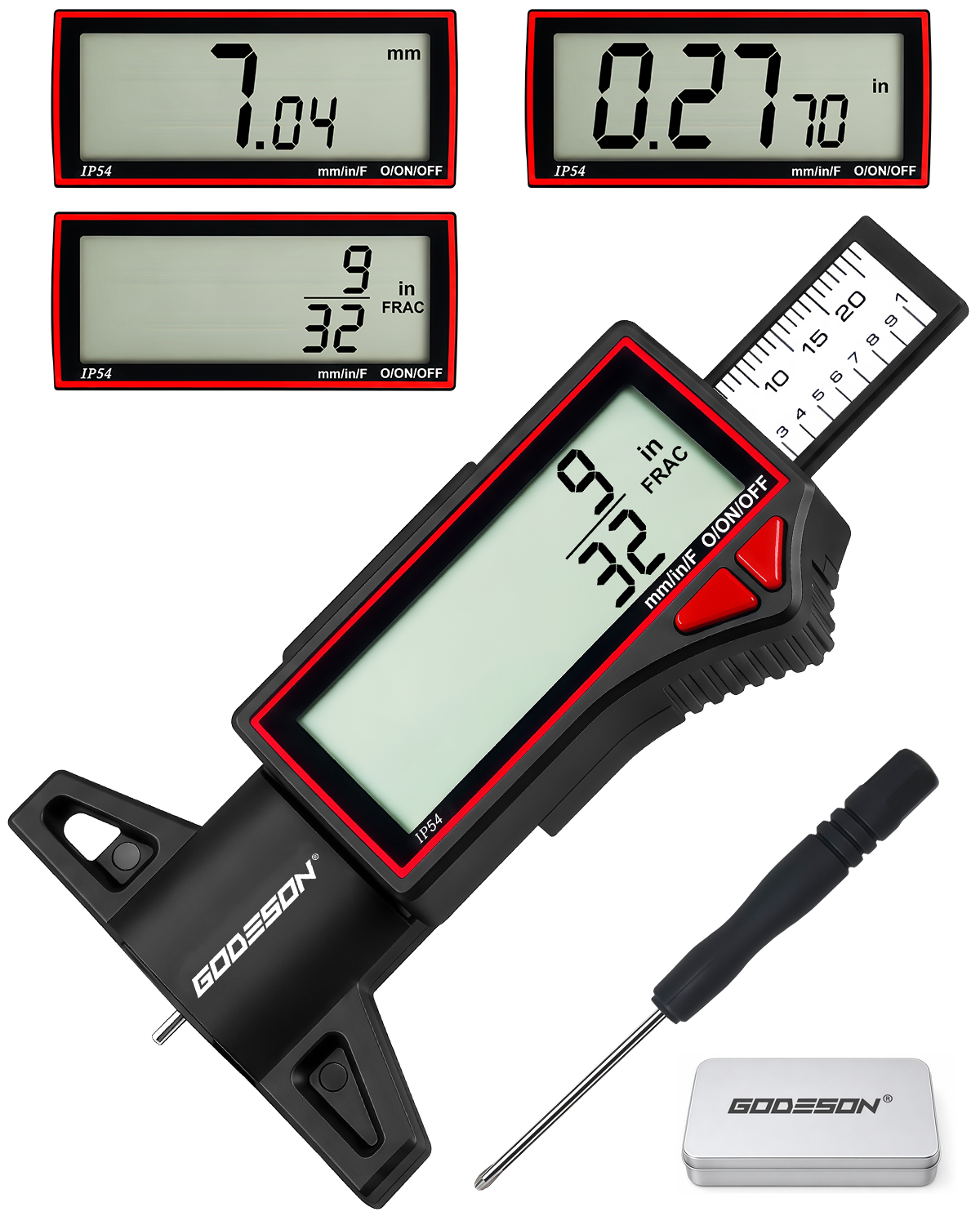
Based on the product information provided, the GOODESON-branded kit centers on a handheld digital gauge with a flat probe and measuring bar, plus a metal storage box, screwdriver, and user manual. The gauge body appears to be made from black plastic with red trim or buttons, while the probe and measuring bar include metal parts. That combination is typical of compact measurement tools: molded housing for grip and electronics, metal where wear resistance matters.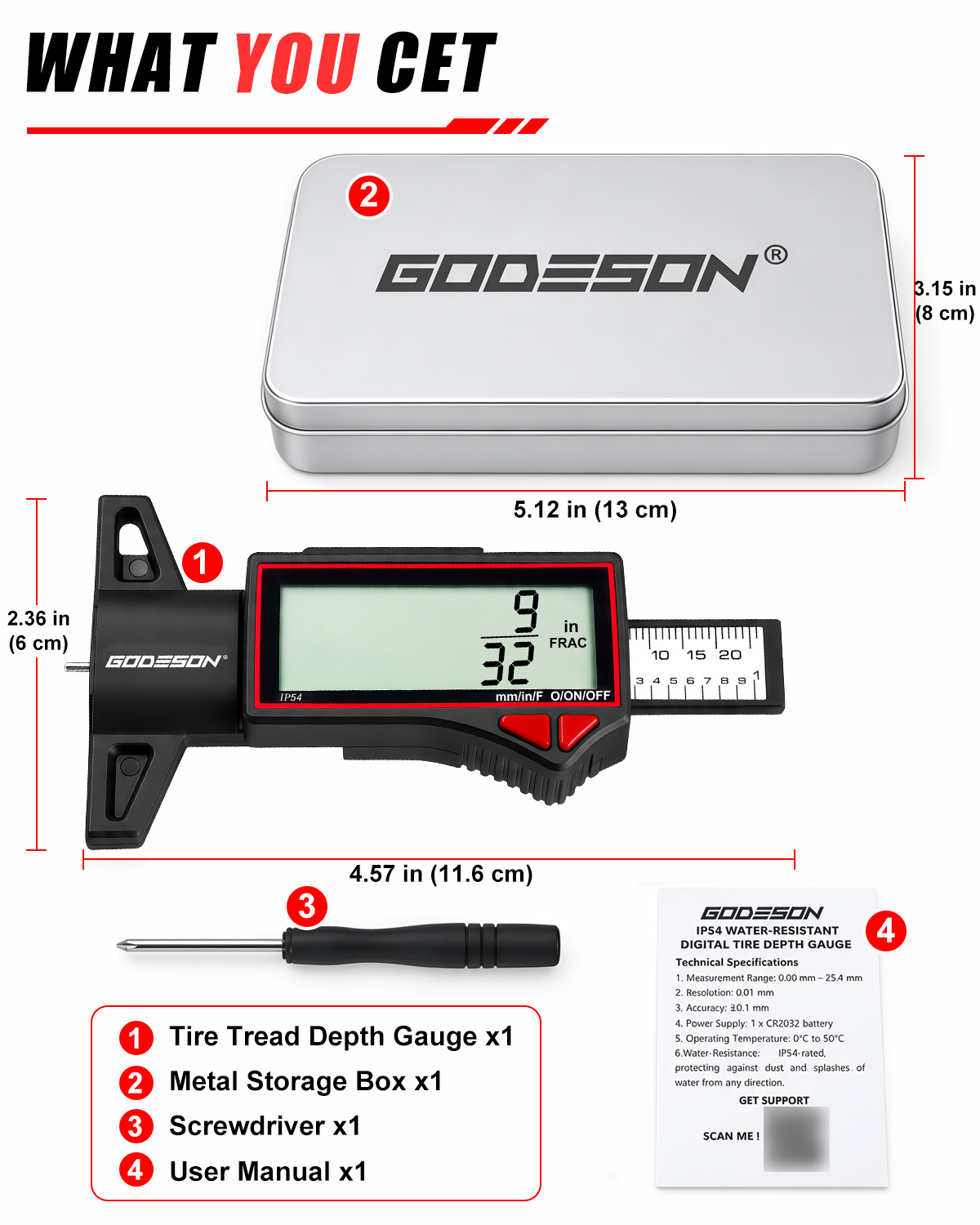
A few selling points are visible and practical. The measurement range is listed as 0.00 mm to 25.4 mm, which covers common tire tread inspection needs. Resolution is 0.01 mm, and accuracy is stated as ±0.1 mm. The display can switch between mm, inch, and fraction formats, which is useful in mixed-service environments where one technician thinks in millimeters and another prefers fractions.
The power source is one CR2032 battery, and the stated operating temperature is 0°C to 50°C. IP54 water resistance is also listed, which is worth noting because tire inspection is rarely a clean-room task. A little moisture, grime, or dust is normal in the field. IP54 is not a license to soak the tool, but it does suggest the gauge is meant for real workshop use rather than a dry office drawer.
How a digital tread depth gauge helps the buyer make a decision
The most useful part of a digital tread depth gauge is not the screen itself. It is consistency. Visual inspection can catch bald tires, obvious cupping, or irregular wear, but it does not tell you whether a tire is at 4 mm, 3.5 mm, or just under a legal or fleet threshold. That difference affects whether a tire stays in service, gets rotated, or moves to replacement planning.
For sourcing managers or service leads, that matters because replacement timing is a cost issue as much as a safety issue. Replacing too early wastes usable tire life. Replacing too late creates risk, downtime, and sometimes compliance trouble. A tool with a digital readout reduces argument and guesswork, especially when several people inspect the same vehicle over time.
There is also a process advantage. If the same gauge is used across a team, the shop gets a more uniform inspection routine. That helps with records, rotation planning, and conversations with customers who want a simple explanation rather than a lecture.
Key technical traits to look at before buying
Measurement range and resolution
For tread inspection, range is usually less important than trust in the low end of the scale. A range up to 25.4 mm is ample for tire work. The resolution of 0.01 mm sounds impressive, though in practice the user still has to place the probe carefully and read the tire surface properly. Very fine resolution is only useful if the measurement technique is stable.
Readability in the shop
Digital readout is one of the strongest reasons to choose this type of gauge. In a tire bay, numbers that are easy to read can save time and reduce miscalls. mm/in/fraction modes are a practical touch because they let the user match the shop’s preferred standard without mental conversion.
Durability and handling
The metal storage box is a small but sensible inclusion. Precision tools often disappear into drawers, get knocked around on benches, or end up in service vehicles. A case helps preserve the probe and keeps the gauge from being bumped out of calibration by rough storage. The exact interior protection is not specified, so buyers should not assume it is padded or lined unless they can verify that directly.
Environmental tolerance
IP54 water resistance and a 0°C to 50°C operating range make the tool more realistic for workshop conditions. Still, no buyer should treat it like a rugged industrial gauge meant for washdown. A cautious user will wipe the probe clean and avoid exposing the electronics to harsh fluid contact. That is just basic care, but it is easy to overlook when a tool is used quickly between vehicles.
Where this kind of gauge fits in real operations
The GODESON tire tread depth gauge fits neatly into a few work environments:
Tire shops, where quick tread checks support selling decisions and service recommendations.
Automotive maintenance bays, where tread depth is one part of a broader vehicle inspection.
Fleet inspections, where repeatable measurements help standardize replacement planning.
Roadside checks, where a compact tool can verify whether a tire deserves immediate attention.
DIY garages, where owners want a clearer picture than a simple penny test or eyeballing the grooves.
In each setting, the gauge’s value is not theoretical precision alone. It is speed, legibility, and enough durability to survive regular use.
Common buying mistakes with tread depth gauges
One mistake is assuming that all tread gauges tell the same story. They do not. A basic mechanical gauge may be perfectly adequate, but it can be slower to read. A digital model may be easier to use, but only if the probe is placed correctly and the user understands what the display means.
Another mistake is focusing only on the screen and ignoring the probe design. The probe and measuring bar are the parts that meet the tire. If they are awkward, flimsy, or hard to position, a precise display will not save the measurement.
A third issue is buying for the wrong environment. A buyer might see IP54 and assume the tool can tolerate anything a workshop throws at it. It can tolerate some dust and splashing, but not neglect. Precision tools still need careful handling, especially around the measuring face.
Finally, some teams buy a good gauge and then fail to standardize its use. One person checks the center of the tread, another the shoulders, and a third reads the display differently. That is how bad maintenance data gets dressed up as “roughly okay.” A simple inspection rule set is worth more than a fancy spec sheet.
Practical advice for shops and fleet buyers
If you are evaluating a digital tread depth gauge kit like this one, start with the work environment. If the tool will live in a service truck or a busy tire bay, the storage box and water resistance matter more than they would in a private garage. If the tool will be used by multiple technicians, prioritize display clarity and a measurement format that everyone understands.
Also consider how the tool will be recorded. Some teams only need a pass/fail check. Others log exact tread numbers across axles and service intervals. A gauge with a clear digital readout makes those records easier to trust, but only if the team is disciplined about using the same reference points.
A small caution: tread depth is only one part of tire condition. Sidewall damage, irregular wear, inflation problems, and age-related degradation can all matter even when the tread number looks acceptable. That is one reason buyers should view this gauge as a decision aid, not a full tire health assessment.
FAQ for first-time buyers
Is a digital tread depth gauge better than a manual one?
Often yes, if you want quicker reading and less interpretation. Manual gauges can still be very good, but digital displays reduce reading errors and are easier to standardize across a team.
Does 0.01 mm resolution mean the measurement is that exact in real use?
Not necessarily. Resolution is the smallest displayed increment, not a guarantee of real-world repeatability. Tire surface texture, probe placement, and user technique all affect the actual result.
Can this gauge be used in wet conditions?
The listed IP54 water resistance suggests some protection against dust and splashing, but it should not be treated as waterproof. Drying and proper storage still matter.
What tires is it for?
The provided information does not limit it to a specific tire class. It appears intended for general tread inspection, but buyers should confirm fit for their application if they are working with specialty or nonstandard tires.
What a buyer should verify before placing an order
Before purchase, check whether the battery is included, since that is not confirmed in the provided data. Confirm the calibration or zeroing procedure, because the exact method is not stated. If the tool will be used in a formal inspection workflow, ask how the shop wants measurements recorded and whether the gauge’s reading format matches existing procedure.
The case is another detail worth confirming. A metal box is useful, but if the tool will be tossed into a service cart, buyers may want to know whether the box is lined or simply for storage. That is a small point, yet small points tend to decide whether a tool lasts in daily use.
For teams looking for a compact, readable tire inspection tool, the GODESON tire tread depth gauge has the right basic shape: digital display, multiple unit modes, a sensible measurement range, and packaging that suggests it is meant to be stored rather than lost in a drawer. It is not trying to be a laboratory instrument. It is trying to make tire wear visible in a format a technician can use immediately.
Next step for sourcing or shop evaluation
If you are comparing tread inspection tools for a workshop, fleet program, or retail counter, use this kit as a benchmark for the questions that matter: is the display easy to read, is the probe practical, is the storage robust, and does the measurement method fit your inspection routine? Those answers will tell you more than a flashy product title ever will.
For a buying team, the sensible next step is to request the exact accessory list, confirm battery inclusion, and check how the gauge is intended to be used in your specific tire categories. A good tread depth gauge does one thing well, but in vehicle maintenance, that one thing often decides the whole service call.