What a 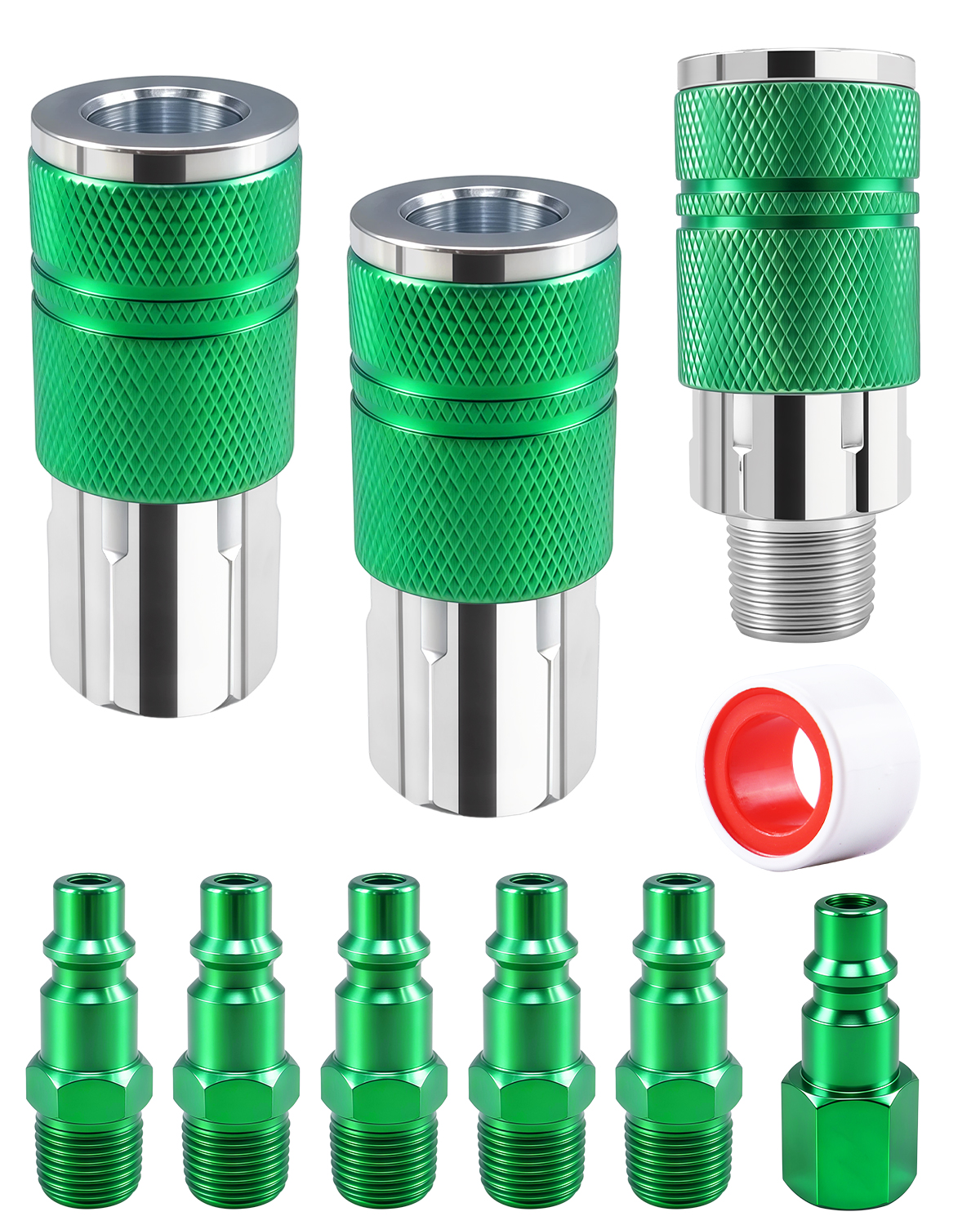 is really trying to solve
A GODESON air fitting is the kind of small hardware that only gets attention after a line starts leaking, a tool feels sluggish, or a setup takes too long to change over. In compressed-air work, those little interruptions matter. A fitting is not just a connector; it is part of the system’s uptime. It has to join quickly, seal reliably, and survive the repeated handling that comes with maintenance, shop-floor testing, and portable pneumatic equipment.
From the product details provided, the fitting set appears to be an industrial quick-connect and threaded adapter family with a knurled coupling body, smaller male plug-style adapters, hex shoulders for wrenching, and an included sealing ring or bushing. That combination points to a practical use case: fast connection and disconnection where a technician still needs a secure threaded interface. For buyers, the real decision is not whether a fitting looks robust in a photo. It is whether the design matches the line, the media, and the way the equipment is serviced in the field.
Why these fittings matter in day-to-day manufacturing
In a factory or maintenance environment, air lines are rarely static. Tools get swapped. Test rigs get reconfigured. Hose assemblies move from bench to line, then back again. Every time that happens, the connector has to do three jobs at once: keep the connection sealed, make assembly practical, and hold up to repeated use.
That is where the visible features in this type of fitting matter. The deep knurling on the coupling body suggests a grip intended for quick hand adjustment. The hex flats on the smaller adapters suggest there are moments when a wrench is still the right tool. And the threaded ends imply the fitting is not only a snap-in convenience part; it is also meant to be installed into a broader system with conventional threaded hardware. For engineers and sourcing teams, that dual-purpose design can be useful, but it also means more attention is needed during selection.
What is visible in the product design
The supplied product information points to a few concrete details worth noting.
Knurled coupling body
The larger green cylindrical part has pronounced diamond knurling. That is a practical feature, not decoration. In a greasy or compressed-air environment, grip matters. A knurled surface lets a technician tighten or release the connector without immediately reaching for a tool. It can save time during service, though it does not replace proper installation when a threaded seal needs a specific seating method.
Machined male adapters with hex shoulders
The smaller green parts show hex shoulders and threaded ends. This is a common industrial pattern because it makes installation manageable without damaging the body. The hex section gives a wrench land, while the threaded end integrates with the machine, manifold, or hose-end assembly. It is a sensible detail, especially where operators may need to rework a line in a cramped enclosure.
Sealing component included
A white/red ring or bushing is visible as part of the set. The exact material is not identified, so it should not be over-interpreted, but its presence suggests the assembly is designed with sealing support in mind. That matters because many connector problems begin with assumptions about thread sealing. A thread can hold a fitting in place, but the seal itself often depends on the mating design and the correct interface components.
Likely materials and finish: useful, but keep the caution light on
The green parts appear to be machined metal with an anodized or coated finish, and aluminum alloy is a reasonable assumption based on the look and weight profile implied by the geometry. The silver threaded section may be stainless steel or plated metal. That said, exact alloy and surface specification are not confirmed, and it would be a mistake to specify them too confidently from appearance alone.
Why does that matter to buyers? Because material choice affects corrosion resistance, thread wear, and compatibility with the surrounding assembly. In compressed-air service, the environment can be deceptively harsh: moisture, shop contaminants, vibration, and routine operator handling all work on the fitting over time. A protective finish may help, but it is only part of the story. The base metal and thread design still matter more than the color.
How to think about application fit
Based on the product information, this fitting family is likely suited to pneumatic systems, compressed-air lines, hydraulic or coolant connections, industrial hose or tube adapters, test equipment, and service lines where quick connect/disconnect is useful. That is a broad list, and deliberately so. The image does not identify a specific standard, pressure class, or valve type, so a responsible buyer should treat it as a candidate component rather than a drop-in replacement.
For engineers, the right question is not “Can this fitting connect?” but “Can it connect in the way our system expects?” That includes thread type, sealing method, space envelope, and how often the line will be cycled. A connector used on a production test stand faces a different duty profile than one used on an occasional maintenance hose. The visible build suggests the part was made for practical industrial handling, but the system requirements still govern the final choice.
Selection criteria that save trouble later
When sourcing a GODESON air fitting or a similar quick-connect adapter, the following checks tend to prevent the frustrating returns that eat time in procurement.
Thread compatibility
Confirm the thread standard before anything else. Do not rely on photographs, package titles, or the assumption that “it looks like the one we use.” Thread size, pitch, and sealing geometry are the difference between a clean assembly and a recurring leak complaint.
Sealing method
Determine whether the joint seals on the threads, a face seal, an O-ring, or a separate ring/bushing arrangement. The included sealing component suggests sealing support is part of the design, but the exact method is not supplied. That is a detail worth clarifying before purchase.
Service frequency
If the connector will be cycled often, the grip surfaces and thread durability become more important. Knurling helps the hand interface, but repeated wrenching can still wear softer materials. In high-cycle service, this is where material selection quietly decides how long the fitting remains pleasant to use.
Space and access
The hex shoulders are helpful, yet tight installations still need room for a tool. If access is poor, a fitting that looks compact in a catalog can become annoying on the machine. Field techs notice that quickly.
Common mistakes buyers make with air fittings
The first mistake is treating all air fittings as interchangeable. They are not. Even within one plant, there may be multiple thread systems, multiple sealing styles, and multiple pressure environments. The second mistake is assuming the fitting’s finish tells the whole story. A green anodized body may look premium, but finish alone does not guarantee compatibility or longevity.
A third mistake is overlooking the service condition. If a connector will live on a portable compressor line or a test rig that gets knocked around, it needs more than a decent seal. It needs a shape that technicians can grip, install, and remove without fighting it. That is where the knurled body and hex flats are more than visual cues; they are practical features that reduce downtime.
One more caution: do not use a threaded air adapter in place of a true quick-connect interface unless the whole system is built for it. A part can look versatile and still be wrong for the job.
How this style of connector fits into a broader assembly strategy
Industrial teams often separate their fittings into two categories: permanent installation hardware and service-access hardware. The parts described here seem to sit between those two camps. The threaded ends support installation into a fixed system. The knurled and plug-style features support faster handling. That hybrid approach can be smart when a line must be reconfigured, but it also demands disciplined inventory control.
For sourcing managers, that means keeping the mating parts clearly identified and documented. For engineers, it means showing the connector standard on drawings rather than describing it loosely as “air fitting.” Small ambiguity on paper becomes big ambiguity in the warehouse.
Buyer-facing advice before you place an order
If you are evaluating this product for procurement, ask for the exact thread specification, sealing arrangement, compatible media, and any dimensional drawing available from the supplier. If the part is intended for pneumatic service, confirm whether it is being used as a quick-connect coupler, a plug, or a threaded adapter in the actual assembly. Those roles are not interchangeable even when the parts look similar.
It also helps to request close-up photos of the thread ends and the mating face. With fittings, the interface is the product. A clear image of the outside shape is useful, but it will not tell you enough about the seal. That is a small nuisance during sourcing, yet it is still cheaper than discovering the mismatch after the first installation run.
FAQ
Is the GODESON air fitting for compressed air only?
The supplied data supports pneumatic and compressed-air use, but the exact compatible fluids or gases are not identified. Check the supplier’s specification before exposing it to anything beyond the intended service.
Can the finish tell me what material it is made from?
Not reliably. The green parts appear to be machined metal with a protective finish, likely anodized or coated, but the base alloy is not confirmed.
Why are there both knurling and hex flats?
They serve different working conditions. Knurling helps hand operation, while hex flats give a wrench point when more torque or controlled installation is needed.
What should I verify first when replacing an existing fitting?
Thread standard and sealing method. If those are wrong, the replacement will fail before anything else matters.
A practical next step
If you are comparing a GODESON air fitting against other industrial connector options, start with the interface, not the marketing label. Match the thread, confirm the seal, review the service environment, and make sure the physical shape suits the technician who will actually install it. That is the unglamorous part of sourcing, but it is usually where the real savings are found.
For teams building pneumatic assemblies, the smartest move is to keep a short approval checklist tied to the exact fitting type, then buy against that record rather than against memory. It sounds tedious. It is also how you avoid the sort of mismatch that steals half a shift.