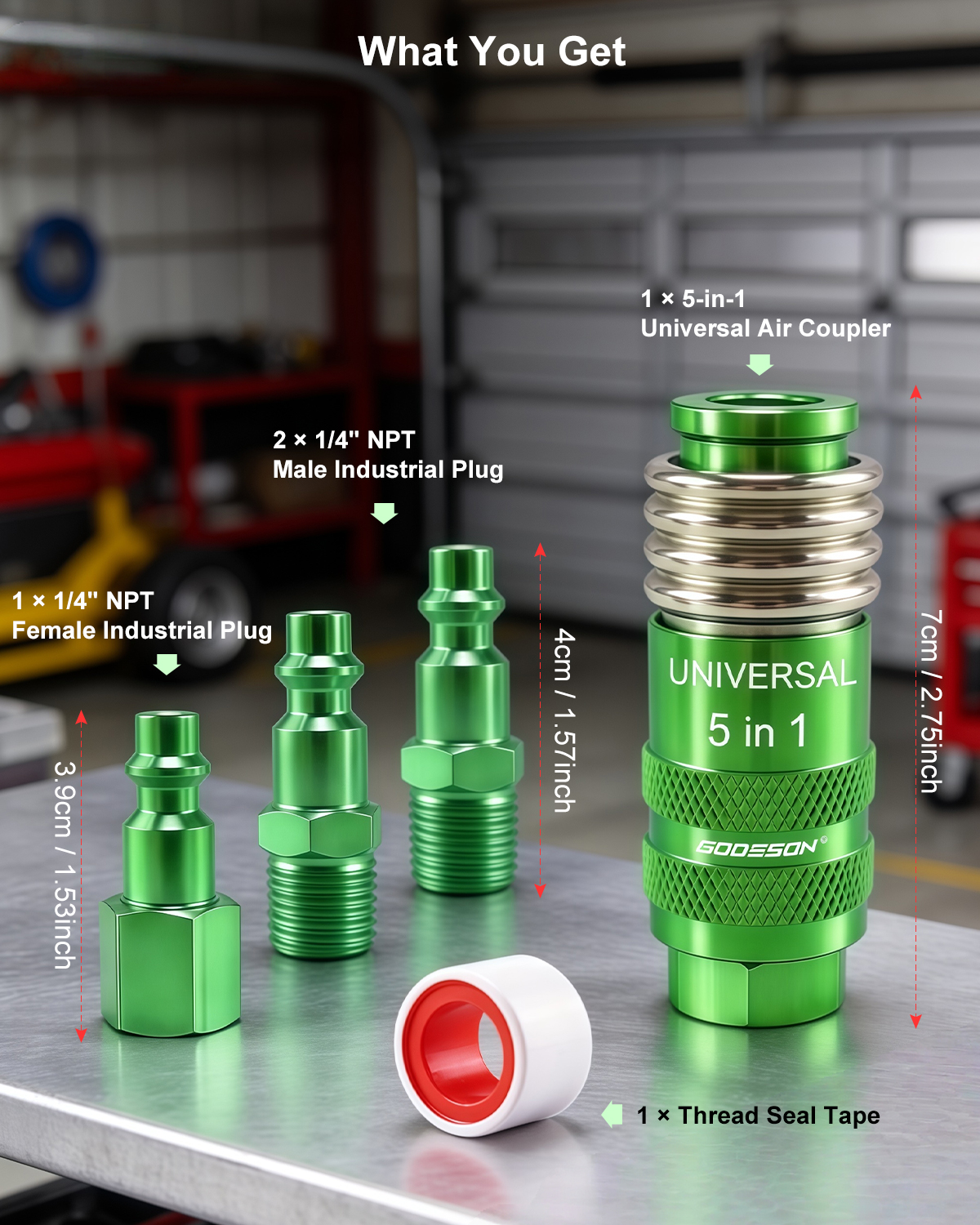
What a GODESON air fitting is really solving
A GODESON air fitting is the kind of small hardware that only gets attention when it fails. In a compressed air system, a loose joint, a poor thread match, or a cheap coupling can waste air, create nuisance downtime, and turn a simple maintenance task into a leak hunt. This product sits in that practical middle ground: a metal air fitting for pneumatic connections, designed for workshop and industrial use, with a visible claim of safe, leak-free air connection and pressure handling up to 300 PSI.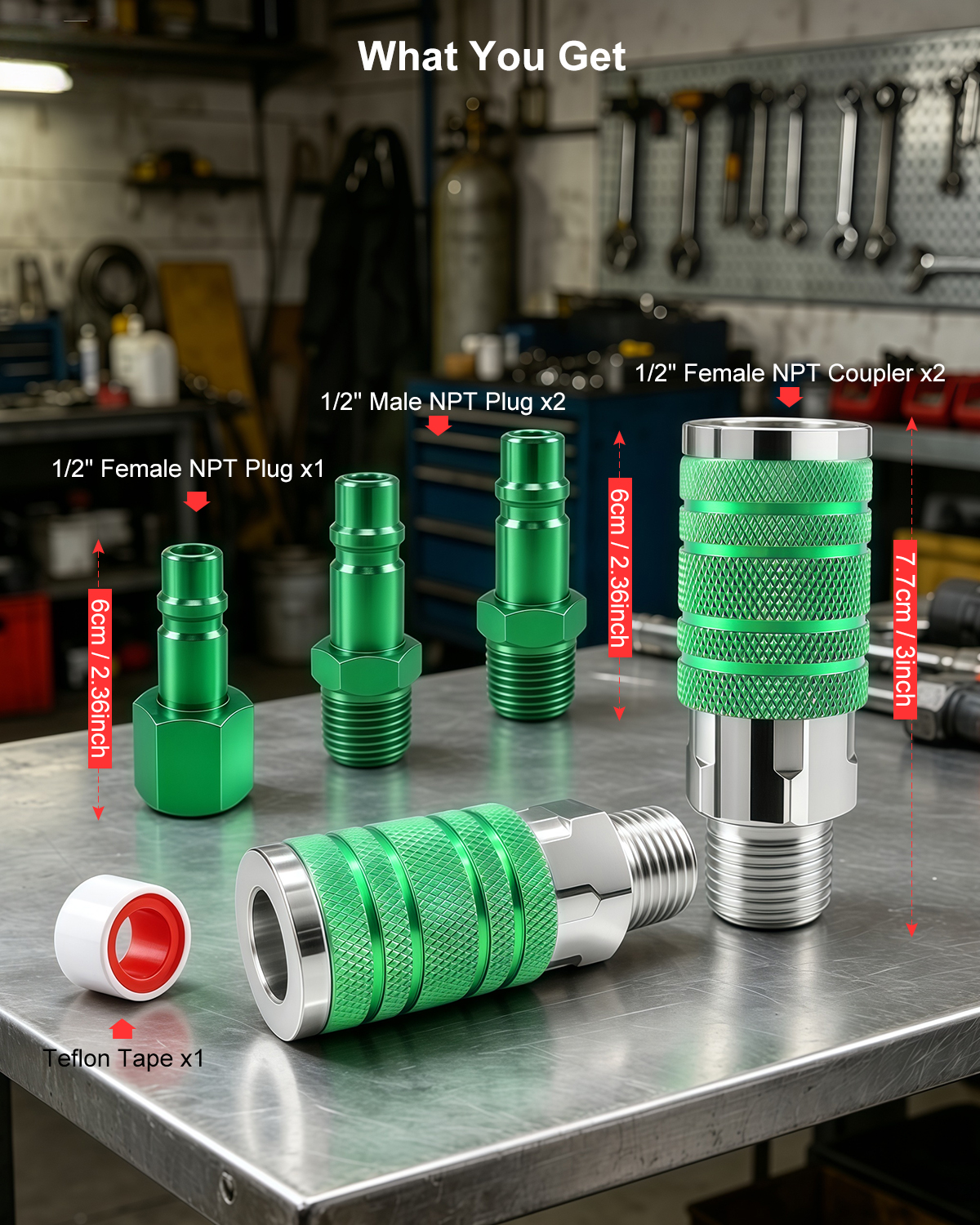
For engineers and sourcing teams, the real question is not whether a fitting looks robust in a product photo. It is whether the part will hold up in a system where vibration, repeated connection cycles, and hurried maintenance work are normal. That is why details such as all-metal construction, a threaded interface, and a wrench-friendly hex section matter more than marketing language.
At a glance: what stands out
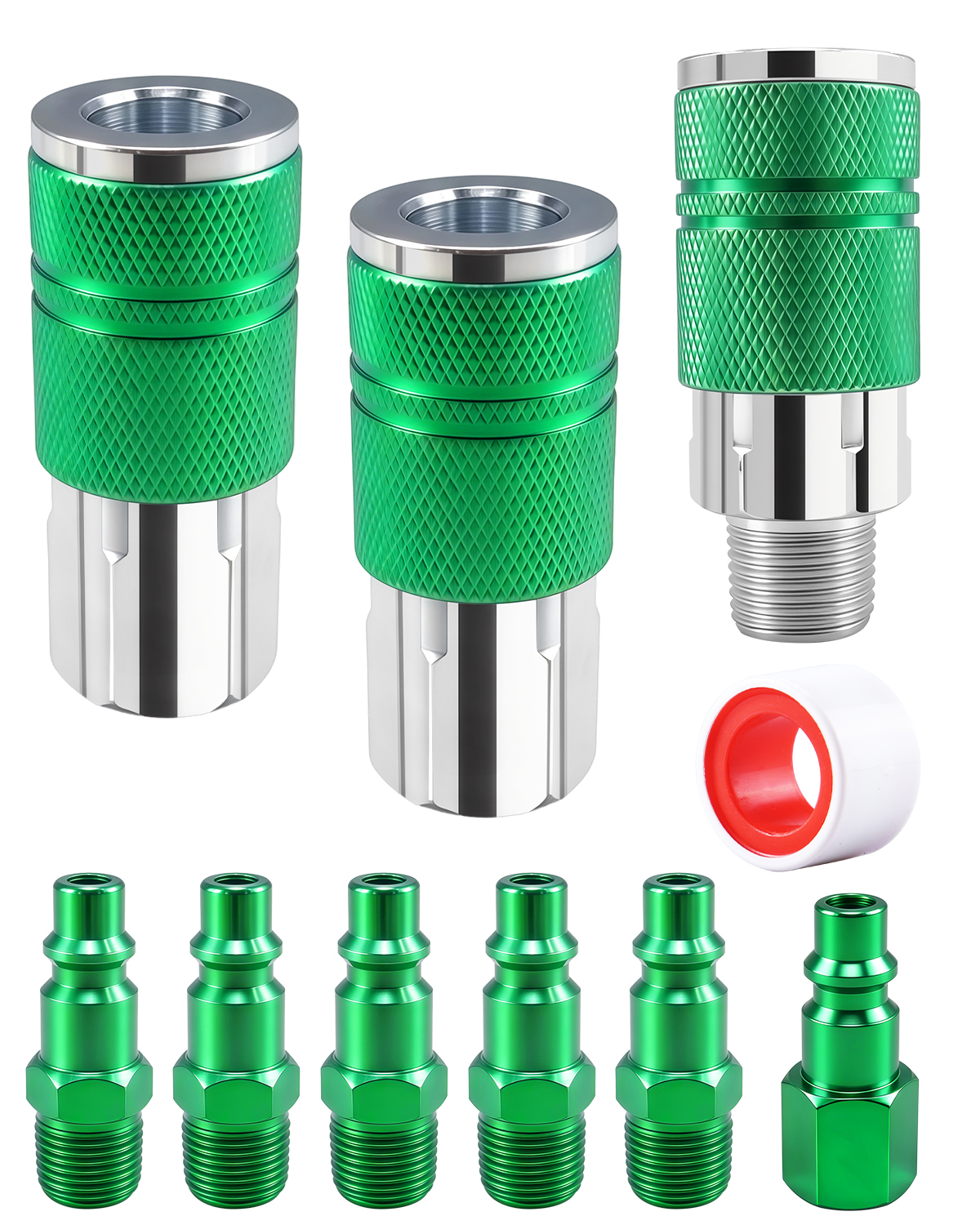
This fitting appears to be a machined metal pneumatic connector with a polished silver body and a bright green knurled sleeve or grip section. The design suggests a hose-end or connector-style part intended to make air hookups easier to handle by hand while still allowing wrench tightening where needed.
The key points visible from the product data are straightforward:
- All-metal construction
- Pressure rating shown up to 300 PSI
- Visible threaded female end
- Hexagonal lower section for tightening
- Knurled green grip area for hand handling
That combination tells a fairly clear story. This is not a decorative accessory. It is a utilitarian component for compressed air lines, pneumatic tools, and workshop systems where a dependable seal matters more than appearance.
Why buyers care about the construction
Compressed air is expensive enough without leaking away through weak fittings. Even a small leak can become a persistent operational cost, especially in systems that run often or stay pressurized for long periods. In that context, all-metal construction is not just a durability feature; it is a maintenance decision.
Plastic-bodied connectors may have a place in low-demand environments, but they are usually less attractive in harsher shop conditions. Metal fittings are generally preferred where there is repeated connection, more vibration, or higher mechanical stress around the hose end. The visible hex section also suggests the part is meant to be installed and serviced like a serious mechanical component, not simply snapped in and forgotten.
The green knurled sleeve is worth noting too. Knurling is a practical touch, not a cosmetic one. It improves grip when hands are oily, cold, or gloved. That sounds minor until someone is trying to disconnect or secure a line on the floor of a workshop.
Likely use cases in the field
The product data points to a broad set of compressed air applications rather than a niche specialty part. That matters for sourcing, because a fitting used on general workshop air lines faces different demands than one built for a controlled OEM assembly.
Typical use cases include:
Workshop air systems
Bench air lines, compressor outlets, reel systems, and service bays all benefit from fittings that can be tightened securely and checked visually. A reliable air fitting reduces the chance of slow leaks that are easy to ignore until they add up.
Pneumatic tools
Impact wrenches, blow guns, air ratchets, and similar tools often see repeated connect-disconnect cycles. A connection point needs to survive that routine without becoming loose or difficult to seal.
Industrial maintenance and utility air
Maintenance teams value parts that can be serviced quickly. If the fitting is accessible and wrenchable, it is easier to replace or inspect during planned maintenance rather than during an emergency repair.
Compressed air lines
Any air line that needs a threaded, leak-resistant connection can potentially benefit from a fitting like this, provided the thread standard and mating components are matched correctly.
What the 300 PSI claim does and does not tell you
A pressure rating up to 300 PSI is useful, but it should not be read as a complete specification. It tells the buyer that the fitting is intended for compressed air service beyond the very light-duty range. It does not, however, reveal everything needed for system design.
What is still unknown, and should be confirmed before purchase or rollout, includes:
- Thread standard and size
- Exact sealing method
- Material alloy
- Surface treatment or plating
- Temperature range
- Compatibility with specific quick-connect standards, if any
That caution matters. A fitting can be perfectly solid and still be the wrong choice if the thread geometry does not match the rest of the system. In air systems, mismatched standards are a classic source of field complaints.
How to evaluate this kind of fitting before you buy
A sourcing manager usually wants three things: compatibility, durability, and repeatability. An engineer wants the same, but with a few more questions attached.
1. Confirm the interface
The visible internal threaded female end suggests a specific mating requirement, but the image alone does not identify the exact thread size or standard. Before placing volume orders, the buyer should verify the mating hardware and the air hose or tool end that will connect to it.
2. Check installation access
The hexagonal lower section is a good sign for serviceability. If the fitting will be installed in a tight cabinet or under a bench, wrench access can matter as much as the connection style itself.
3. Match the duty cycle
A fitting used on a stationary line does not face the same abuse as one attached to a portable tool. If the line is moved, flexed, or disconnected frequently, the grip design and metal body are more valuable than they would be on a static branch line.
4. Be realistic about seal performance
A “leak-free” claim is only meaningful when the mating thread, seal method, and installation practice are correct. Thread sealants, proper torque, and clean mating surfaces still matter. No connector should be treated as immune to a bad installation.
Common mistakes buyers make with air fittings
One of the biggest errors is buying by appearance. A polished metal fitting can look universal, but compressed air hardware is full of standards, thread forms, and small compatibility traps. If the fitting is being sourced for a production environment, the risk of a wrong match is not trivial.
Another common mistake is assuming that a pressure number alone defines quality. Pressure rating is only one part of the picture. A fitting can meet the pressure requirement and still be annoying in practice if it is difficult to tighten, difficult to inspect, or mismatched to the rest of the installation.
A more subtle issue is over-specifying where it is not needed. Some buyers reach for the most complex connector available when a simple, rugged threaded fitting would do the job better. In air systems, simplicity often wins as long as the sealing method is sound.
Where this type of fitting fits in a broader procurement strategy
For procurement teams, this is the sort of component that seems small until it becomes a recurring issue across multiple workstations or service points. Then the cost is not the part itself, but the time spent chasing leaks, replacing cheap couplings, or standardizing around incompatible hardware.
A sensible strategy is to treat fittings as part of the system architecture, not as incidental accessories. That means aligning the fitting type with the compressor output, hose assemblies, tool interfaces, and maintenance procedures. If the GODESON air fitting is being considered for a shop standard, the first step is to validate its exact thread and connection format against current inventory.
Practical buying advice for engineers and sourcing teams
If you are evaluating this part for a project, ask for the basic dimensional and interface data before committing to a trial. That is especially important if the fitting will be used in a multi-site rollout where a mismatch can create supply headaches.
A short internal checklist usually helps:
- Does the thread standard match existing equipment?
- Will the all-metal body suit the environment and duty cycle?
- Is the 300 PSI claim above the operating requirement with margin?
- Can operators grip and service the fitting easily?
- Will installation tools fit the available space?
If the answer to those questions is yes, the part has a reasonable case as a general-purpose compressed air connector. If not, the safe move is to keep looking rather than forcing a near-match into service.
FAQ
Is the GODESON air fitting suitable for industrial use?
Based on the available product information, it appears suitable for compressed air and pneumatic applications that need a rugged, metal connector. Exact suitability depends on the matching thread and system requirements.
Does the 300 PSI rating mean it is safe for all air systems?
No. The rating is only one factor. The fitting also has to match the thread standard, seal method, and actual operating conditions of the system.
Can I identify the exact fitting standard from the image alone?
Not reliably. The image shows a female threaded end and a metal body, but it does not confirm the exact thread size or coupling standard.
What is the main advantage of the knurled green sleeve?
It improves grip and handling, especially during manual adjustment or disconnection. That is useful in workshops where gloves, oil, or limited space make smooth surfaces harder to work with.
Bottom line for buyers
The GODESON air fitting presents as a solid, practical pneumatic connector: all-metal, wrenchable, and built for compressed air service with a visible 300 PSI claim. That makes it the sort of part that can earn its place in a workshop or industrial maintenance setup, provided the buyer verifies the interface details before ordering.
If your team is standardizing air hardware, the next step is not just comparing catalog photos. Confirm the thread specification, check the mating components, and decide whether this style of fitting fits your installation method. A small part like this can save time for years, but only if it matches the system cleanly from the start.