Why an adjustable torque wrench still matters on the shop floor
The ATsafepro torque wrench sits in a category that looks simple until a fastener fails. Anyone who has worked on vehicles, machines, or precision assemblies knows the problem: too little torque and a joint loosens; too much and threads stretch, gaskets crush, or a component cracks later under vibration. That is why a controlled tightening tool is not a luxury item. It is a basic quality-control instrument.
For buyers, the real decision is not whether a torque wrench is useful. It is which one gives you repeatable tightening, a clear working range, and the documentation needed to support inspection records. In that sense, this adjustable torque wrench kit is aimed at a practical middle ground: manual control, visible scale markings, interchangeable socket adapters, and a calibration certificate that can be filed with incoming tool documentation.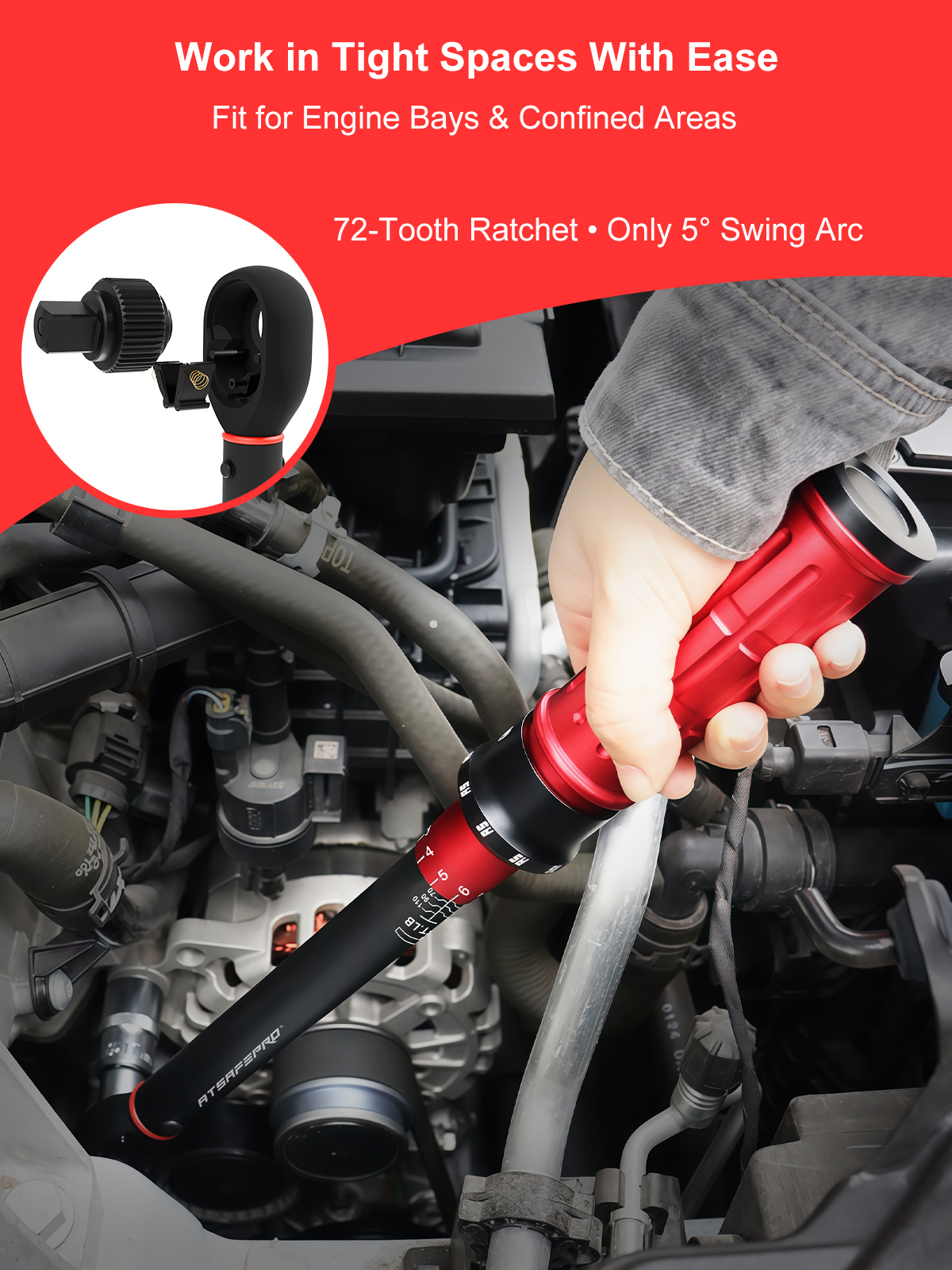
What is included in the kit
Based on the supplied product details, the kit appears to include a main torque wrench, at least two chrome-plated socket adapters, a molded storage case, and a calibration certificate or inspection sheet. The wrench itself has a matte black metal body with a red adjustment handle or grip, plus a slim shaft with printed torque scale markings. There is also a knurled section near the head-end, which should help with handling during setup.
The certificate is not a small detail. In many factories and service departments, the tool may be used daily, but the paperwork is what gets checked first during audits, quality reviews, and internal tool control. A wrench supplied with calibration documentation is easier to place into controlled use than a bare hand tool with no record trail.
Quick reference: where this kind of wrench fits best
Good fit
Automotive repair and maintenance
Machine assembly and servicing
General fastening tasks where a specified torque value matters
Workplaces that keep calibration records for inspection or traceability
Less ideal
Jobs requiring very rapid repetitive fastening without re-checking
Applications that need digital data output or programmable torque logging
Situations where the fastener spec calls for a specialized angle-torque sequence and the wrench setup does not support it
That last point is worth a caution. A torque wrench is not a substitute for reading the fastening spec correctly. Some assemblies need a sequence, a lubricant assumption, or a two-stage tightening method. The tool can only apply torque; it cannot interpret the engineering note printed on the drawing.
Understanding the visible specifications
The certificate information provided with the kit shows a range of 10–110 FT.LB and lists the model as 3/8 110 FT.LB. It also notes 0.50% precision and references ISO6789, GB/T 15729, and ASME B107.14M. Those references matter because buyers often compare tools not just by feel, but by whether the instrument is presented as a calibrated torque device under recognized standards.
A practical note here: the exact way a wrench behaves depends on its internal mechanism, which is not visible from the supplied data. That is normal. What the buyer can verify is the stated working range, the calibration paperwork, and whether the torque window matches the fastening tasks in the plant or garage.
For many maintenance jobs, 10–110 FT.LB covers a useful spread. It is wide enough for a number of automotive and machinery applications, but not so broad that the lower end becomes an afterthought. Still, users should check whether their highest-torque fasteners sit near the top of the range. A wrench used constantly at its limit is not the same as one used in the middle of its working range.
Construction details that matter in use
The wrench body appears to be metal with a matte black finish. That kind of finish tends to read clearly in a busy toolbox and is less visually distracting than highly polished surfaces. The red adjustment section is also useful from a usability standpoint because operators can see at a glance where to grip and adjust.
The socket adapters are chrome-plated steel, which is the kind of finish many users expect for accessory pieces because it resists casual wear and wipes clean easily. The storage case is black molded plastic, again a practical choice rather than a decorative one. It gives the tool a fixed place, which matters more than people admit. A torque wrench tossed loose into a drawer is more likely to lose its setting or suffer accidental damage.
There is also a subtle but important feature in the printed torque scale. For a manual adjustable wrench, legibility is part of the product’s performance. A precise tool with a hard-to-read scale becomes a nuisance in real work, especially in dim service bays or when the operator is moving quickly between fasteners.
How buyers should evaluate a torque wrench like this
The first question is torque range. Match the wrench to your actual fastening work, not to an idealized list of future jobs. If the majority of your fasteners sit between, say, 20 and 80 FT.LB, a 10–110 FT.LB tool may be practical. If you mainly work on much smaller fasteners or much heavier assembly work, you may want a different range altogether.
The second question is documentation. A calibration certificate is useful only if your organization actually tracks tools by serial number, date, or inspection interval. If you do, then a certificate makes onboarding simpler and may reduce friction during receiving inspection. If you do not, the certificate is still a sign that the manufacturer is positioning the tool for controlled use, not casual guesswork.
The third question is the interface. Does the wrench’s adjustment system suit the operators who will use it every day? A good tool should be easy enough for a technician to set correctly under normal shop conditions. If adjustment is fiddly, the risk is not just inconvenience; it is inconsistent torque application.
Common mistakes when using a manual torque wrench
One of the most common errors is using the wrong unit or reading the scale too fast. Another is setting torque and then letting the wrench live at that setting in storage, which is not always ideal for tool care depending on the wrench type and maker guidance. Users also sometimes ignore the fastener condition. A dry thread, a lubricated thread, and a dirty thread do not behave the same way under load.
A related mistake is assuming that “more precise” means “no need to follow procedure.” Even a calibration-backed wrench will not rescue a poor tightening sequence. On wheel assemblies, engine components, and structural joints, the order of tightening matters as much as the number on the scale. That is a job for the service procedure, not the tool itself.
Where this kit is especially practical
For automotive maintenance, a tool in this class can be a sensible shop staple. Technicians often need one torque wrench that handles a broad set of common fasteners without moving to an oversized or overly specialized tool. The included socket adapters increase flexibility, although buyers should confirm the complete accessory set before assuming a specific drive configuration.
In machinery assembly, the advantage is traceability. A calibrated wrench with a certificate can support quality records, especially where assembly teams need to show that fasteners were tightened with a documented tool. That is not a paperwork exercise for its own sake. It helps reduce blame-shifting when a joint loosens months later.
For service work, portability also matters. The storage case keeps the wrench and accessories together, which is useful for field technicians and mobile maintenance teams. Small details like that often separate a tool that gets used from one that gets left behind.
Buyer advice: what to confirm before ordering
Before placing an order, confirm the exact drive size, the accessory contents, and whether the tool’s working direction matches your intended use. The available product details point to controlled clockwise tightening, but the exact reverse-direction behavior should not be assumed from the image alone.
It is also wise to verify the unit system needed by your team. The certificate shows FT.LB, so if your procedures are written in N·m, make sure operators can convert correctly or that the tool range is suitable for your internal standards.
Finally, check how your organization handles calibration records. If each tool needs to be logged, the certificate date and reference standards are useful starting points, but they should still be entered into your own tracking system. A certificate sitting in the case is better than none, yet it does not manage itself.
What this wrench helps you decide
The ATsafepro torque wrench is best understood as a controlled fastening tool for buyers who want a straightforward manual solution with visible adjustment, accessory flexibility, and calibration paperwork. It is not trying to be a high-end digital instrument, and that is fine. Many shops do not need a screen; they need a wrench that can be set, used, stored, and documented without fuss.
If your work depends on repeatable torque values and you need a tool that can move between maintenance tasks without creating paperwork headaches, this kind of kit deserves a close look. The main question is whether the range, certificate, and accessory setup align with your actual fastening process.
Next step
If you are sourcing torque tools for automotive service, machinery assembly, or inspection-controlled maintenance, compare the listed torque range, certificate details, and accessory set against your standard work instructions. That simple check will tell you quickly whether this wrench belongs in the cart or whether you need a different range, drive, or documentation package.