How to Prevent Tire Blowouts: Habits and Tools Every Driver Needs

  • blog
Posted by ATSAFEPRO On Sep 10 2025

prevent tire blowout

How to Prevent Tire Blowouts: Habits and Tools Every Driver Needs

Why Blowouts Are So Dangerous

A tire blowout doesn’t just leave you stranded—it can cause loss of control, collisions, or serious injuries. According to the National Highway Traffic Safety Administration (NHTSA), thousands of accidents each year are linked to tire failures, with blowouts being one of the most sudden and severe. The good news? Most blowouts are preventable with consistent maintenance and the right tools.

The Hidden Causes of Blowouts

Blowouts are rarely “bad luck.” They are usually the result of neglect or small issues that snowball:

  • Underinflation: Low PSI creates excess heat, which weakens sidewalls.

  • Overinflation: Too much pressure reduces flexibility, making tires more vulnerable to impact damage.

  • Worn Tread: Bald or thin tread cannot disperse heat or resist road hazards.

  • Overloading: Carrying more than the rated load adds stress beyond the tire’s design.

  • Extreme Heat: Hot summer roads magnify the effects of poor maintenance.

Tire Pressure: Your First Line of Defense

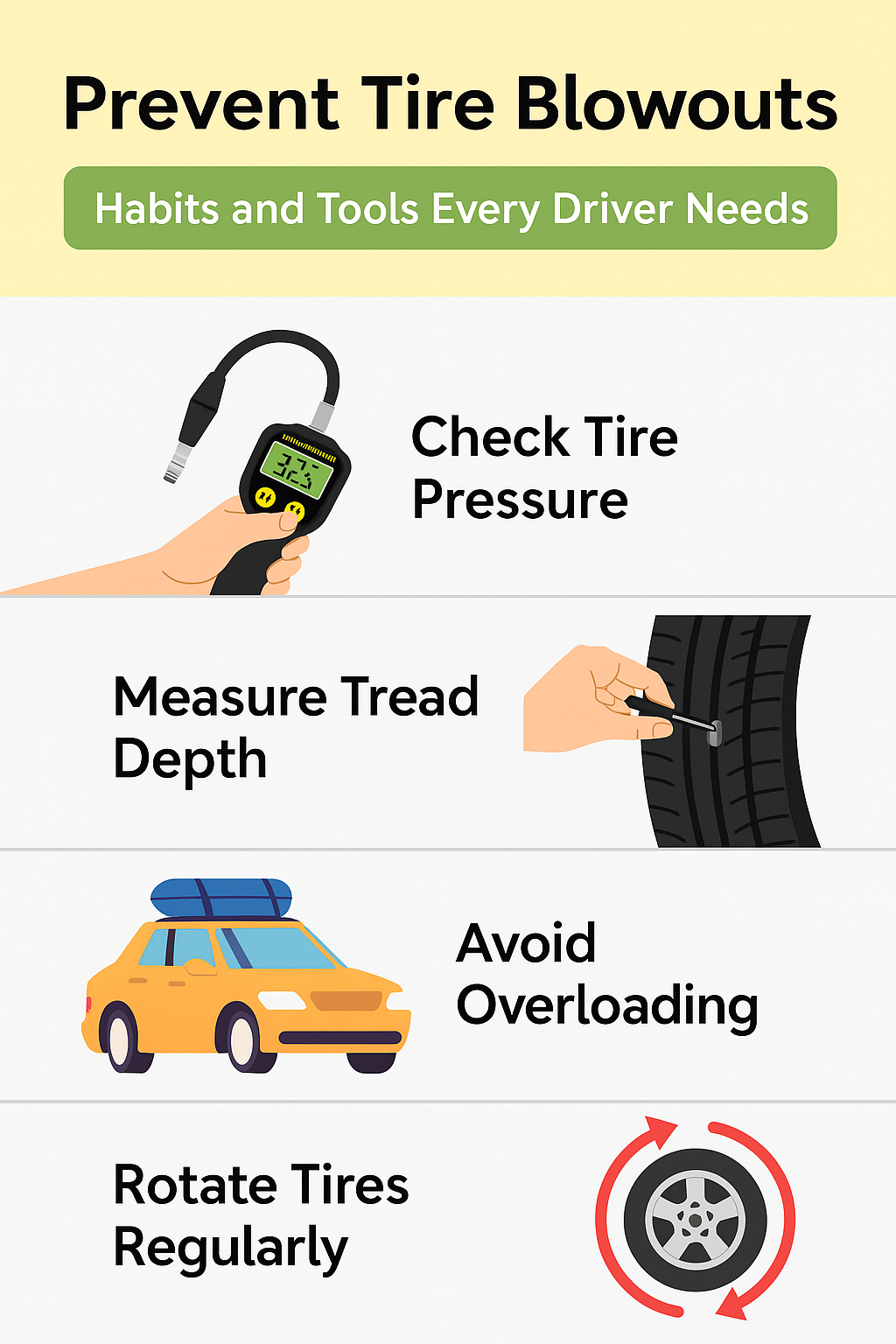
The simplest way to prevent blowouts is maintaining the correct PSI. Underinflated tires are the leading cause of sudden failures, especially at highway speeds. A digital tire pressure gauge from ATSAFEPRO gives exact readings in seconds, ensuring your tires are always within safe limits. Pairing this with a portable tire inflator means you never need to rely on gas stations—you can adjust PSI anytime, anywhere.

Tread Depth: Grip That Saves Lives

Tread is what allows your tires to grip wet or uneven surfaces. Once tread drops below 2/32 of an inch, the tire is at high risk of skidding, hydroplaning, and blowouts. A tread depth gauge from ATSAFEPRO gives precise readings, helping you know when replacement is not just smart, but necessary. For family vehicles and long-distance travelers, this habit is one of the easiest ways to avoid roadside emergencies.

Real-Life Situations Where Prevention Matters

  • Highway Driving in Summer: Heat and speed multiply the risk of blowouts. Checking PSI before long trips avoids disaster.

  • Family Road Trips: Overloaded cars demand higher PSI—something many new drivers forget. A quick inflator check prevents dangerous overheating.

  • Daily Commuting: Stop-and-go traffic wears tread unevenly. Measuring depth monthly ensures you catch issues before they escalate.

  • Rainy Season: Worn tread on wet roads can lead to skids and tire bursts. Regular checks protect both you and your passengers.

Building Blowout Prevention Into Your Routine

  • Check tire pressure at least once a month and before any long trip.

  • Use a tread depth gauge every season to monitor wear.

  • Rotate tires every 5,000–7,000 miles to balance stress.

  • Avoid overloading beyond the vehicle’s recommended weight.

  • Replace tires before they reach critical wear, not after.

ATSAFEPRO: Tools That Keep You in Control

What makes prevention easy is having tools you trust. ATSAFEPRO tire gauges, inflators, and tread depth tools are built for everyday drivers, providing accuracy without complexity. Instead of relying on guesswork, you gain reliable readings and quick fixes that keep you safe on highways, during commutes, or on family trips.

Prevention Is Protection

Blowouts don’t have to be a surprise. By combining consistent habits with reliable tools, you lower risks, protect your passengers, and extend your vehicle’s lifespan. With ATSAFEPRO tire care solutions, prevention becomes simple—and safety becomes second nature.

Explore ATSAFEPRO tire tools or connect via Contact Us to build your own blowout prevention routine today.
Featured Blogs

Tag:

  • Blog
Share On
Featured Blogs
ATsafepro Torque Wrench: What Buyers Should Check Before Ordering

ATsafepro Torque Wrench: What Buyers Should Check Before Ordering

1. ATsafepro torque wrench: what buyers should look for before they put one in a cart 2. 1. What the kit appears to be for 3. 2. What you can verify from the visible design 4. 3. Why socket material and markings matter 5. 4. Quick buyer checklist for an adjustable click-type torque wrench set 6. 5. Where buyers tend to get tripped up 7. 6. Practical notes for shops, fleets, and retail buyers 8. 7. Short takeaways for procurement teams 9. 8. FAQ: common questions buyers ask 10. 9. A sensible next step

ATsafepro Torque Wrench Review: What Buyers Should Check

ATsafepro Torque Wrench Review: What Buyers Should Check

1. A practical look at the ATsafepro torque wrench: what buyers are really checking 2. What stands out in the kit 3. How a click-type torque wrench helps in daily work 4. What the visible construction suggests 5. Where this kind of kit fits best 6. How buyers should evaluate it before purchase 7. Common mistakes buyers make with torque tools 8. A short interview-style takeaway from the shop floor 9. What to ask the supplier before you commit 10. Bottom line for buyers

ATsafepro Torque Wrench Review: Features, Uses, and Buyer Fit

ATsafepro Torque Wrench Review: Features, Uses, and Buyer Fit

1. Why buyers keep asking about the ATsafepro torque wrench 2. Quick take: what this set appears to be built for 3. Interview notes from a buyer’s point of view 4. What the visible design tells you 5. Socket set inclusion: where this package adds value 6. Selection criteria that matter more than the product photo 7. Common mistakes buyers make with torque tools 8. Practical use cases where this set looks sensible 9. Buyer-facing cautions worth saying out loud 10. FAQ 11. What a smart next step looks like

ATsafepro torque wrench: What this adjustable click-type kit offers

ATsafepro torque wrench: What this adjustable click-type kit offers

1. Why an adjustable click-type torque wrench kit matters in real shop work 2. What this kit appears to offer at a glance 3. How a click-type torque wrench works 4. Best use cases for a kit like this 5. Selection criteria buyers should check before specifying one 6. Common mistakes when using a torque wrench kit 7. What the visible construction suggests about durability 8. How to use the kit well in day-to-day work 9. Who should buy this type of kit 10. FAQ 11. What to do next

ATsafepro Torque Wrench: What Buyers Should Check Before Use

ATsafepro Torque Wrench: What Buyers Should Check Before Use

1. ATsafepro torque wrench: what buyers should look for before putting one in service 2. What this kit appears to be 3. Why torque control matters in the shop and garage 4. Quick buyer read: what matters most in a kit like this 5. How a click-type torque wrench is typically used 6. Materials and construction cues buyers can actually inspect 7. Common mistakes when buying a torque wrench kit 8. Practical selection advice for different buyers 9. FAQ 10. What a careful buyer should do next

ATsafepro torque wrench: what buyers should look for in a wheel-service kit

ATsafepro torque wrench: what buyers should look for in a wheel-service kit

1. What is in the kit? 2. Why the socket assortment matters 3. How a click-type torque wrench helps prevent damage 4. Material and construction: what the image suggests 5. Where this type of kit fits best 6. What buyers should verify before ordering 7. Common buyer mistakes with torque wrench kits 8. Quick buyer FAQ 9. Final buyer take