 Why a tire tread gauge still matters in a shop that already has lifts, scanners, and TPMS tools
A GODESON tire tread depth gauge may look like a simple hand tool, but in day-to-day tire service it solves a problem that digital dashboards often blur: how much usable tread is actually left on the tire, right now, on the vehicle sitting in front of you. For a technician, fleet manager, or buying team, that question affects safety recommendations, inspection decisions, and replacement timing. It also affects trust. If a customer is told a tire is “probably fine” when it is close to the wear limit, that guess can come back in the form of complaints, liability concerns, or a lost service opportunity.
This is why tread depth tools remain standard equipment in tire shops, auto service centers, inspection stations, and fleet maintenance programs. They are quick, mechanical, and hard to argue with when used properly. The best versions do not need batteries, pairing, or software updates. They just need a clear scale, a probe that moves consistently, and a design that lets a worker read the result without slowing down the bay.
What the tool is designed to do
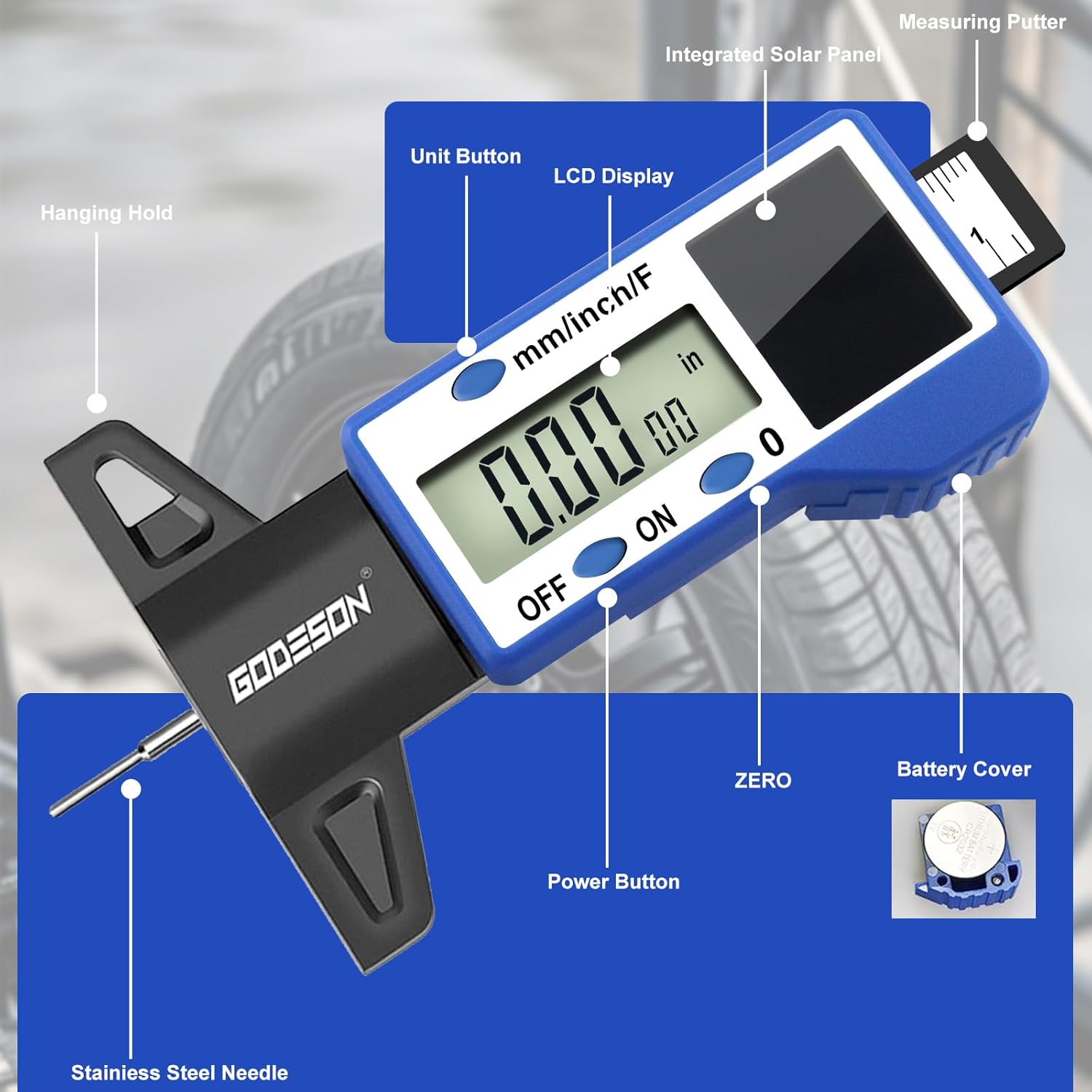
The product shown is a hand-held tire wear depth measuring tool with a spring-loaded probe and a colored readout band. In practical terms, it measures remaining tread depth so a user can judge wear status and decide whether a tire is still serviceable, needs monitoring, or should be replaced soon. The visible scale and color zones are particularly useful for fast screening during routine maintenance or pre-trip inspections, where the operator needs a quick answer rather than a laboratory-style measurement report.
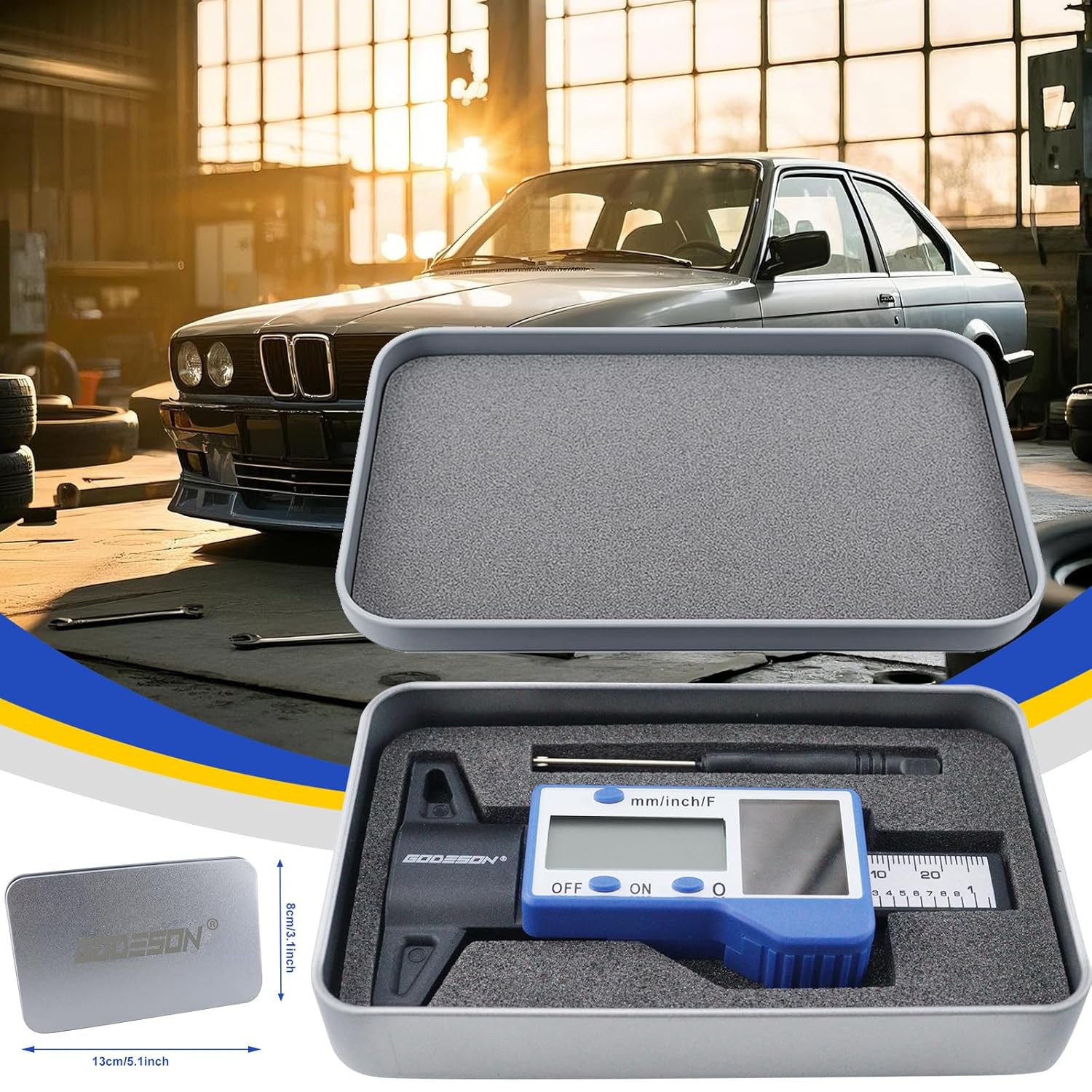
The included interchangeable tip adapters suggest a kit-style setup, not just a single-purpose gauge. That matters more than it first appears. In a shop environment, a set is easier to keep working across different jobs, and the storage case helps keep the small parts from disappearing into a drawer, toolbox, or service cart. Anyone who has searched for a missing probe cap ten minutes before closing will appreciate that detail.
What stands out in the construction
The visible body appears to be a metal housing, likely with a plated or polished finish, paired with a black T-shaped base or handle section. That combination is common in manual measuring instruments because it gives the tool enough weight to feel solid without becoming awkward in the hand. The probe-style measuring rod extends from the housing and is marked with a printed numeric scale. On one version shown, the scale uses colored zones moving from red through yellow into green or teal, which creates a fast visual cue for wear status.
For buyers, this matters because tire tread tools are often handled by different people across a shop. One technician may read the numbers precisely. Another may only need a pass/fail indication during a lane check. A color-coded band reduces the chance of hesitation or misreading, especially when the work area is busy and the lighting is not ideal.
The black knurled-looking adapter caps and the storage case point to a product category that sits somewhere between simple hand tool and small instrument kit. The likely manufacturing mix would include metal machining, marking or printing on the scale, and plastic injection molding for the case and tips. That is not unusual for this kind of accessory. The important part is not the process itself, but whether the finished tool feels consistent and reads clearly in daily use.
How buyers should think about tread depth gauges
When sourcing a tire tread depth gauge, the first mistake is to treat every gauge as interchangeable. They are not. Some are designed for fast visual checks, some for more detailed measurement, and some try to do both. The right choice depends on who is using it and what decision they need to make.
For tire shops and service lanes
Speed and readability usually matter more than fancy features. A gauge with a clear printed scale and obvious wear bands can help technicians move from inspection to recommendation without a second tool. If the shop process depends on consistent communication with customers, that visible red-yellow-green style is especially useful because it translates a measurement into an action.
For fleet maintenance
Fleet buyers often care about repeatability and ease of deployment. A compact gauge with a storage case can be assigned to a vehicle checklist kit or maintenance station. The goal is not just measurement, but discipline: making tread inspection routine enough that tire replacement is planned, not rushed.
For vehicle owners
A simple manual gauge is usually enough for personal use, particularly before long trips or seasonal changeovers. A cautious note here: many drivers look only at the center rib or use a coin test. Those methods can miss uneven wear. A proper tool gives a more direct reading, especially when the tire is wearing unevenly across the tread face.
Why the color-coded scale is more than a convenience feature
Color coding gets dismissed sometimes as cosmetic. In reality, it can reduce friction in the service workflow. When a tool gives a quick visual reading, the user can make a first judgment in seconds and then confirm with the numeric scale if needed. That dual-read approach is practical in a noisy shop where attention is split between the vehicle, the customer, and the next ticket.
It also helps with communication. Saying a tire is “in the red” is not the same as citing a number, but it can open the conversation. A good gauge should support both. The visible printed scale handles the measurement; the colored zones help make the result usable.
Common buyer questions that are worth asking before purchase
Because the supplied data does not confirm exact calibration, units, or range, buyers should not assume every gauge in this style is identical. A few questions matter more than the marketing copy:
Does the gauge read in millimeters, 32nds of an inch, or both?
How easy is it to read the scale under shop lighting?
Are the interchangeable tips included as standard, or are they configuration-dependent?
Is the probe movement smooth and consistent from unit to unit?
Will the case actually protect the tips in a toolbox, or is it mostly for display?
These may sound basic, but they are the difference between a tool that lives in a drawer and one that gets used every day. For B2B buyers, that is the real metric.
Practical mistakes to avoid when using a tread depth gauge
The first mistake is pressing the tool inconsistently. A spring-loaded gauge depends on a steady hand and flat contact with the tread surface. If the tool is angled or bumped during reading, the number can shift enough to matter.
The second mistake is measuring only one spot. Tires wear unevenly. Inner edge, outer edge, and center can tell different stories, especially if alignment or inflation has been off. A quick check in one location is better than guessing, but it should not be treated as a full inspection.
The third mistake is ignoring the context of the measurement. Tread depth is only one part of tire condition. Sidewall damage, irregular wear, and age still matter. A neat gauge reading does not make up for visible cracking or a tire that has lived a hard life.
Where this type of gauge fits in the service workflow
A hand-held tread depth tool works best as a frontline inspection instrument. It belongs in the same category as pressure gauges and inspection lights: simple tools that help workers make fast, defensible decisions. For a service center, it can be used at intake, during rotation, or before a tire recommendation is written up. For an inspection station, it becomes part of the evidence behind a pass/fail call. For a fleet, it can sit inside a preventive maintenance checklist that flags vehicles before tire wear becomes an operating issue.
That is the real buying argument. This is not a glamorous tool, and it is not supposed to be. It is a small control point that helps the shop avoid bad calls and the fleet avoid unexpected tire expense.
What to look for in a supplier or OEM-style offering
If you are sourcing this product for resale, shop use, or inclusion in a maintenance kit, favor consistency over novelty. The visible features in this design—metal body, printed scale, colored wear bands, interchangeable tips, and a dedicated case—suggest a practical industrial accessory rather than a novelty item. That is usually a good sign.
Still, request clarity on packaging configuration, the exact contents of the kit, and whether the visual scale is part of every unit or only certain versions. Since the exact range and units are not confirmed here, buyers should also verify how the tool aligns with their local inspection habits and internal reporting method. A gauge that does not match the shop’s preferred measurement format creates friction quickly.
A straightforward next step for buyers
If your team needs a compact, easy-to-read tire inspection tool for daily shop use or fleet checks, a color-coded mechanical gauge like this one is worth evaluating. The combination of a visible numeric scale, spring-loaded probe, interchangeable tips, and storage case is aimed at practical work, not shelf appeal. Ask for the exact measurement format, confirm what comes in the kit, and compare readability under real shop lighting before you place an order.
That small bit of due diligence usually tells you more than a polished product photo ever will.