Why a tread depth gauge still matters in day-to-day tire work
A GODESON tire tread depth gauge sits in that useful category of shop tools that does one job quickly and leaves little room for argument. It is for anyone who needs to know whether a tire still has usable tread, whether wear is even, and whether a customer or driver can safely keep running the set for a while longer. That sounds simple, but in practice it affects service calls, replacement timing, fleet uptime, and safety decisions that can’t wait for a full inspection bay.
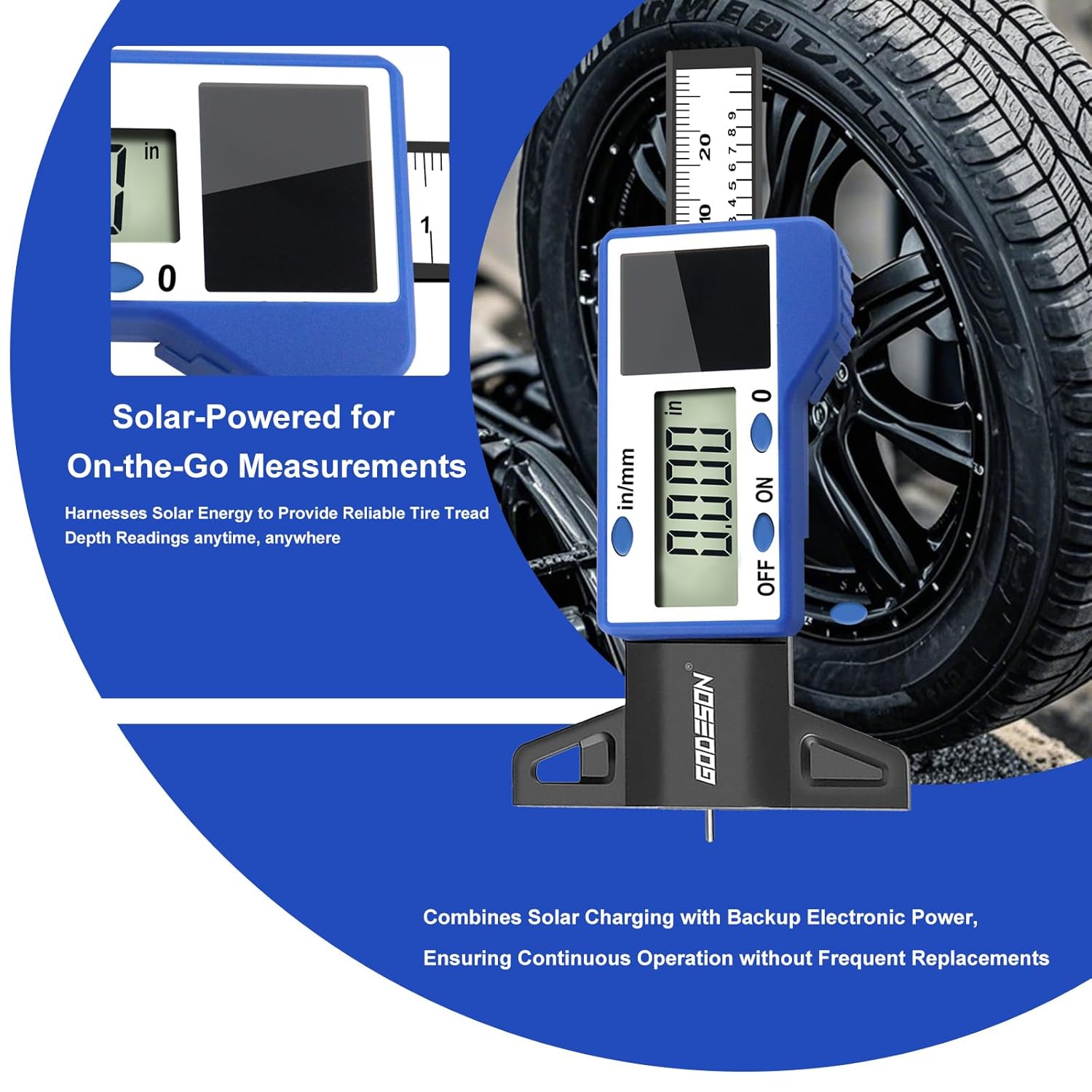
For technicians and sourcing managers, the real question is not whether a tread gauge is a basic tool. It is whether the gauge is easy to read, durable enough for repeated handling, and clear enough that different people in a shop will get the same answer. A tool that is quick to grab and quick to interpret tends to get used. One that is awkward or vague often ends up in a drawer.
What this style of gauge is designed to do
The product visible here is a handheld tire wear inspection tool in the classic mechanical pencil style. A spring-loaded probe extends from the body and registers tread depth against a printed scale. In the units shown, the scale includes numbered markings from 0 to 32, along with colored warning bands: red near the low end, yellow in the middle, and green in the higher range. That kind of visual layout helps when a mechanic needs to make a fast call between “still serviceable” and “plan replacement soon.”
There is no need to overcomplicate the use case. The tire tool is meant for quick checks on passenger vehicles, service fleets, dealership inspections, rental returns, and general DIY maintenance. It is not a laboratory instrument, and it is not trying to be. Its value comes from speed, repeatability, and the fact that the reading is visible at a glance.
What stands out in the visible construction
The body appears to be metal, with a reflective chrome or silver finish, paired with black plastic thumb pads or end caps. That combination is common in hand tools where the manufacturer wants a firmer feel than all-plastic construction without making the tool bulky. The probe or rod is metallic and extends from the lower end, which is exactly what you want in a spring-probe design: a simple moving element with few parts to snag or misalign.
The accessory set matters as well. The clear or tinted storage case and the black knurled cylindrical accessories suggest a kit rather than a bare tool. Buyers should avoid assuming too much about those parts from appearance alone; they may be interchangeable tips, adapters, or simply storage components. Still, a kit format is practical in a shop because it reduces loss and keeps the gauge in one place between jobs.
Quick-reference view: what buyers usually care about
When teams compare tread depth gauges, the conversation usually comes down to a short list of practical points:
Readability: Can the user see the measurement fast, without squinting at a tiny scale?
Handling: Does the thumb pad feel stable, and does the probe move smoothly under spring pressure?
Durability: Will the body, scale sleeve, and probe survive normal bench and pocket use?
Portability: Does the tool fit in a glove box, pocket, drawer, or service tray?
Consistency: Will different users in the shop get the same answer on the same tire?
Those questions sound obvious, but they are the ones that determine whether a tool gets used every day or only during inspections that happen under pressure.
Why the colored scale is more useful than it first appears
A lot of people think a tread depth gauge is just about numbers, but the color bands are doing real work. The red/yellow/green layout gives an immediate visual cue that supports a decision before the user even studies the exact mark. In a busy bay, that can shave a little time off every inspection. It also helps when one person performs the check and another person writes up the service estimate.
That said, color zones should not replace judgment. A tire can still deserve attention even if the reading is in a better-looking band, especially if wear is uneven across the tread, one shoulder is more worn than the other, or the vehicle has visible alignment or inflation issues. A gauge tells you depth; it does not explain the cause.
Mechanical pencil-style gauges: strengths and limits
This design has been around for good reasons. It is compact, it has few failure points, and it is usually intuitive enough that new staff can learn it fast. For fleet checks, that matters more than people admit. The simplest tool is often the one most likely to be used correctly across shifts.
The trade-off is that a spring-probe gauge depends on proper placement. If the probe is not seated squarely in the tread groove, the reading can be off. The user also has to avoid measuring across wear bars or debris-packed grooves. That is not a flaw unique to this product; it is a normal caution with this type of tool. In other words, the gauge is straightforward, but it still rewards careful technique.
What makes a gauge useful in a shop setting
For service technicians, the best tread inspection tools are the ones that disappear into the routine. They should be easy to pick up with one hand, easy to reset, and easy to read in less-than-perfect lighting. A gauge with a clean scale and a solid body usually wins out over one with a fussy mechanism or tiny markings.
For sourcing managers, a few non-glamorous details deserve attention. The finish should hold up to handling. The printed scale should stay legible after repeated use. The probe should move without sticking. And if the product is sold as a kit, the case should actually protect the tool instead of merely looking organized in photos. Those are small issues on paper, but they become the difference between a tool program that runs smoothly and one that generates complaints.
Common mistakes when buying or using tread depth gauges
One common mistake is treating all gauges as interchangeable. They are not. A cheap tool may look similar from a distance, but if the numbers are hard to read or the spring action is inconsistent, the tool will slow down inspections and invite re-checks.
Another mistake is expecting the gauge to solve tread-wear interpretation by itself. Uneven wear, cupping, inner-edge wear, and shoulder wear can matter just as much as the absolute depth reading. If a tire shows a few decent grooves but an obviously irregular pattern, the real issue may be inflation, alignment, suspension, or rotation habits.
There is also a practical caution on contamination. Dirt, stone fragments, and moisture in the tread can distort a quick reading. A technician should clear the groove before measuring, especially on fleet vehicles that come in from harsh conditions. It is a tiny step, but skipping it can lead to sloppy decisions.
Who is most likely to benefit from this type of tool
Vehicle maintenance shops will use it for intake checks and replacement recommendations. Tire retailers can use it during inspections and customer consultations. Fleet operators can use it as part of routine condition checks, especially when they need a low-cost tool that multiple staff members can carry. DIY owners can keep one in the glove box and track tire condition between rotations.
If your work involves repeated visual inspections rather than data logging, a manual tread depth gauge is usually enough. If you need digital records, paired reporting, or automated fleet software integration, you may want a different inspection workflow. The right tool depends on the decision you need to make, not on the appeal of a more complicated product.
Practical buyer advice before placing an order
Look closely at the scale format, because that affects how your team reads the tool. If the measurement markings are easy to understand in the lighting conditions where the tool will be used, it will get used more often. Check whether the storage case is genuinely protective, especially if the gauge will ride in a toolbox with heavier hand tools.
If you are buying for a shop or fleet, ask how the tool will be issued and stored. A pocketable tool can disappear faster than a larger one, so the accessory case may matter more than expected. And if there are multiple black knurled accessories in the set, confirm what each part does before standardizing the kit. It is better to clarify that early than to discover later that different users are assembling the gauge differently.
FAQ: short answers buyers usually want
Is this type of gauge suitable for fast inspections?
Yes. A spring-probe tread depth gauge is made for quick checks, especially when the user needs a simple pass/fail or replace-soon decision.
Does the colored scale replace the numbered scale?
No. The color bands help with quick interpretation, but the numbered markings give the actual reading.
Can it help identify uneven wear?
Yes, if the user measures across different grooves and compares readings. The gauge itself does not diagnose the cause, but it can reveal that the wear pattern is not uniform.
Is a mechanical gauge still relevant if digital tools exist?
Very much so. Mechanical gauges are simple, portable, and dependable for routine inspections where a fast, visible reading is enough.
Final buying thought
The appeal of a GODESON tire tread depth gauge is not that it is fancy. It is that it solves a routine inspection problem cleanly. If the body feels solid, the scale is easy to read, and the probe action is smooth, the tool will earn its place in the glove box or service tray. For shops, fleets, and owners who want a quick wear check without extra steps, that is usually enough. If you are comparing options, focus on readability, handling, and how the tool will actually be used in the field, not just on the picture in the catalog.
For buyers building out a tire inspection kit, this is the kind of hand tool worth evaluating on practicality first. A simple gauge will not replace experience, but it will make experience faster to apply.