Why a disc brake rotor micrometer matters in real workshops
A GODESON Disc Brake Rotor Micrometer is the kind of tool most people only appreciate after they’ve been burned by a bad measurement. On paper, rotor thickness sounds simple: measure the part, compare it to the service limit, and decide whether it stays on the vehicle. In practice, the job gets messy fast. Rotors wear unevenly, corrosion builds at the edge, and a caliper or tape measure can give you a false sense of certainty. For anyone making repair decisions, quoting a brake job, or checking incoming parts, the difference between “close enough” and an actual precision reading is the difference between a clean job and a comeback.
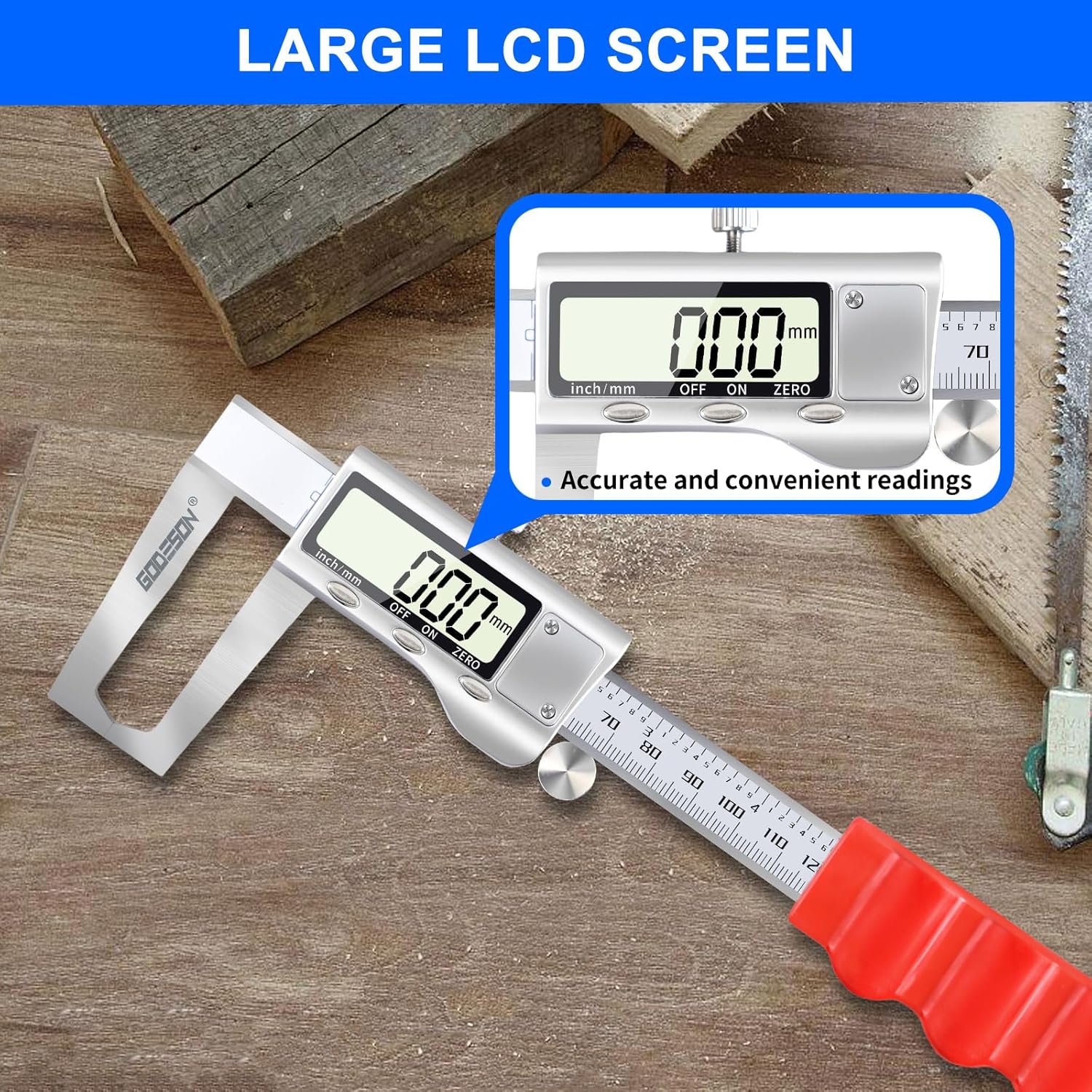
This is where a digital rotor micrometer earns its place on the bench. The visible design of this tool suggests a depth-style precision measuring instrument built for thin components and hard-to-reach surfaces, with a digital LCD, unit switching, a hold function, and visible inch/metric display examples. That combination is useful not only for brake work, but also for broader inspection tasks where a long-reach measuring beam is more practical than a standard micrometer frame.
What the tool is designed to do
The GODESON Disc Brake Rotor Micrometer appears to be a special-purpose digital measuring tool for small linear dimensions. The long narrow beam and pointed contact end are the giveaway. That geometry is meant to reach into places where a standard outside micrometer or caliper can struggle, especially when the surface is recessed or when you need consistent contact at a specific point on a rotor face.
The digital head shows readings in both inch and metric formats, and the interface appears to support mm, in, and fraction display modes. There is also a visible hold function, along with ON/OFF, unit, and zero controls. For the shop floor, that matters more than it sounds. A live reading you can freeze is often easier to record when a part is awkwardly positioned or when the operator needs to step away from the tool to verify paperwork.
Key visible features buyers will notice first
Digital readout and unit switching
The display examples show both 0.1805 in and 4.58 mm, which indicates the tool is intended for fast conversion between measurement systems. That helps in mixed environments where one technician thinks in decimal inches and another is checking against metric documentation. It also reduces the small but expensive errors that happen when someone mentally converts a number under time pressure.
Hardened measuring element
The beam area is marked “STAINLESS HARDENED,” suggesting a hardened stainless measuring component. In practical terms, that usually means better resistance to wear and a sturdier feel during repeated contact with metal parts. It does not replace careful handling, of course, but it is a sensible feature for a tool that will live in an automotive or machine-shop drawer rather than a clean-room cabinet.
IP54 marking
An IP54 marking is visible on the head or adapter area. That points to a level of dust and splash protection, which is useful in busy service environments. Brake dust, coolant mist, and general bench grime are not glamorous topics, but they are the everyday enemy of digital inspection tools. A bit of environmental resistance can make the difference between a tool that stays in service and one that becomes drawer clutter.
Storage case and cable accessory
The red protective case is not just packaging. For a precision tool, storage matters. A measuring beam that gets tossed into a toolbox with pliers and sockets is a measuring beam that eventually stops measuring accurately. The included cable accessory also suggests some kind of connection or power-related function, although the exact purpose is not stated and should not be assumed.
Where it fits in the inspection workflow
For brake service, the basic workflow is straightforward: clean the rotor surface, measure at the correct points, compare the readings to the service specification, and document the result. That sounds simple, but rotor wear is rarely uniform. The outer edge may show a lip, the face may have scoring, and corrosion can distort the visual impression of remaining material. A dedicated disc brake rotor micrometer helps the technician focus on the actual thickness, not the surface appearance.
In machining or quality control, the same tool can be useful for thin cylindrical or flat parts where a long reach is needed. It is not a universal substitute for every metrology tool on the bench, and it should not be treated that way. But for parts that sit awkwardly in a recess or require a more specialized contact point, the tool has a clear practical role.
How to judge whether this style of micrometer is the right buy
Buyers usually get stuck on the wrong question first. They ask whether the tool is “good enough,” when they should be asking what kind of measurement problem they need to solve. If the shop primarily works on brake service, the obvious concern is rotor wear assessment. If the user also inspects odd-shaped parts, then reach, display clarity, and unit flexibility become more important than a long list of features they may never touch.
Look at the way the tool will actually be handled. Will it stay on a clean inspection bench, or be used in a service bay with dust and vibration? Will the same person use it every day, or will it be shared among technicians with different habits? A digital rotor micrometer with visible hold and zero functions is easier to standardize across multiple users, but only if the team agrees on a simple measurement method. Without that, even a good tool produces inconsistent results.
Common mistakes when measuring rotor thickness
One common mistake is measuring a dirty rotor and trusting the number. Rust scale, brake dust, and surface glaze can all interfere. Another is measuring only one point because the first reading looked acceptable. Rotors can taper or wear unevenly, so one reading is a convenience, not a diagnosis.
Another caution: do not confuse a tool’s digital display with calibration. A readable screen does not guarantee that the instrument is correct. The product information shown here does not state exact accuracy, range, or calibration status, so those details should be verified before purchase if they matter to the application. That is a small but important point for sourcing teams. A tool can be perfectly usable for field checks and still not meet a stricter metrology requirement.
What makes this style of tool useful beyond brake work
Although the name points to brake rotors, the design is broader than that. A depth-style precision measuring tool with a digital readout can serve in general inspection work where a narrow probe and a readable display are more useful than a bulky frame. That includes certain machine-shop checks, maintenance work, and quality control tasks on parts that have recessed surfaces or limited access.
The ability to switch between units is especially practical in mixed-production environments. Some teams still work from inch-based prints while others live in metric. A tool that shows both reduces mental arithmetic and keeps the conversation on the part, not the conversion chart. That alone can save time in a shop where technicians are already juggling more urgent problems.
Buyer’s checklist before placing an order
Before buying a GODESON Disc Brake Rotor Micrometer, confirm a few basics that are not clearly stated in the available product information. Check the measuring range, resolution, and accuracy if those are critical to your work. Verify whether the included cable is for charging, data transfer, or something else. Make sure the tool’s measurement style fits your parts, because a rotor micrometer is useful precisely because it is specialized.
Also think about storage and handling. If the tool will be passed around, the case matters. If it will be used in a dusty environment, the visible IP54 marking is encouraging, but it should be treated as protection, not immunity. Precision tools still need a little respect, and that is often where shops cut corners.
FAQ
Is this only for brake rotors?
Not necessarily. The design suggests brake rotor use, but the measuring geometry can also suit other inspection tasks that need a narrow reach and small linear measurement.
Does the display support both inch and metric units?
Yes, the visible readout examples indicate inch and metric formats, and the unit switch appears to include mm, in, and fraction modes.
Can I assume the exact accuracy from the image?
No. The available information does not state range, resolution, or accuracy, so those should be confirmed separately if they are important to your application.
Is the tool protected for shop use?
The visible IP54 marking suggests a useful level of dust and splash protection, which is practical for service and inspection environments.
A practical next step for buyers
If you are sourcing a digital rotor micrometer for brake service or general inspection, start by matching the tool to the measurement task, not the brand name alone. Check the visible features, confirm the specifications that matter to your process, and make sure the team understands how the tool will be used and stored. That is usually the difference between a precision instrument that pays for itself and one that quietly disappears into a toolbox.
For sourcing, maintenance, or shop managers, the real question is simple: will this tool help your people make repeatable decisions quickly, without arguing over the reading? If the answer is yes, then a well-designed disc brake rotor micrometer is worth a closer look.