GODESON Digital Caliper: what buyers should compare before they click “add to cart”
The appeal of a GODESON Digital Caliper is easy to understand: it gives a fast, readable measurement in a shop environment where a fraction of a second matters, and it does so without asking the operator to squint at a vernier scale. For machinists, maintenance crews, and quality inspectors, that matters more than the marketing language on the box. The real question is not whether a digital caliper is convenient; it is whether this particular style of tool fits the work, the environment, and the level of confidence required for the job.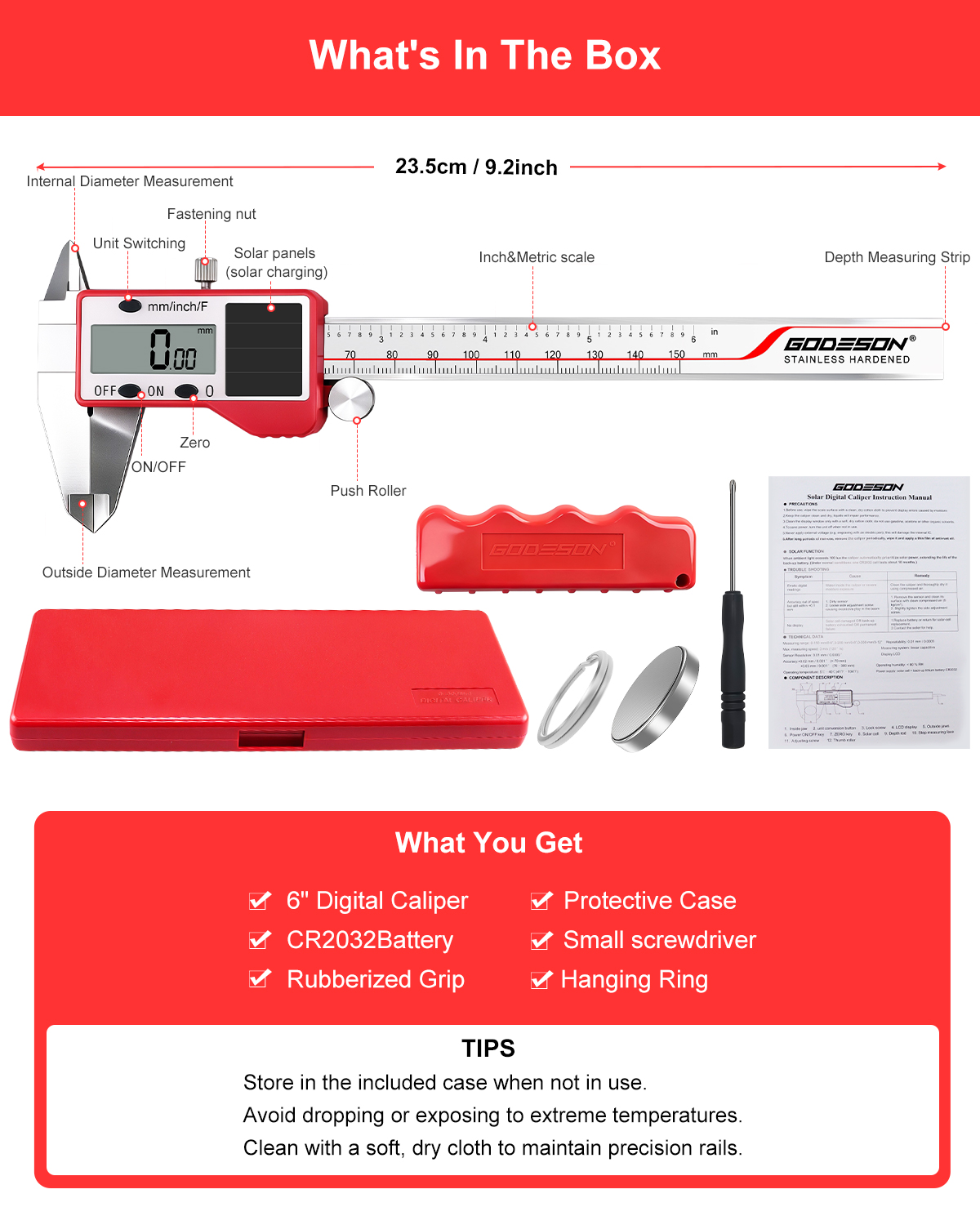
That comparison becomes important when a buyer is choosing between a rechargeable digital caliper, a traditional dial caliper, or a manual vernier model. Each can measure external dimensions, internal dimensions, depth, and steps, but they do not always behave the same in dirty, wet, or high-traffic shop conditions. A tool that is easy to read may still be the wrong tool if the battery strategy, protection level, or jaw feel does not match the day-to-day workload.
What the product image tells us, and what it does not
From the visible details, this caliper is a rechargeable digital measuring tool with a black LCD readout, a red handle/body, a metal-looking beam and jaws, and a USB charging cable in the package. The display shows mm and in modes, along with a zero function, which is the sort of basic interface most buyers expect now. The packaging also indicates a measurement range of 0–200 mm / 8 inch, placing it squarely in the common handheld inspection category.
The visible IP54 marking is worth noting. In plain shop language, that suggests the tool is designed to resist limited dust ingress and splashes, which is useful around coolant mist, light shop debris, and general bench use. It is not the same thing as waterproof, and that distinction matters. A caliper with an IP rating is usually more forgiving than an open electronics unit, but it should still be treated as a precision tool, not a washdown instrument.
What is not visible should not be guessed at. Accuracy, resolution, repeatability, battery capacity, charge time, and electronics architecture are not confirmed by the image alone. A cautious buyer should resist reading more into a product photo than the photo can support. That is especially true for metrology tools, where small claims often decide whether the tool is a daily workhorse or a drawer item.
Digital caliper versus dial and vernier: a practical comparison
A digital caliper wins on readability. The LCD makes it easy to see the number quickly, and the dual-unit display saves time when drawings, supplier data, or legacy shop habits mix metric and imperial references. For quick checking, sorting parts, and general assembly work, that convenience often outweighs the romance of a purely mechanical instrument.
A dial caliper offers a different feel. Some operators prefer the needle and scale because it gives an immediate sense of movement, and there is no battery to think about in the moment. In a clean environment with trained users, a dial tool can be very satisfying to use. It is, however, slower for many operators to read precisely, especially under poor lighting.
A vernier caliper is the old-school option and still has a place. It is rugged in a very direct way, and it does not depend on electronics, but it asks more from the user. Reading a vernier scale accurately takes time and practice, which can be a real issue when multiple people share the same tool pool.
The GODESON Digital Caliper sits in the modern middle. It is geared toward convenience, speed, and broad usability. For mixed-skill teams, that is often the best compromise. For a metrology lab or a controlled inspection room, the debate becomes less about convenience and more about whether the tool’s stated performance matches the required standard. That is a separate conversation, and buyers should keep it separate.
Where this type of caliper fits best
For workshop and manufacturing inspection, a handheld digital caliper is often the first tool out of the drawer. It is quick for checking shaft diameters, plate thickness, slot widths, edge distances, and depth features. In machining and fabrication, that speed helps operators decide whether a part is within a usable window before sending it to the next process.
In maintenance and assembly, it is equally useful. Small components rarely arrive labeled with the exact dimension you need, and sometimes the only practical way to confirm fit is to measure the part directly. A rechargeable design is particularly attractive in shared shops because it avoids the inconvenience of frequent battery replacement, though that advantage depends on the actual runtime and charging behavior, which are not shown here.
Quality control teams may use the tool for incoming checks and basic process verification. That said, a buyer should be honest about the job. A handheld digital caliper is excellent for quick dimensional comparison, but it is not a substitute for more specialized gauging when tolerances tighten or when roundness, surface condition, or geometric relationships matter.
Selection criteria buyers should weigh before choosing
The first criterion is the environment. If the tool will live near coolant, chips, dust, or a busy bench, the IP54 marking is a meaningful point in its favor. If it will be used mostly in a clean inspection setting, the protection rating may matter less than display clarity and jaw feel.
The second criterion is unit handling. Dual mm/in readout is not a luxury feature in a mixed-manufacturing environment; it reduces conversion mistakes and shortens the checking cycle. That matters more than many product listings admit. A shop that works from both ISO and imperial prints can lose time at every measurement if operators keep reaching for a calculator.
The third criterion is power strategy. Rechargeable tools are convenient, but buyers should ask the simple operational questions: How is it charged? How easy is it to keep in service? Does the shop already have a charging routine? A rechargeable tool can reduce battery waste and simplify stocking, but only if it is disciplined into the workflow.
The fourth criterion is feel. This sounds subjective, and it is, but it matters. Jaw smoothness, beam finish, and display layout affect how often the tool is used correctly. A caliper that feels awkward often becomes a caliper people avoid, and that is a hidden cost.
Practical cautions that buyers sometimes overlook
Digital calipers are convenient enough that users can become careless. The zero function makes it easy to reset a reading, but that does not fix a poor measuring habit. Part burrs, debris on the jaws, or inconsistent hand pressure can distort a measurement faster than many operators realize.
Another quiet issue is storage. The red case shown with this product is not just packaging; it is part of the tool’s life cycle. A caliper tossed into a drawer with loose cutters or drill bits will not stay accurate-looking for long, and scratched jaws create mistrust even before measurable wear shows up.
One more practical note: dual-unit display does not remove the need to know which standard the drawing actually uses. Mixed-unit habits can create avoidable errors, especially when a part is close to nominal and the check is being done under time pressure. The display is a convenience, not a decision-maker.
Who should choose this style, and who probably should not
This style makes sense for buyers who need fast general measurement, clear readout, and a tool that can be carried from bench to machine without fuss. It is a good fit for maintenance teams, fabricators, prototype shops, and general production support.
It may be less suitable for users who need fully traceable metrology documentation, highly specialized measurement functions, or a tool that must remain in a tightly controlled calibration program with known published performance data. Those users may need a different class of instrument altogether.
FAQ buyers often ask
Is a rechargeable digital caliper better than a battery-powered one?
Not automatically. Rechargeable can be more convenient and reduce battery handling, but only if the charging routine is easy and the tool stays ready when needed.
Does IP54 mean the caliper can be used anywhere in the shop?
No. It suggests better resistance to dust and splashes, but it is still a precision electronic tool. Treat it accordingly.
Is the 0–200 mm / 8 inch range enough for most shop work?
For small to medium components, yes. For larger parts, another measuring method may be necessary.
Can it replace a micrometer?
Not really. A caliper is more versatile, but a micrometer is the better choice when a job calls for tighter, more controlled measurement on a specific feature.
What a sensible buyer should do next
If you are comparing the GODESON Digital Caliper against other handheld measuring tools, start with the actual use case rather than the feature list. Check the environment, the units used on drawings, the need for rechargeable power, and the level of measurement confidence required. Then ask for the details that are not obvious from a product image: accuracy, resolution, battery behavior, and any documentation that supports the tool’s performance.
That approach saves more money than chasing the lowest price or the flashiest display. For most shops, the right caliper is the one operators will use correctly every day, not the one that looks best in the catalog.