Why a click-type torque wrench still matters on the shop floor
The ATsafepro torque wrench sits in a category that many mechanics and production teams treat as routine until something goes wrong. A fastener that is too loose can back out under vibration. One that is too tight can strip threads, distort a flange, or turn a simple service job into a damaged assembly. That is why an adjustable click-type tool is more than a convenience item: it is a control device for repeatable fastening.
For buyers comparing hand tools, the real question is not whether a torque wrench is useful. It is whether the kit matches the work. A wheel service bay, a maintenance crew, and an equipment assembly line all need controlled torque, but they do not always need the same drive size, socket set, or storage format. The ATsafepro torque wrench is presented as a kit with a ratcheting head, a long handled body, an engraved torque scale, and multiple sockets in a hard case. That combination points to practical, everyday fastening rather than a single-purpose specialty tool.
What the kit appears to include
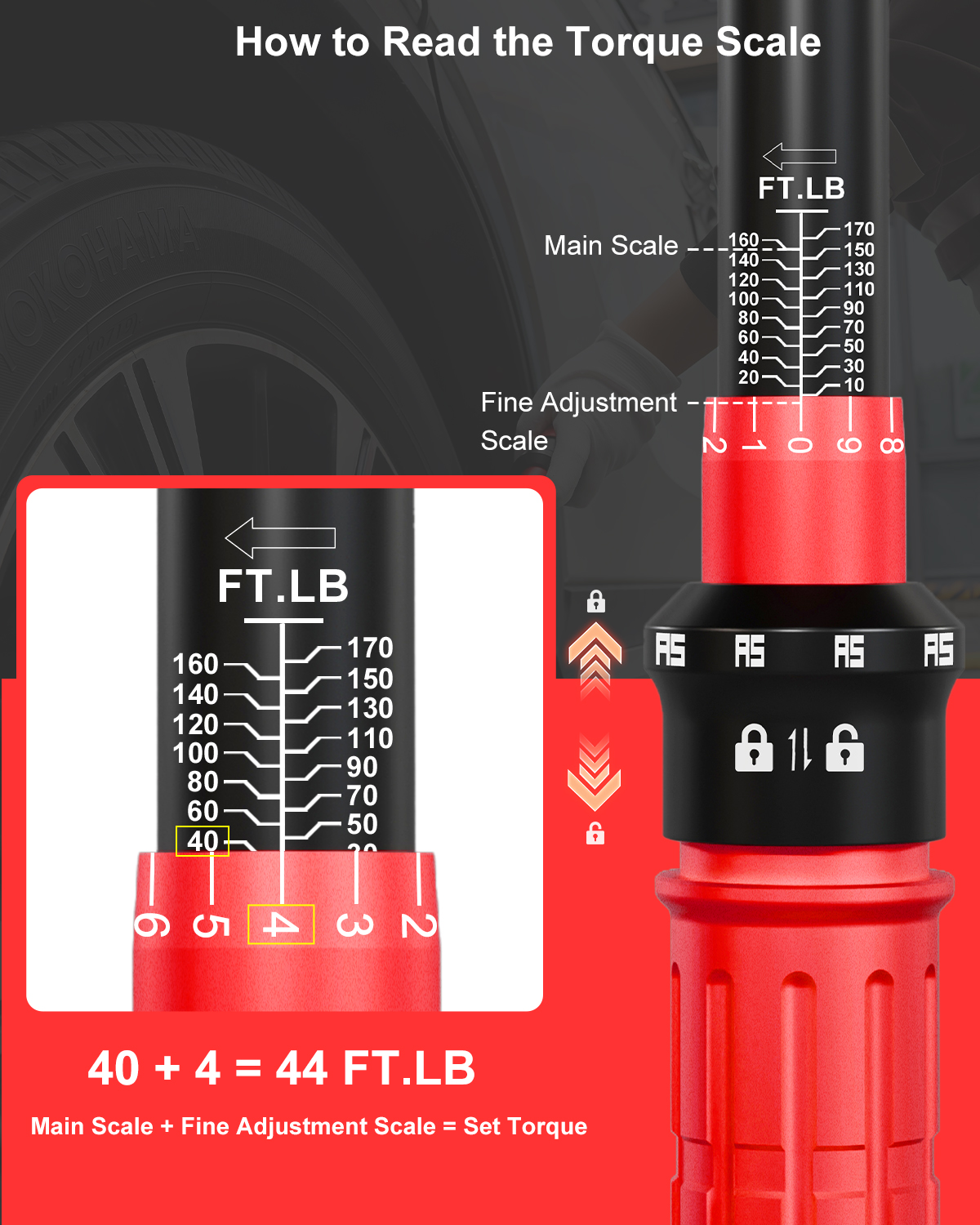
From the visible product details, this is an adjustable click-type torque wrench kit with a red metal body, a black textured grip area, and a black ratcheting head. The shaft carries an engraved torque scale, which is the critical feature on any adjustable wrench of this type. Users set the desired value, tighten the fastener, and feel or hear a click or release when the preset torque is reached.
The kit also includes a plastic carrying case and multiple sockets. The visible socket markings show CR-MO 17 mm, 19 mm, and 21 mm, along with at least one smaller adapter or chrome socket piece whose size is not readable. That matters because wheel service and general automotive repair often revolve around a small family of common sizes. Color coding on the sockets adds a simple but useful layer of identification in a busy tool cart.
How this kind of wrench works in practice
A click-type wrench is preferred in many shops because it gives a clear tactile endpoint. The user sets the target torque on the body, attaches the proper socket, and applies force until the mechanism releases. That release is the signal to stop pulling. It is a simple idea, but it helps reduce the two most common fastening errors: over-tightening and inconsistent tightening between fasteners on the same part.
That consistency matters in places that see vibration, heat cycling, or repeated removal and installation. Wheel lug nuts are the obvious example, but the same logic applies to brake components, engine bay brackets, equipment guards, and many maintenance tasks around industrial machinery. The wrench does not replace judgment; it supports it. A good technician still starts fasteners by hand, uses the correct socket, and follows the sequence specified by the equipment maker.
Why the included socket set changes the buying value
On paper, a torque wrench is the main product. In real use, the sockets often determine whether the kit is immediately useful or just another tool waiting for missing accessories. The visible CR-MO socket markings suggest a chromium-molybdenum construction, which is commonly chosen for strength and wear resistance in service environments. I would still avoid making assumptions about exact impact rating or heat treatment unless the supplier states it plainly, but the material marking is a positive sign.
For automotive and mechanical work, a mixed kit can save time at the point of use. Instead of hunting for separate sockets, extensions, and adapters, the operator opens the case and gets to work. That reduces small delays that add up in a service lane or during preventive maintenance. It also lowers the chance of pairing an appropriate torque setting with the wrong socket, which is a more common shop error than people admit.
Selection criteria buyers should care about
Torque range and readability
The visible scale is important, but the exact torque range is not provided here, so buyers should confirm whether the wrench covers the fasteners they actually service. A tool can look robust and still be a poor fit if the lower or upper end of its range misses the job. For wheel work, assembly tasks, or general maintenance, the usable range is more important than the appearance of the handle.
Drive size and socket compatibility
The head appears to be a square-drive ratchet head, but the exact drive size is not visible. That is not a minor detail. Drive size affects socket compatibility, clearance, and the overall feel of the tool. A purchasing team should verify the drive size before standardizing the kit across vehicles, benches, or field service teams.
Calibration and repeatability
Any torque tool lives or dies by repeatability. The product description indicates precision torque calibration by design, but the exact tolerance is not stated. Buyers should ask for calibration information if the tool will be used in controlled assembly, safety-critical fastening, or any workflow where documentation is expected. In less formal maintenance work, the practical issue is simply whether the wrench behaves consistently over time.
Grip and ergonomics
The black textured grip on the ATsafepro torque wrench may seem like a cosmetic detail, yet it is the kind of feature that matters after twenty or thirty fasteners. A long handle gives leverage, and a non-slip surface helps the operator maintain control while applying a steady pull. That can reduce fatigue, especially when working on larger bolts or in awkward positions under a vehicle or machine frame.
Common mistakes when using a torque wrench kit
The most common mistake is treating a torque wrench like a breaker bar. It is not meant for loosening seized fasteners with heavy force. That abuse can compromise the mechanism or at least its consistency. Another common issue is leaving the setting in place after use; many shops prefer to back the scale down to the minimum recommended setting for storage. It is a small habit, but one worth keeping.
Another practical warning: users sometimes rush the prep work and skip cleaning the threads or checking the fastener condition. No torque wrench can fix damaged threads, rust, or contaminated seating surfaces. If the joint surface is dirty or corroded, the final clamping load may be different from what the scale suggests. That is one of those unglamorous details that separates decent fastening from reliable fastening.
Where this kit fits best
The visible configuration points toward automotive service first, then general mechanical fastening. Wheel lug nut installation and removal are the clearest use case, especially with the included 17 mm, 19 mm, and 21 mm sockets. Beyond that, the kit could suit light equipment assembly, maintenance teams, and workshop technicians who need a straightforward torque-controlled solution in a portable case.
It is less obviously a specialized production-line tool and more a practical field or shop kit. That is not a flaw. In many buying decisions, a versatile kit is more valuable than a highly specialized one, provided the range, drive, and socket selection are a match for the work.
Buyer-facing checklist before ordering
Before approving a purchase, I would confirm four things: the exact torque range, the drive size, the calibration specification, and whether the included sockets cover the jobs you actually see. If those answers are clear, the rest is mostly about durability and convenience. The case, the visible metal construction, and the ratcheting head all suggest an everyday service tool rather than a delicate bench instrument.
If your team uses shared tools, the color-coded sockets and molded case are worth more than they first appear. They reduce loss, make audits easier, and cut down on the “where did that adapter go?” problem that every shop knows too well.
Practical takeaway for sourcing teams
The ATsafepro torque wrench appears designed as a ready-to-use fastening kit: adjustable wrench, ratchet head, multiple sockets, adapter pieces, and storage case. For sourcing managers, that makes it a useful candidate when the goal is controlled tightening with minimal extra purchasing. For engineers and technicians, the main decision is whether the unknowns—exact drive size, torque range, and calibration detail—fit the intended application.
If you are comparing similar kits, ask for the specifications that actually affect daily use, not just the product photos. A bright handle and a tidy case are nice. A wrench that matches the fastening requirement is what saves time and prevents rework.
FAQ
Is this wrench suitable for wheel lug nuts?
The included 17 mm, 19 mm, and 21 mm sockets strongly suggest wheel service use, though final suitability still depends on the exact torque range and the vehicle spec.
Do the sockets look like impact sockets?
The markings show CR-MO, which is commonly used for stronger sockets, but the exact impact rating is not stated in the supplied information. Treat that as likely, not guaranteed.
Can it be used for assembly work outside automotive repair?
Yes, provided the torque range and drive size fit the job. Controlled tightening is useful anywhere fasteners need repeatable load without damage.
What should I verify with the supplier?
Ask for drive size, torque range, calibration details, and any official information on the socket construction and intended use.
Next step
If you are evaluating the ATsafepro torque wrench for shop use or purchasing it for a service team, start with the application, then match the specification. That sequence sounds simple because it is. The tool should follow the fastening requirement, not the other way around.