Why an adjustable torque wrench still matters on the shop floor
An ATsafepro torque wrench is the kind of tool people only notice when something goes wrong. A fastener is either under-tightened and backs off in service, or over-tightened and stretches, strips, or distorts a joint. In automotive work, machinery assembly, bicycle service, and general maintenance, that difference can be expensive. A controlled tightening tool is not about making the job look neat; it is about repeatability, joint integrity, and not having to reopen a build because one bolt was “good and tight” by feel.
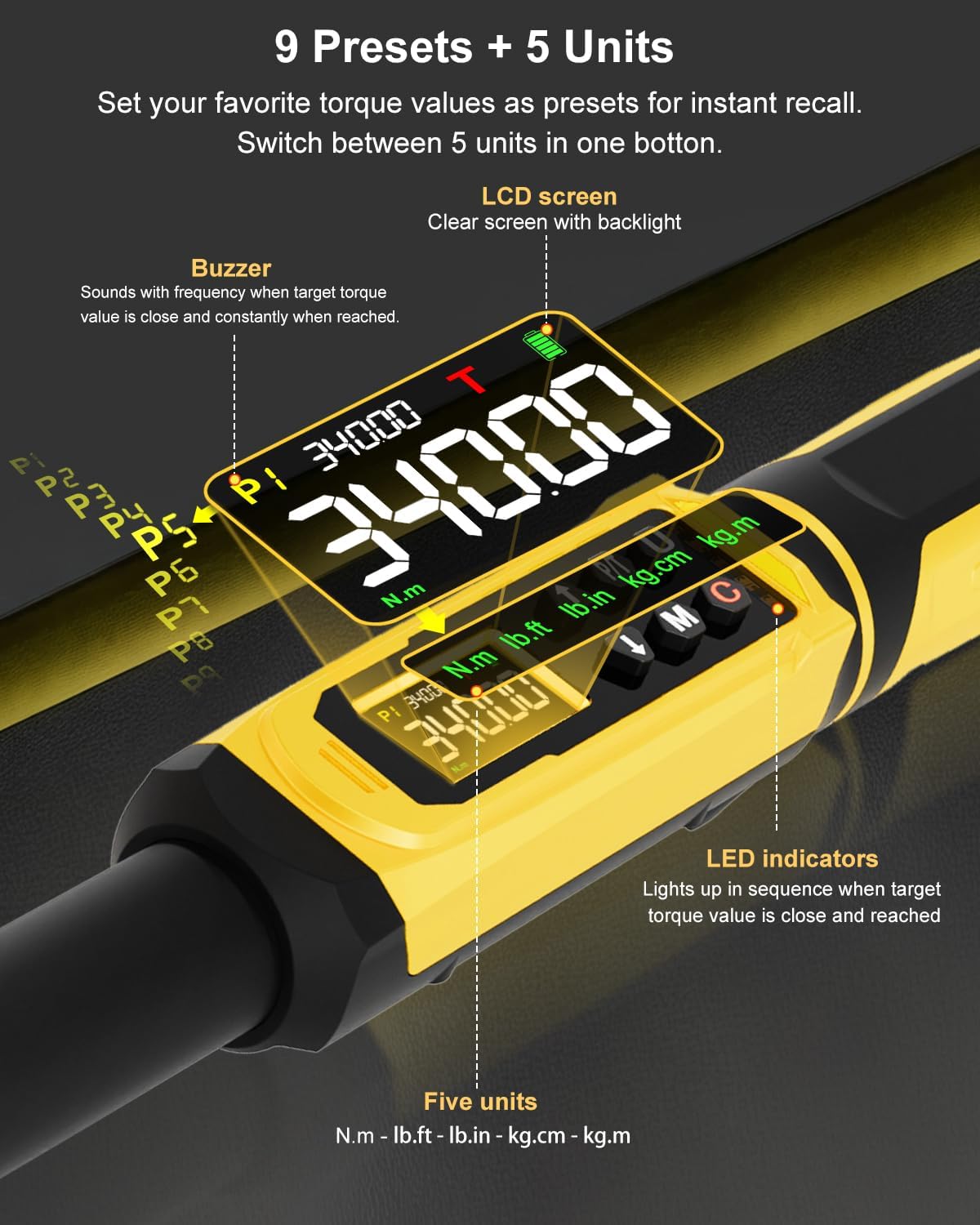
The visible product here is an adjustable, presettable torque wrench kit with a hard case, socket accessories, and a calibration or inspection certificate. That combination tells buyers something important: this is not just a hand tool, but a controlled fastening setup intended for people who care about consistency. For sourcing managers and technicians alike, the real question is not whether a torque wrench is useful. It is whether this style of kit fits the work, the range, and the verification process you need.
What the kit appears to include
Based on the product information supplied, the kit centers on a long black metal wrench body with a red adjustment grip at the top, a torque scale collar with white markings, and a square drive head at the working end. The case is a textured black hard plastic box, and the package also shows two chrome socket adapters or socket heads, plus a calibration sheet.
That matters because buyers often compare the wrench alone and miss the ecosystem around it. A torque tool without a storage case gets knocked around in a drawer. A wrench without visible calibration paperwork may be fine for casual use, but in a controlled maintenance environment it can slow down receiving inspection or internal QA checks. The presence of the certificate is a practical selling point, not a decorative one.
Visible features that stand out
The wrench shows a black painted or coated shaft, chrome-plated silver components, and a red molded or anodized-looking adjustment section. The body is elongated and cylindrical, with a knurled silver section near the top for grip. A printed torque scale is visible on the collar, and the lower end appears to be a square drive interface for interchangeable sockets.
The certificate visible in the supplied data references a 3/8 110 FT.LB model and a torque range of 10–110 FT.LB. It also indicates ISO 6789 and ASME B107.14M compliance or test reference. I would still advise a buyer to verify the exact wording on the certificate and the tool body itself before treating those marks as procurement facts, but they are clearly part of the saleable package as described.
How this style of torque wrench works in practice
The mechanical structure appears to be the familiar adjustable, click-type family of torque wrench, though the image alone does not fully confirm the internal mechanism. In practical terms, that means the user sets a target torque value on the scale, tightens the fastener, and stops when the tool indicates the target has been reached. This is the common workflow in field service because it is simple, fast, and more consistent than hand estimation.
For mechanics and assemblers, the biggest advantage is control. You can tighten a wheel component, engine fastener, fixture bolt, or maintenance fitting without guessing. That is especially useful on assemblies where the hardware is valuable, threads are limited, or the sealing surface depends on even clamping force. It is a small habit that can save a big repair.
Where a 10–110 ft-lb range fits best
A 10–110 ft-lb torque window is broad enough for many medium-duty fastening tasks. In the field, that range often covers automotive work, motorcycle service, light machinery, and general maintenance around equipment frames or brackets. It is not a universal tool for every job, and that is worth saying plainly. If a team is working mostly on very small fasteners or very high-torque industrial joints, one wrench will not cover everything cleanly.
For buyers, the useful question is whether the center of the range matches the fasteners they actually touch every day. A wrench is usually most comfortable and reliable when the target torque sits in a sensible part of the scale, not at the extreme ends. If your crew regularly needs values close to the lower limit or the upper limit, you may want a second wrench that better brackets those jobs.
Selection criteria buyers should check before ordering
When evaluating an ATsafepro torque wrench or any similar kit, start with the drive size, the working range, and the intended application. The supplied information points to a 3/8 reference on the certificate, which is a common size for general service work. That is useful, but it should still be matched to your sockets and adapters before purchase approval.
Next, look at how the adjustment mechanism is meant to be used. A clear scale and a firm locking or setting action reduce the chance of accidental changes. In a busy shop, a wrench that drifts out of adjustment because it was tossed into a toolbox is not much better than guesswork. A hard case helps, but only if operators actually return the tool to the case after use. That sounds obvious; in real life, habits vary.
Finally, check the documentation flow. If you need internal calibration records, receiving inspection files, or traceability for maintenance departments, the certificate is part of the value. If the tool is for a weekend mechanic or a small repair bench, the paperwork matters less, but it still signals a more controlled manufacturing and verification process.
Common mistakes with adjustable torque wrenches
One of the most common mistakes is using a torque wrench as a breaker bar. That is a fast way to damage the mechanism or throw off its accuracy. Another frequent error is storing it at a high setting after use. Many toolmakers and service technicians prefer to back the wrench down to the lowest safe setting before storage, because it reduces internal spring stress. The exact storage practice should follow the tool’s own instructions, but the general principle is sound.
Users also sometimes assume that all sockets and adapters are interchangeable without consequence. Not always. Extra length, worn interfaces, or questionable adapters can affect the real-world result. In tight tolerance work, even a small change in setup can matter. It is wise to keep the extension chain as short and consistent as possible unless the job truly requires it.
And there is a simple human mistake that shows up everywhere: people trust their memory instead of the scale. If the target is 25 ft-lb, set 25 ft-lb, not “about the same as yesterday.” That habit is how loose joints and over-torqued fasteners keep reappearing on the same bench.
How the included certificate affects buying confidence
The inclusion of a calibration or inspection sheet is worth more than many buyers initially think. In manufacturing and maintenance environments, verification paperwork can shorten approval cycles and reduce internal debate about whether a tool can be put into service. If the certificate is genuine and clearly tied to the wrench in the case, it helps support controlled fastening programs and basic quality assurance.
That said, buyers should read certificates carefully. Compliance references, model references, and range values should align with the actual tool. If a certificate looks generic, incomplete, or disconnected from the physical product, ask for clarification before it becomes a receiving headache. A neat sheet of paper is useful only when it matches the wrench in the box.
Practical buyer advice for sourcing teams
If you are buying this type of kit for a maintenance department, focus on workload fit rather than tool marketing language. Ask three questions: Is the torque range right? Is the drive size right? Is the documentation level sufficient for our process? That framework is usually more effective than chasing feature lists.
For purchasing teams supporting multiple users, a hard case and visible scale markings are not minor details. They affect how the tool is stored, found, and used. In shared environments, tools with clear markings and simple adjustment controls are less likely to be misused by someone who only picks them up occasionally.
For engineering teams, think about the fasteners around the assembly, not just the wrench itself. Torque control should align with the joint design, thread condition, lubricant use, and assembly sequence. A quality wrench supports the process, but it cannot fix a poor fastening spec.
FAQ: quick answers buyers usually want
Is this suitable for everyday service work?
Yes, the described range and 3/8 reference make it suitable for many common automotive and maintenance tasks, provided the target torque falls within range.
Does the kit look ready for controlled use?
The included calibration or inspection certificate suggests a more controlled package than a bare tool. Still, internal requirements should be checked against the actual paperwork.
Are the exact internal mechanics confirmed?
No. The tool appears to be a mechanical adjustable torque wrench, likely in the click-type family, but the image alone does not fully prove the internal mechanism. That should be confirmed from supplier documentation.
Should buyers care about the case and accessories?
Yes. The case protects the tool, and the adapters or socket heads may reduce the need for extra purchases. Just verify what the accessories are before assuming their exact function.
A sensible next step
If you are comparing torque wrench kits for assembly, maintenance, or repair use, this ATsafepro torque wrench package is worth reviewing as a medium-range, documentation-included option. The key is to match the visible 10–110 ft-lb range and 3/8 reference to your actual fastening jobs, then confirm the certificate details against your internal quality requirements. That is the sort of unglamorous check that prevents expensive rework later.
For teams buying at scale, ask the supplier for the exact model, the full calibration record, and clear confirmation of the drive size and included accessories. A torque wrench is only as useful as the process built around it, and the process begins before the carton is opened.