Why a torque wrench is more than just a tighter fastener
Anyone comparing an ATsafepro torque wrench to a regular ratchet is really comparing two different ways of thinking about assembly. One is about speed; the other is about control. In automotive work, bike service, machinery repair, and general workshop maintenance, controlled tightening is not a luxury. It is what keeps a fastener from loosening, stripping, or loading a joint unevenly.
That matters because too little torque can leave a wheel nut, bracket, or critical joint drifting loose over time. Too much can stretch the fastener, crush a gasket, or damage threads before the operator even feels resistance. The practical buyer decision is simple: if your work depends on repeatable fastening, you need a tool that helps you hit a target, not guess at it.
The ATsafepro kit visible here is built around that idea. It appears to be an adjustable mechanical torque wrench set with a graduated scale, a locking or setting collar, a ratchet head, socket adapters, a hard case, and a calibration certificate. Those are the details that matter to engineers and sourcing teams, because they tell you this is not just a hand tool; it is a process tool.
What stands out in this kit
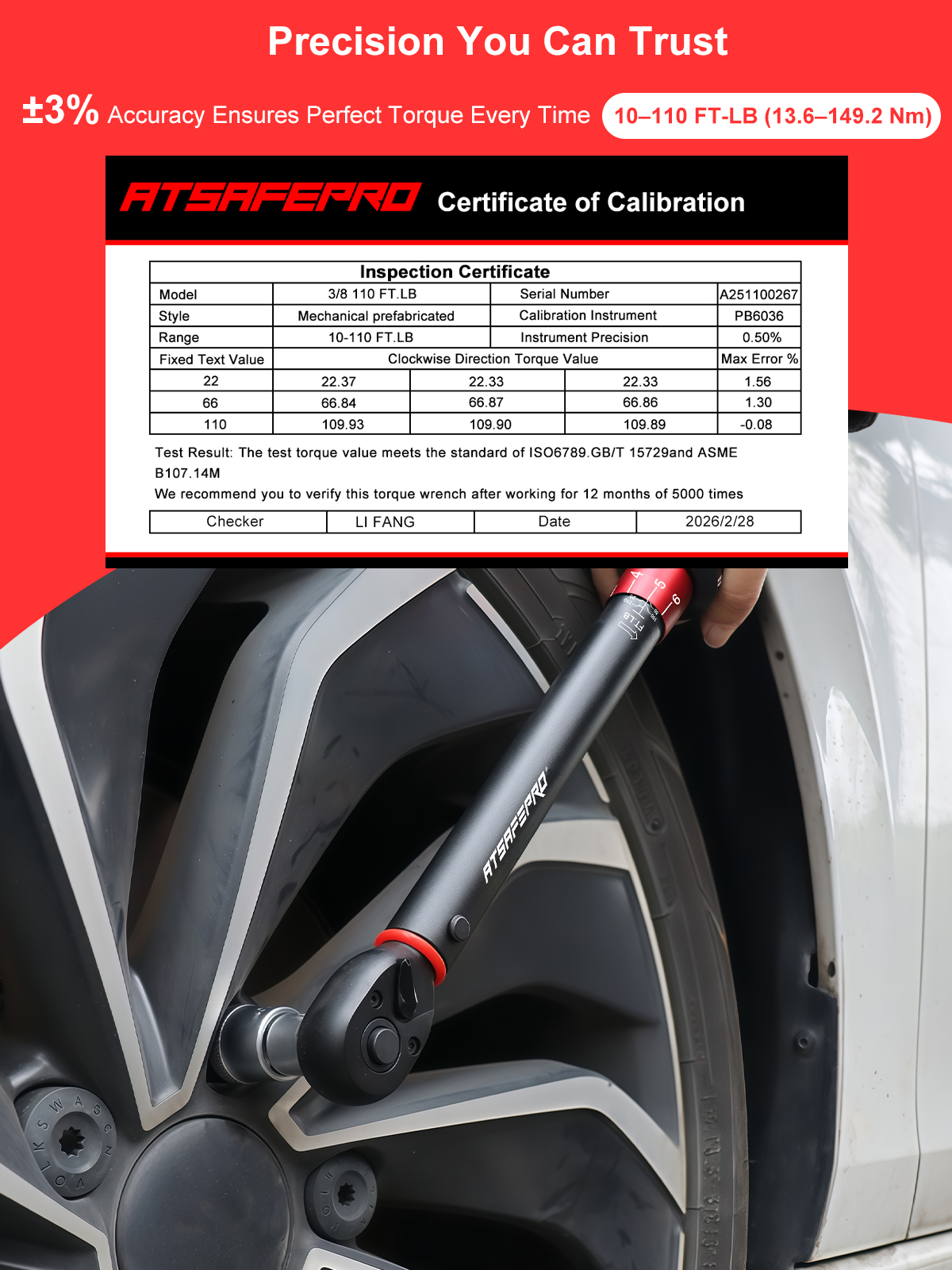
The most useful thing in the package is not the chrome finish or the red handle accents, though those do make the tool easier to identify on the bench. It is the combination of visible adjustment features and documentation. The certificate shown with the kit includes a 10–110 ft-lb torque range and references ISO6789, GB/T 15729, and ASME B107.14M. For buyers, that hints at calibration and inspection discipline, which is often the difference between a tool that looks right and one you can actually trust in production or service work.
The visible 3/8 reference on the certificate is also worth noting. In real purchasing terms, that points the buyer toward a common drive format for mid-range fastening tasks. It is a sensible size for automotive maintenance, machinery assembly, and many mechanical repair jobs where a technician needs better control than a breaker bar can offer, but does not need a large heavy-duty drive.
The included storage case is another quiet benefit. Torque tools get damaged in messy drawers and shared carts far more often than people admit. A molded case does not just organize the kit; it helps protect the setting mechanism, keeps the adapters together, and reduces the chance that someone leaves it adjusted at an unknown setting.
Where this type of wrench fits best
Automotive maintenance
Wheel-related work, engine bay fastening, brake jobs, and accessory installation all benefit from controlled tightening. A torque wrench like this is especially useful when technicians are repeating the same task across multiple vehicles. Repeatability is the real asset. If a shop has several people touching the same job, a torque tool reduces variation in the final assembly.
Bicycle and motorcycle assembly
These assemblies often use smaller fasteners and more delicate interfaces, so the cost of over-tightening can be immediate. A mechanical adjustable wrench with a defined scale is a practical choice for handlebars, stems, clamps, and other joints where consistency matters. The caution here is obvious but worth saying: smaller fasteners do not forgive sloppy habits.
Machinery assembly and repair
For light to medium mechanical assembly, the wrench gives teams a straightforward way to apply controlled torque without moving to a powered system. That can be useful during prototype builds, maintenance shutdowns, and fixture assembly where hand control is preferred. The added socket adapters suggest broader bench utility, though buyers should confirm exactly which drive sizes are included before assuming compatibility.
How to judge a torque wrench before buying
There are a few points that should always come before price or finish. First is the torque range. A 10–110 ft-lb range covers a useful middle ground, but only if it matches the work you actually do. If your application lives mostly below 10 ft-lb or above 110 ft-lb, this set is the wrong fit no matter how polished it looks.
Second is the adjustment system. On a mechanical wrench, the user needs a clear scale and a way to lock the setting or prevent accidental movement. That matters in a busy shop, where tools get passed around and set down quickly. A vague adjustment collar is a nuisance; in torque work, it becomes a reliability problem.
Third is documentation. The calibration certificate included with this kit is not decorative. For maintenance teams, incoming inspection groups, and quality-conscious buyers, it is evidence that the wrench was checked against a standard at shipment. That does not replace periodic verification in service, of course, but it does give the buyer a cleaner starting point.
What the finish and construction suggest
The visible construction looks like a metal-bodied wrench with a polished chrome-silver head, a black-coated shaft or handle section, and red grip accents. That combination usually signals a tool intended for workshop use rather than delicate bench display. The smooth surface should help with cleaning and corrosion resistance, though the exact coating and material grade are not stated, so it is best not to read too much into the appearance alone.
From a sourcing perspective, the long lever-style body is useful because it gives the operator leverage and makes the scale easier to read at a glance. A good torque wrench should not fight the hand. It should feel balanced enough that the user can apply force smoothly and stop at the set value without jerky movement. That is especially important if the wrench is being used repeatedly through a shift.
Common buyer mistakes
The first mistake is selecting a torque wrench by drive size alone. Drive matters, but it does not tell you whether the torque range suits the application. A nicely built wrench can still be a poor choice if the range is wrong.
The second mistake is ignoring the certificate and assuming all torque tools are the same once they leave the box. They are not. Calibration, inspection records, and serial identification are what make one tool easier to control than another. If a team shares tools, traceability becomes more valuable than many buyers expect.
The third mistake is using one wrench across every fastening task. In practice, a torque wrench works best when matched to the job class. High-precision, low-torque work should not be forced into the same tool used for heavier service work. That is where errors creep in.
Practical advice for engineering and purchasing teams
If you are buying for a workshop, start with the most common fastener range and the most common drive size in your environment. For many service operations, a mid-range adjustable wrench like this one is a sensible anchor tool. If the kit will be used by multiple technicians, the case and calibration papers are especially useful for control and handover.
If you are buying for a product team or a repair line, ask how the wrench will be verified after use. Calibration certificates help at receiving, but internal tracking is what keeps the tool credible over time. That point is easy to overlook until an audit or field failure forces the issue.
If you are evaluating the ATsafepro torque wrench as part of a larger tool set, confirm adapter compatibility and the exact included components. The image shows interchangeable adapters, but buyers should not assume every drive conversion is in the box unless that is specified in the order record.
FAQ buyers usually ask
Is this suitable for automotive work?
Yes, based on the visible 10–110 ft-lb range and the mechanical adjustable design, it appears well suited to many automotive maintenance tasks, especially controlled tightening tasks in the mid-range.
Does the calibration certificate matter?
Yes. For controlled fastening, a certificate is useful because it signals the tool has been inspected and checked against a stated standard. For many buyers, that is the difference between a commodity wrench and a manageable quality asset.
Can it replace every torque tool in a shop?
No, and that is where some procurement spec sheets go wrong. A mid-range wrench is useful, but it will not cover every low-torque precision job or every higher-torque industrial fastening task.
What this kit is really selling
The ATsafepro torque wrench kit is not just a hand tool in a case. It is a controlled fastening package aimed at users who need repeatability, a readable scale, and basic verification paperwork. That makes it attractive to automotive shops, maintenance teams, and buyers who care about inspection discipline as much as physical build quality.
If you are deciding whether it belongs in your toolkit or purchasing list, the question is not whether it looks robust. The question is whether your fastening work benefits from torque control often enough to justify keeping a verified tool close at hand. In most mechanical environments, that answer is yes.
For sourcing teams, the next step is straightforward: confirm the drive size, torque range, adapter set, and calibration documentation against your actual use case. If those line up, this kind of wrench can earn its place quickly, because it solves a problem that guesswork never solves for long.