Why a torque wrench is more than a “nice to have” in the workshop
The ATsafepro torque wrench sits in a category that many buyers only think about when something goes wrong: a wheel nut loosens, a fastener strips, or a critical joint is tightened by feel and ends up too loose or too tight. In automotive work and mechanical maintenance, that guesswork can cost time, parts, and sometimes safety. A torque wrench is not a luxury tool; it is a control tool. It helps the user tighten nuts and bolts to a specified torque value instead of relying on arm strength, habit, or luck.
That matters most where repeatability matters. Seasonal tire changes, suspension work, machinery assembly, motorcycle maintenance, fleet servicing, and general workshop repairs all benefit from controlled tightening. The point is not to make every fastener “perfect” in the abstract. The point is to make the joint consistent with the requirement of the job. That is the decision this article helps with: whether a torque wrench kit like this is a practical fit for your maintenance routine, and what to look for before you buy one.
What is visible in the ATsafepro torque wrench kit
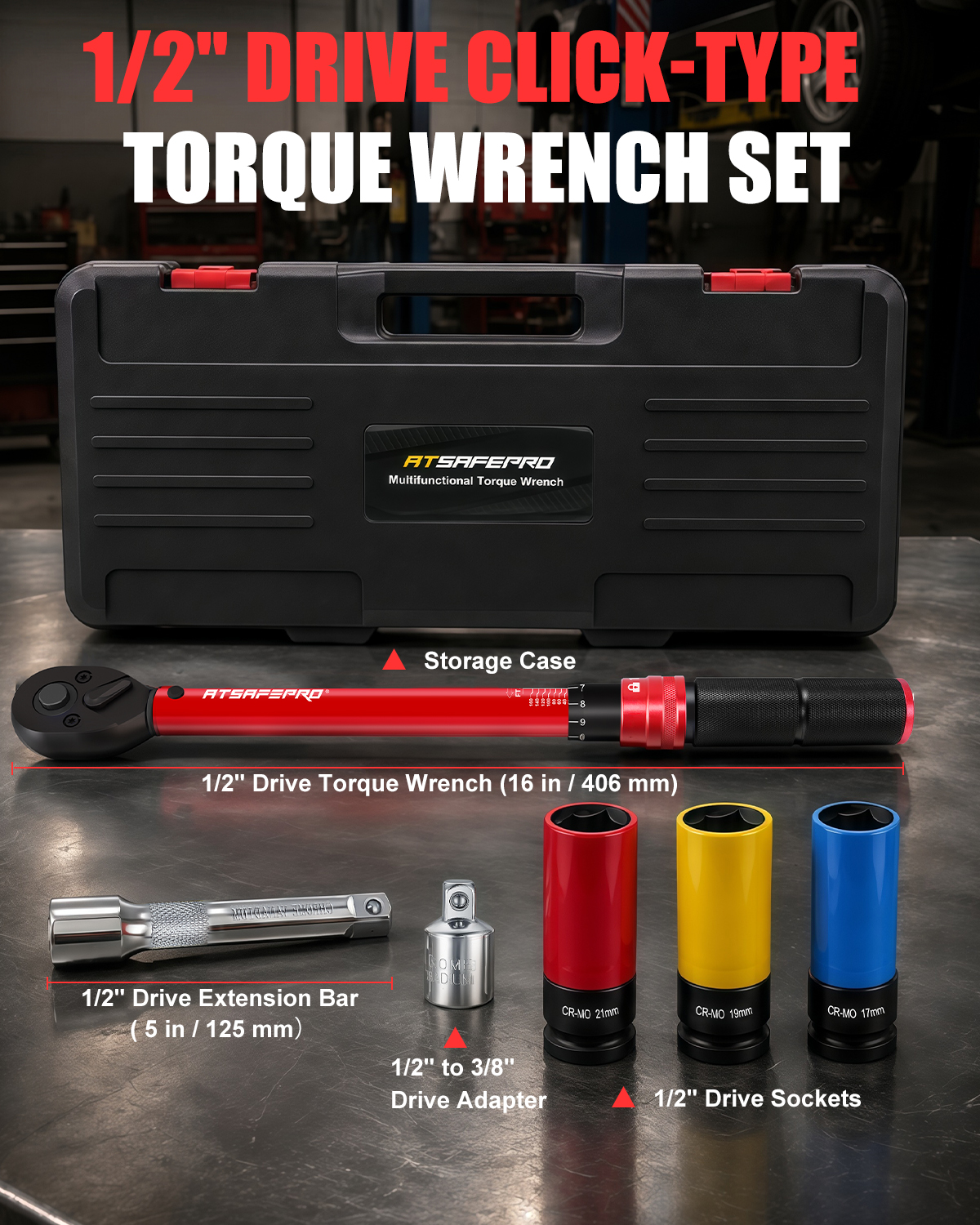
From the product information provided, this is an adjustable click-type torque wrench set for automotive and mechanical fastening. The visible layout is straightforward and familiar to anyone who has spent time in a service bay: a torque wrench with a black textured grip, a red body with printed torque scale markings, a black ratchet head, and a molded hard case with fitted slots. The kit also includes multiple sockets, shown in 17 mm, 19 mm, and 21 mm sizes, plus a silver adapter or extension.
That configuration suggests a kit designed for practical field use rather than bench display. The hard case is not a small detail. Tools that live in garages, vans, and shared workshop drawers get dropped, borrowed, and mixed with unrelated sockets. A fitted case helps keep the set together, which in turn helps keep the tool used correctly. A missing socket or a lost adapter often turns a decent kit into an incomplete one faster than buyers expect.
Quick buyer takeaway
If your work involves wheel nuts, suspension parts, or general maintenance fasteners that must be tightened with some discipline, this type of kit is aimed squarely at that need. If you need laboratory-level traceability, a calibration record, or a published accuracy spec, that is a different procurement discussion and would need verification from the seller.
Why the structure of a torque wrench matters
A torque wrench is only as useful as the confidence the operator has in it. The visible construction here points to a common and practical form factor: steel or alloy steel shaft, coated red body, textured grip, and a ratchet head with a selector or knob. That combination usually aims to balance durability, readability, and control. The printed scale on the shaft is especially important because a torque tool has to be readable under workshop conditions, not just in a catalog photo.
The black grip also matters more than buyers sometimes admit. In real use, hands are oily, gloves are worn, and work happens in awkward positions. A textured handle reduces slip and gives the operator a more predictable feel during tightening. That is not a glamorous feature, but it is one of the reasons some tools get used every week while others stay in the case.
The sockets shown appear to be chrome-plated and color-coded deep sockets. Based on the visible presentation, they are likely intended for automotive wheel work and related fastening, though exact alloy grade and impact rating cannot be confirmed from the image alone. That caution matters. Sockets that look sturdy are not automatically suitable for every drive tool or every load condition, so buyers should still verify whether the included sockets match their intended application.
Where this kit fits best
This kind of torque wrench kit is most useful in settings where controlled tightening is routine rather than occasional. A dealer service bay may use it on wheel installation and wheel-related maintenance. An independent repair shop may rely on it for repeated jobs that demand consistency across different technicians. Fleet maintenance teams need the same advantage, especially when several people share the same equipment and must work to the same fastening practice.
It also makes sense for motorcycle owners, bike technicians, and mechanical hobbyists who want a single kit for common service work. For home users, the value often lies in reducing uncertainty. It is one thing to “snug down” a bolt on a garden machine. It is another to tighten wheel hardware or suspension fasteners on a vehicle where the wrong approach can create real trouble. The torque wrench narrows that gap between casual tightening and controlled assembly.
How buyers should judge a set like this
The first question is not brand. It is fit for purpose. A torque wrench kit should be evaluated against the work it will actually do. For many buyers, that means checking the torque range, drive size, and whether the included sockets match the common fasteners in the shop. Those details are not fully confirmed here, so they should be verified before purchase rather than assumed from the photo.
Next, look at the readability of the scale and the ease of adjustment. A torque wrench that is hard to set becomes a nuisance quickly, especially when multiple technicians share the tool. The presence of a printed torque scale is a good start, but scale clarity, marking contrast, and adjustment smoothness all affect day-to-day usefulness. If a tool forces the user to squint under poor light or guess where the setting lands, the work slows down and mistakes become more likely.
Also consider the case. A molded hard case with fitted slots does not change torque performance, but it does change tool life and shop organization. It keeps accessories together and reduces the chance that the wrench gets knocked around in a drawer or thrown loose into a truck bed. For a product intended for automotive and mechanical fastening, that is a sensible detail rather than an extra.
Common mistakes when using a torque wrench
One of the most common errors is treating a torque wrench like a regular ratchet. It is not. The tool is meant for final tightening to a target value, not for breaking loose stubborn fasteners or using as a general pry tool. That misuse can damage the mechanism or at least reduce trust in the reading. Another mistake is ignoring the fastener sequence. On wheel installation, for example, tightening in a random pattern can create uneven seating even if the final torque number is correct.
There is also the human habit of overwriting the setting. Some users rush the job and keep pulling after the wrench indicates the target has been reached. That defeats the point of using a controlled tool. A click-type torque wrench is useful only when the operator respects the signal. It sounds obvious, but in busy workshops obvious rules are often the first ones to be skipped.
Storage is another practical issue. If the tool is left set at a high torque value for long periods, it may not behave as consistently over time. Best practice is to return the wrench to its lowest recommended setting after use, or at least to a relaxed setting that does not leave the internal spring under unnecessary load. Buyers who already know this are usually the ones who get better service life from their tools.
What the socket set adds to the value
The included 17 mm, 19 mm, and 21 mm sockets make the kit more immediately useful for wheel-related work. In plain terms, that means the buyer is less likely to need a separate trip for basic fitment on common automotive hardware. The silver adapter or extension adds flexibility as well, though its exact function should be checked against the intended use before relying on it in a tight-access job.
For procurement teams, the presence of accessories can be a double-edged thing. On one hand, a complete kit is easier to deploy. On the other, if the sockets or adapter are not suitable for the torque levels and drive conditions involved, they may become the weak point in the package. That is why buyers should not stop at “the kit includes sockets.” They should ask whether the sockets are appropriate for the fastening task, whether they are clearly marked, and whether the storage layout keeps the set organized in actual use.
Practical advice before placing an order
If you are sourcing a torque wrench for workshop or fleet use, ask for the torque range in writing, the drive size, the calibration or accuracy information if available, and the materials used in the sockets. The product description here does not verify those details, so they should be treated as open items, not assumptions. That is a small but important caution. Too many tool purchases are made from a photo and a short headline, and only later do buyers discover the range does not match the job.
Also think about how the tool will be trained into use. In a small shop, one technician may learn the feel quickly. In a larger operation, you need consistency across people. A tool with clear markings, a sensible case, and common socket sizes is easier to standardize. That can save more money than a slightly lower purchase price ever will.
FAQ about the ATsafepro torque wrench
Is this tool suitable for wheel installation?
Based on the visible socket sizes and the product category, yes, it appears aimed at automotive wheel and fastening work. Final suitability depends on the torque range and drive specification, which should be confirmed before purchase.
Does the kit include a hard case?
Yes. The provided product information shows a molded black plastic hard case with fitted interior slots and red latches.
Are the sockets impact-rated?
That is not confirmed from the image alone. Buyers should verify that point directly with the seller if impact use is expected.
Is this a click-type wrench?
The product description says adjustable click-type torque wrench set, though the exact mechanism should still be checked in the listing details.
Final buying judgment
The ATsafepro torque wrench, as presented, looks like a practical workshop kit rather than a specialty instrument. Its value is in straightforward utility: controlled tightening, common socket sizes, a readable scale, and a storage case that keeps the set together. For automotive maintenance, general mechanical fastening, and routine service work, that is exactly the kind of tool many buyers need.
If your work depends on repeatable fastening and you want a kit that is easy to store, easy to carry, and ready for common wheel and mechanical jobs, this type of torque wrench set deserves a close look. Just verify the critical specs before placing the order. In tool buying, the difference between a useful kit and a frustrating one is often a single missing detail.
For sourcing teams, the next step is simple: confirm the torque range, drive size, accessory compatibility, and any quality documentation available from the supplier. Those four items tell you far more than a polished product photo ever will.