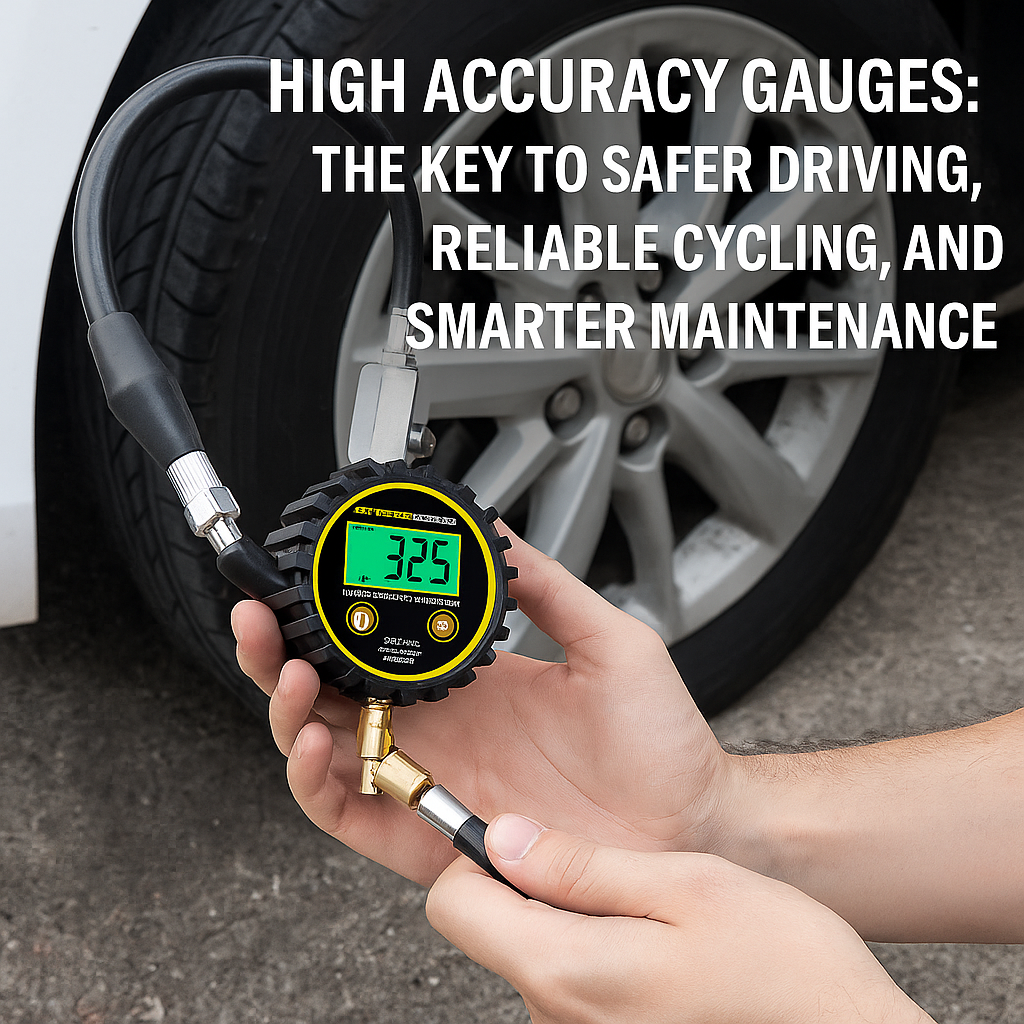
High Accuracy Gauges: The Key to Safer Driving, Reliable Cycling, and Smarter Maintenance
Why Accuracy Is More Than Just a Number
Most drivers and cyclists assume that any gauge will “do the job,” but the difference between a standard tool and a high accuracy gauge can be critical. Studies by tire safety associations show that even a 2–3 PSI error can increase braking distance by up to 10% in wet conditions. For cyclists, inaccurate readings can mean underinflated tires that drag on performance or overinflated ones that increase puncture risk. Precision, in this case, isn’t luxury — it’s safety.
Everyday Scenarios Where Accuracy Pays Off
-
Car Owners Preparing for Trips: Before a long highway drive, knowing your tires are at the exact recommended PSI can prevent blowouts, improve fuel efficiency, and reduce tire wear.
-
Cyclists Before a Ride: A properly inflated tire maximizes grip and minimizes rolling resistance. A high accuracy gauge ensures you’re not guessing.
-
DIY Users at Home: Whether it’s inflating a motorcycle, checking air compressors, or setting up garden tools, accurate readings mean longer equipment life and fewer costly errors.
High Accuracy Gauges vs. Standard Gauges
| Feature | Standard Gauge | High Accuracy Gauge |
|---|---|---|
| Error Margin | ±2 to 4 PSI | ±0.5 to 1 PSI |
| Readability | Basic scale, less clear | Clear dial or digital display |
| Durability | Varies widely | Built with calibrated mechanisms |
| Best Use | Rough checks | Safety-critical and performance applications |
This comparison shows why relying on cheaper tools often leads to miscalculations that can compromise safety.
Selecting the Right Accuracy Class for Your Operation
Not every user needs lab-grade precision, but choosing the right class of accuracy depends on your application:
-
Everyday Drivers: A ±1 PSI gauge is more than enough to cover daily checks.
-
Performance Cyclists: Look for gauges with ±0.5 PSI tolerance to optimize speed and safety.
-
DIY Mechanics: Gauges with calibration certificates provide the confidence needed when accuracy is non-negotiable.
ATSAFEPRO offers a range of gauges calibrated to suit these needs, from compact digital models to rugged mechanical types built for workshop conditions.
Real-World Situations Solved by Accurate Gauges
-
Avoiding Hydroplaning: Correct tire inflation, measured precisely, reduces water buildup under tires and prevents loss of control.
-
Protecting Carbon Bike Frames: Exact PSI prevents overstressing lightweight tires and rims designed for narrow tolerances.
-
Improving Fuel Economy: According to the U.S. Department of Energy, properly inflated tires can improve fuel efficiency by up to 3% — achievable only with accurate measurements.
The ATSAFEPRO Advantage
Unlike generic gauges, ATSAFEPRO high accuracy gauges are calibrated, tested, and designed for real-world users. Whether you’re a cyclist preparing for a long ride, a driver checking tires before a family trip, or a hobbyist working in the garage, ATSAFEPRO tools combine:
-
Precise measurement accuracy, even under tough conditions.
-
Durable design, built to last through repeated use.
-
Ease of use, with clear displays and ergonomic construction.
Bringing It All Together: Why Precision Tools Matter
A gauge may seem like a small purchase, but when it comes to driving safety, cycling performance, or reliable home maintenance, precision makes the difference between confidence and risk. A high accuracy gauge not only prevents accidents and equipment failures but also saves money by reducing unnecessary replacements and improving efficiency.
Ready to make precision part of your routine? Explore ATSAFEPRO’s high accuracy gauges today or connect with us through our Contact Us page. With ATSAFEPRO, you’re not just measuring — you’re protecting your journey, your ride, and your investment.