Why a tread depth gauge still matters in a shop full of scanners
A GODESON tire tread depth gauge is the kind of tool that looks simple until you need a reliable answer in under a minute. In fleet bays, tire shops, used-car inspections, and even on a driveway before a long trip, the question is the same: how much tread is actually left, and is it enough to keep the vehicle safe and roadworthy?
That sounds basic, but it drives real decisions. A tire that looks “fine” from a few feet away can still be close to its wear limit, especially if the center and shoulder wear differently. By the time the tread is visibly smooth, the conversation has usually shifted from maintenance to replacement. A mechanical tire tread depth gauge gives the buyer or technician a concrete number instead of a guess.
For sourcing managers and shop owners, the practical value is just as clear. It is a low-cost inspection tool, but it supports high-value decisions: whether to rotate, replace, document, or reject a tire. That is often where the savings are won or lost.
What this type of gauge is designed to do
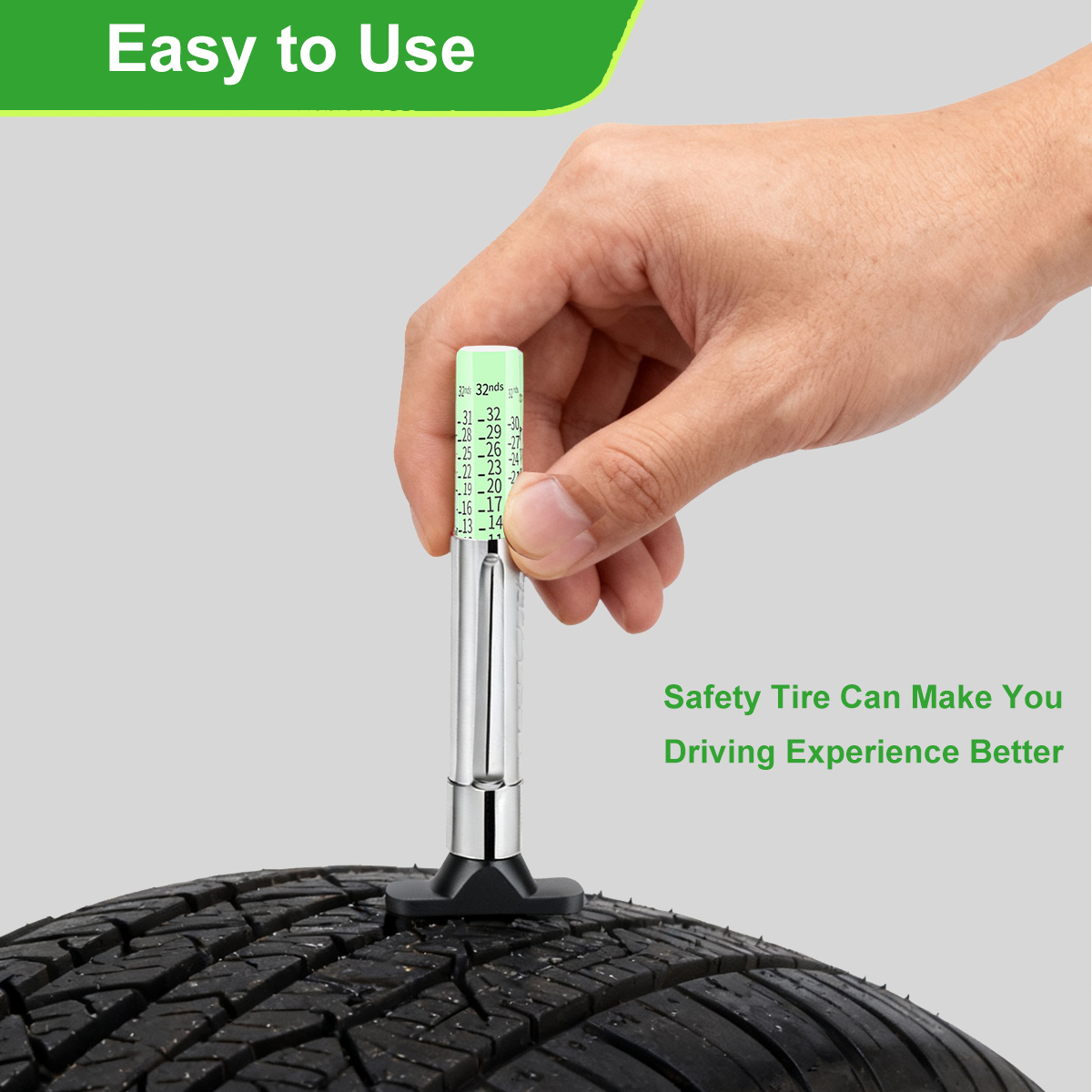
The visible product here is a plunger-style tire wear inspection tool with a polished metal body, a sliding probe, and a color-coded measurement scale. The scale appears numbered from 0 to 32, which suggests a tread-depth reading in thirty-seconds of an inch, a common format in North American tire service.
The colored zones are useful because they turn a measurement into a decision aid. Green, yellow, and red markings help the user interpret whether the tread is still in a comfortable operating range, approaching the point of concern, or already too worn for normal service. That does not replace local legal requirements or shop policy, but it speeds up the conversation.
The kit also appears to include a storage case and several small black cylindrical accessories. From the image alone, it is not safe to claim exactly what those caps do, but the presence of a case matters for a working shop. Small inspection tools disappear easily in a toolbox drawer. If the gauge lives in a case, it is more likely to be found when the vehicle comes in.
Where a mechanical tread gauge fits best
Not every measurement task needs a digital instrument. For many tire inspections, a mechanical gauge is the better shop-floor choice because it is quick, rugged, and easy to explain to a customer.
Automotive repair shops
Technicians need to check tread depth across multiple tires, often during the same service visit. A plunger-style gauge can be used rapidly at several points across the tire to detect uneven wear. That matters when alignment, inflation, or suspension issues are suspected.
Fleet maintenance
For fleet operators, tread depth is a maintenance-control issue, not just a safety item. Tires wear at different rates depending on load, route type, and driving style. A simple gauge gives a repeatable visual record during inspections. It is not glamorous, but it is effective.
Used-car appraisal and vehicle inspection
A buyer looking at a used vehicle often wants evidence, not reassurance. A tread depth reading can support negotiation, flag a near-term replacement cost, or expose a set of mismatched tires. In that setting, the gauge is part of the due-diligence kit.
DIY safety checks
For drivers who want to avoid guesswork, this tool is straightforward enough to use without special training. That said, it still helps to measure more than one point per tire. A single reading can miss cupping or shoulder wear, which are often the real warning signs.
How to read the tool without overthinking it
The reading process is simple, but a few habits make it more useful.
First, place the gauge squarely on the tread and let the probe contact the groove. The goal is to measure the usable depth of the tread, not the top of a raised wear bar or a decorative rib. If the gauge is not seated flat, the reading can be misleading by a small amount. That small amount matters when a tire is close to the limit.
Second, take readings in more than one location. Inner edge, center, and outer edge should all be checked. Uneven wear tells you something about the tire or the vehicle. A single “good” number in one area can hide a bad wear pattern elsewhere.
Third, use the color bands as a quick filter, not as a substitute for the number. Color is convenient, but the numerical scale is what makes the result defensible when you are speaking to a customer or documenting an inspection.
Why buyers still choose a mechanical format
Digital inspection tools are useful, but they are not always the right answer. A mechanical tire tread depth gauge has a few advantages that still matter in real shop conditions.
It is easier to keep ready. There are no batteries to check. It is also usually less fragile than a display-based tool, which matters when a gauge spends time on a workbench, in a pocket, or in a service cart. The polished metal body shown here suggests a tool made for repeated handling rather than delicate lab use.
There is also a communication advantage. Some customers trust a simple printed scale more readily than a digital display they cannot see calibrated. The reading can be shown directly, which makes the inspection feel transparent. That helps in sales conversations, especially when a replacement recommendation needs to be justified.
Still, mechanical tools are not magical. If the probe is damaged, dirty, or not seated correctly, the result is useless. A durable tool is only useful if it is checked and handled properly.
What to look for when sourcing this kind of gauge
If you are evaluating a product like the GODESON tire tread depth gauge for a shop, program, or retail shelf, the questions are practical.
Readability
The scale should be easy to read under shop lighting. The visible color coding is a plus here. Small numbers on a reflective body can become awkward if the print quality is poor.
Construction
The combination of a metal body and black plastic components is typical for this category. What matters is whether the sliding probe moves smoothly and returns consistently. A stiff probe slows down inspections. A loose one creates doubt.
Storage and organization
A case is not a luxury. It reduces the chance of loss and keeps small accessories together. For teams that issue tools to technicians, that can be the difference between controlled inventory and constant replacement.
Use case fit
If your team mainly checks commercial tires, you may want a tool that is easy to read quickly and robust enough for daily use. If the primary use is consumer-facing, the color zones and simple plunger action may be more valuable than extra features.
Common mistakes buyers and users make
The most common mistake is assuming tread depth is only about legality. It is not. Tires can become noisy, prone to hydroplaning, or unevenly worn well before they reach a hard limit. That is why proactive measurement matters.
Another mistake is checking only one tire, or one spot on one tire. On a set that has seen uneven inflation or an alignment issue, the bad tire is often the one you do not inspect carefully enough.
A smaller but frequent problem is treating the colored scale as if it were universal across all markets. It is a helpful guide, but not a substitute for regional regulations, manufacturer guidance, or company policy.
Practical buying advice for shops and sourcing teams
When buying a tire wear inspection tool, think about workflow first. If a technician can grab it, use it, show the result, and put it back without hesitation, the tool will actually be used. That sounds obvious, but many inspection tools fail because they are inconvenient, not because they are inaccurate.
For procurement, the better question is not whether the gauge looks premium. It is whether it supports fast, repeatable checks across a lot of tires. The visible storage case, the clear scale, and the straightforward mechanical layout all point in that direction.
If you are building a small kit for service advisors, fleet inspectors, or retail tire staff, this type of tool is a sensible inclusion. It is compact, easy to understand, and inexpensive compared with the cost of overlooking a worn tire.
FAQ: quick answers buyers usually want
Does this gauge replace a full tire inspection?
No. It measures tread depth, which is one part of tire condition. You still need to look for sidewall damage, irregular wear, punctures, and inflation issues.
Is a color-coded scale enough by itself?
It is useful for quick communication, but the numeric reading should carry the decision. Color helps the user move fast; the number keeps the result precise.
Can one gauge cover shop, fleet, and DIY use?
Yes, in many cases. That is one reason this format remains popular. The same tool can support a technician, a buyer, or a vehicle owner with minimal explanation.
What should a buyer inspect on arrival?
Check that the probe moves smoothly, the scale is legible, the body is clean, and the case keeps all parts together. If the tool feels sloppy in the hand, it will not inspire confidence in the reading.
A sensible next step
If you are sourcing a tire tread depth gauge for inspection work, start by matching the tool to the setting. For fast tire checks and straightforward customer communication, a mechanical plunger-style gauge with a clear numbered scale is a practical choice. The GODESON tire tread depth gauge, as shown, fits that use pattern well enough to deserve a close look.
Before you place it into a shop program or product lineup, verify the scale format, the feel of the probe, the contents of the kit, and whether the storage case suits your workflow. Those small details are usually what determine whether an inspection tool becomes part of daily practice or ends up forgotten in a drawer.