1. Why a digital tread gauge matters before the tire starts talking back
The GODESON Digital Tire tread depth gauge sits in that practical middle ground between a simple “looks okay” glance and a full workshop inspection. For anyone responsible for vehicle safety, tire cost control, or pre-purchase checks, tread depth is one of those small measurements that carries a lot of weight. A tire can still hold air and still be unsafe enough to disappoint the driver in wet weather, on long braking runs, or on a noisy highway commute.
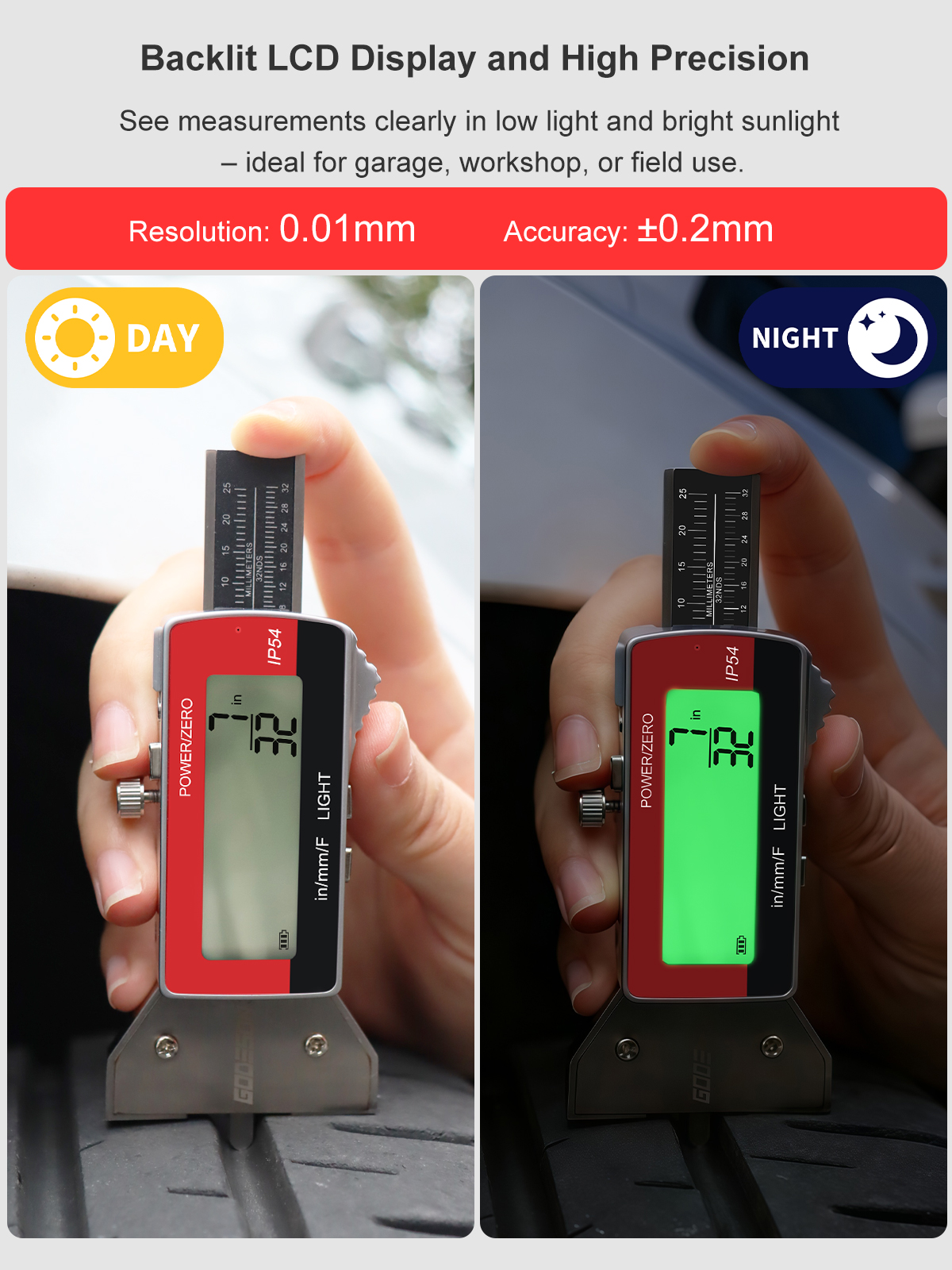
That is why a handheld digital tire tread depth gauge is useful: it turns an estimate into a number. The device shown here has the basic features buyers expect in this category—LCD readout, mm/inch switching, a zero function, and simple on/off controls. Those details sound modest, but in the field they reduce argument. A fleet tech, a used-car inspector, or a retail tire counter can point to the reading instead of debating whether a groove “looks low.”
Below is a buyer-focused listicle that explains what this type of tool does well, where it fits into the inspection process, and what to check before choosing one for workshop or personal use.
2. Quick takeaways for buyers
- It is designed for fast tread checks on passenger cars, SUVs, and similar vehicles.
- The LCD display makes readings easier to share and record than a purely mechanical gauge.
- Unit switching between millimeters and inches helps when teams use different reporting habits.
- A zero function is practical for rechecking the same tire or confirming a baseline.
- It is best seen as an inspection tool, not a repair tool; it helps decide when a tire is approaching replacement, rotation, or further scrutiny.
The real value is not in the gadget itself. It is in the decision it supports: can this tire stay in service, should it be monitored, or is it time to replace it?
3. What the GODESON Digital Tire tread depth gauge is built to do
Based on the visible structure, this is a compact handheld electronic gauge with a red molded housing, a black base or foot, and a small central LCD display. The top probe or stem slides down into the tread groove, while the wider base spans across the tread blocks for a stable measurement. That geometry matters because tread checks are only as good as the tool’s contact points. If the gauge rocks or tips, the reading becomes less trustworthy.
The control layout is straightforward. There are buttons for mm/inch, zero, on, and off. That makes it suitable for quick use in the service lane or garage, where no one wants to step through menus just to capture a reading. For a tool in this category, simplicity is not a compromise; it is part of the job.
One detail worth noting: the exact internal sensing mechanism is not visible, so it is better to describe it as a digital tread depth meter rather than speculate about how the electronics convert movement into a number. The outer design, however, clearly signals its purpose as a direct-reading inspection device.
4. Where this kind of gauge fits in the real world
Passenger vehicle maintenance
For private owners, a tread gauge helps remove guesswork from tire replacement planning. Instead of waiting for obvious wear or relying only on warning signs, the user can check each tire and compare wear across the axle. That is especially useful when a car has uneven wear from alignment issues, pressure problems, or a rotation schedule that slipped.
Workshop and tire service
In a shop setting, the tool is most useful as a fast front-end inspection instrument. Service advisors and technicians can measure tread depth before discussing rotation, balancing, alignment checks, or replacement. A digital readout is easy to document on a job card, and it gives a more professional impression than a rough visual estimate.
Fleet and used-car inspection
Fleet managers care about repeatability and consistency. Used-car buyers care about evidence. In both cases, a digital gauge helps standardize the conversation. It does not replace a full vehicle inspection, but it does provide one of the few wear indicators that can be checked in seconds and understood immediately.
5. The practical features that matter most
- LCD display: Easier to read than a small analog scale when working under time pressure or in dim light.
- mm/inch switching: Helpful for shops serving different markets or technicians who prefer one unit system over another.
- Zero function: Useful for resetting the reference point before a measurement sequence.
- Compact body: Easier to store in a toolbox, glove box, or service cart.
- Wide base: Helps the gauge sit more steadily across the tread surface.
Those are not flashy features, but they are the ones that determine whether the tool is used regularly or forgotten in a drawer after the first week.
6. How to use a digital tire tread depth gauge without fooling yourself
Using a tread gauge looks simple, and mostly it is. Still, a few habits improve reliability. Place the base firmly across the tread, then lower the probe into the deepest usable groove. Let the probe settle without forcing it. Read the display once the tool is stable. Repeat the measurement at several points across the tire rather than trusting one spot.
That last part matters more than many buyers expect. Tires do not always wear evenly. One shoulder can look acceptable while the center is low, or the inner edge can be the real problem. A single reading can miss the story. Three to five checks across each tire usually tell a much better story, even if the result is slightly uneven.
One practical caution: clean the groove first if it is packed with stones, mud, or hardened debris. A tread gauge can only measure what it can touch, and foreign material can distort the reading enough to mislead a casual inspector.
7. What a buyer should compare before choosing a similar gauge
- Readability: Is the LCD large enough to see without squinting?
- Controls: Are the buttons clear and easy to reach with gloved hands?
- Measurement stability: Does the base sit flat and span the tread securely?
- Unit handling: Is switching between mm and inch simple and obvious?
- Reset behavior: Does the zero function respond predictably?
- Body feel: Does it seem robust enough for daily shop handling?
Buyers often focus on the display and ignore the grip, but the housing matters. A small tool that slips from a greasy hand is not a bargain. The exterior finish, button spacing, and stem action all influence whether the gauge feels dependable after dozens of checks in a row.
8. Common mistakes when evaluating tread depth
The first mistake is assuming all tires wear the same way. They rarely do. Front and rear axles behave differently, and alignment issues can create a wear pattern that a quick glance will miss.
The second mistake is trusting the lowest reading from a worn patch without looking for a pattern. If one groove looks unusually low, check the surrounding area. That helps distinguish normal wear from localized damage.
The third mistake is forgetting that tread depth is only one part of tire health. Sidewall damage, age, cracking, and puncture history also matter. A good digital tire tread depth gauge helps narrow the decision, but it does not replace the rest of the inspection.
9. Design notes that hint at manufacturing quality
From the visible construction, the gauge appears to use an injection-molded plastic housing with a structured finish, which is a sensible choice for a hand tool used around vehicles and shop floors. The narrower probe mechanism at the top suggests a sliding measurement assembly designed to move smoothly while staying compact. The black foot adds contrast and likely serves both stability and wear resistance in daily handling.
There is no basis here to claim battery type, calibration method, or protection rating, so buyers should not assume those details without a product sheet. Still, the visible design suggests a tool intended for routine inspections rather than laboratory work. That is not a flaw; it is the right fit for the use case.
10. Who is most likely to get value from this tool?
- Drivers who check tire wear before road trips
- Independent mechanics who need a quick, portable measuring tool
- Tire shops that want a simple customer-facing inspection device
- Fleet teams comparing wear across multiple vehicles
- Used-car inspectors documenting tire condition during appraisal
If the job requires fast, repeatable tread checks and the ability to show a numeric result on the spot, this type of digital gauge is a reasonable fit. If the need is highly specialized testing or shop-grade data logging, a different instrument category may be more appropriate.
11. A short buyer’s checklist before ordering
- Confirm that the display is easy to read in your typical lighting conditions.
- Make sure the mm/inch toggle matches how your team reports tread depth.
- Check whether the gauge shape suits gloved use and repeated handling.
- Verify that the tool’s intended application matches your vehicle types.
- Ask for the full product specification sheet if you need accuracy, range, or environmental details.
That final point is worth stressing. When a product image and basic feature list are all you have, keep your expectations tied to what is visible. A good procurement habit is to separate what the tool clearly offers from what may need confirmation in writing.
12. FAQ
Is a digital tread depth gauge better than a manual one?
Not automatically. Digital models are easier to read and often easier to share with others, but a good manual gauge can still do the job. The advantage here is convenience and quick interpretation.
Can this be used on more than one vehicle type?
Yes, the intended use includes passenger cars, SUVs, and similar vehicles. For specialty tires or unusual tread designs, use care and measure more than one point.
Should I trust one reading?
No. Multiple readings across the tire give a better picture of actual wear. Uneven wear is common enough that a single spot can be misleading.
Does the tool replace a full vehicle inspection?
No. It addresses one part of tire condition: tread depth. It does not assess every safety or service issue.
13. Final buyer note and next step
If your purchase decision is driven by practical tire checks, the GODESON Digital Tire tread depth gauge offers the right basics: a compact body, a clear digital readout, mm/inch switching, and straightforward operation. That combination is usually enough for everyday vehicle maintenance, shop triage, and fleet walk-arounds.
The next step is simple: match the tool to the way your team actually inspects tires. If you need quick field readings with minimal training, this style of gauge makes sense. If you need documented specs for a formal purchasing standard, request the full technical sheet before committing. That small bit of caution saves a lot of back-and-forth later.