Why buyers still care about a digital caliper
A GODESON Digital Caliper is the sort of tool that sits quietly in a drawer until the moment a dimension actually matters. Then it becomes the first instrument someone reaches for. For machinists, inspectors, repair technicians, and even serious DIY users, a digital caliper is often the fastest way to confirm whether a part is within spec, whether a bore is deep enough, or whether two components will really fit together once they leave the bench.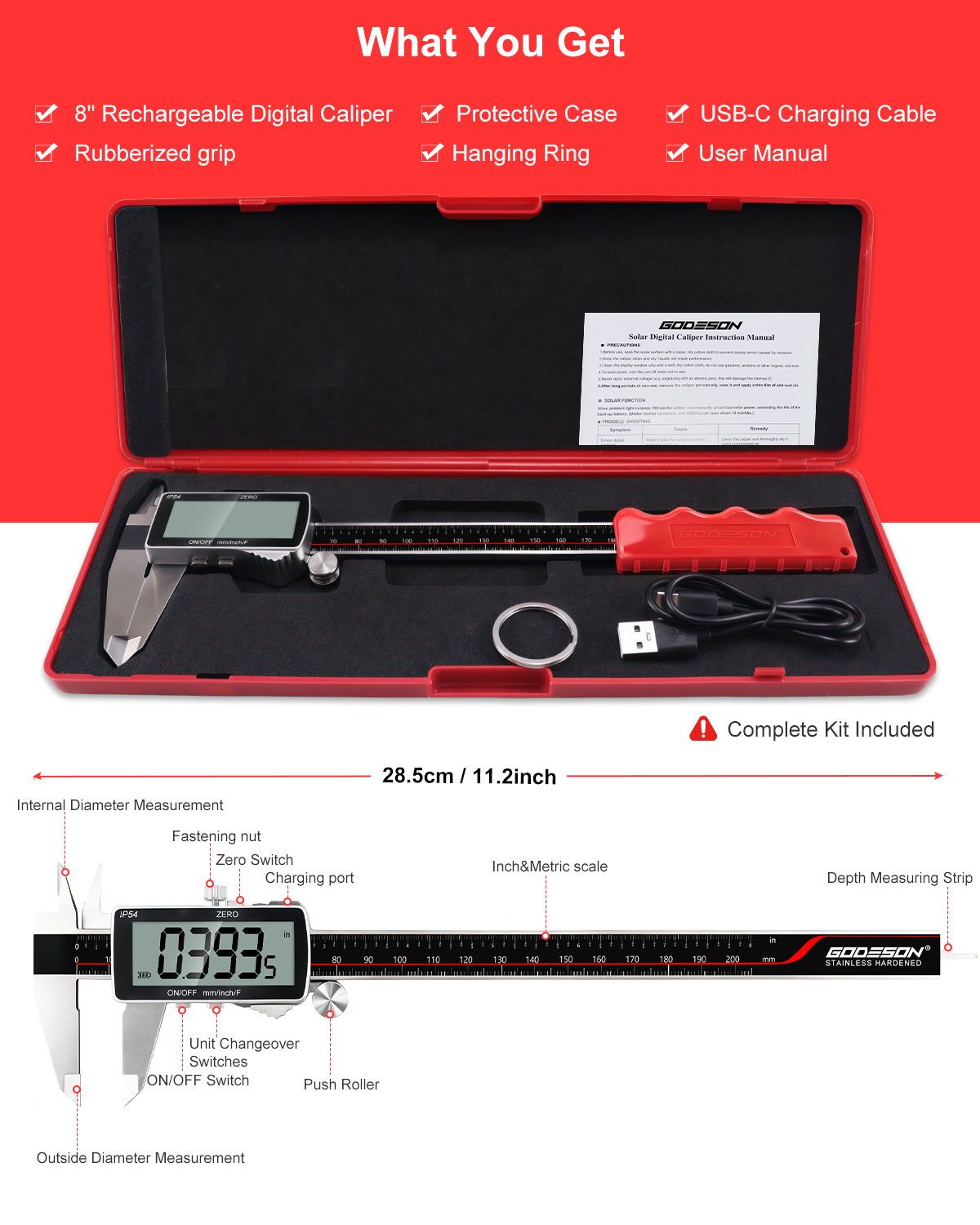
That is the practical value of this category: it does not replace every metrology tool, but it closes the gap between rough measuring and full inspection. A tape measure is too loose. A micrometer is too narrow in scope. The caliper covers the middle ground, which is why it remains a staple in metalworking, workshop fabrication, and dimensional checking on the factory floor.
In this case, the rechargeable format and large LCD display make the tool easier to live with day to day. The body shows a black display housing, red handle, metal jaws, a depth rod, and an IP54 marking. Those details matter more than they first appear. They tell the buyer something about handling, visibility, and the level of protection it is meant to offer in a dusty workshop.
What the tool is designed to measure
A digital caliper is built for four basic measuring jobs, and this one follows that familiar pattern.
It measures outside dimensions with the main jaws, inside dimensions with the upper jaws, steps with the shoulder of the body, and depth with the depth probe. In other words, one tool can handle shafts, holes, slots, lips, recesses, and small components without the user switching instruments every five minutes.
The box marking shows a 0–200 mm / 8 inch range, which is the standard size many buyers expect from a general-purpose shop caliper. That range is broad enough for most bench work, small parts, and routine inspection tasks. It is not meant for large fabrications, and it is not the right choice when a much higher metrology class is required, but for everyday dimensional work it covers a lot of ground.
The display indicates unit switching, with mm/inch/F labels visible. That is useful in mixed environments. A machinist may think in millimeters while a technician or DIY user thinks in inches, and the ability to move between units without mental conversion saves mistakes. Small mistakes in measurement are often what create the expensive ones later.
Quick buyer takeaways
For a sourcing manager or shop buyer, the most useful question is not whether a digital caliper looks modern. It is whether the tool will be practical after the first week of use.
This model appears aimed at buyers who want:
Reliable everyday measurement in a 200 mm class tool
A rechargeable design rather than disposable batteries
A large LCD screen that is easier to read at the bench
Basic resistance to dust and splash exposure, as suggested by the IP54 marking
A storage case that helps prevent jaw damage and accidental knocks
That combination points to a workshop-oriented tool rather than a delicate lab instrument. It is probably best used where speed and convenience matter, with routine checks rather than controlled calibration workflows unless the buyer has additional verification procedures in place.
Why the rechargeable design is worth attention
Rechargeable calipers are not automatically better, but they can be more convenient in environments where tools get used often. Disposable batteries are easy enough to replace, yet anyone who has managed a shared shop drawer knows how often batteries go missing, corrode, or arrive half-discharged. A USB charging cable is a small detail that can reduce friction.
There is still a buyer-facing caution here. Rechargeable electronics are only as useful as their charging habits. If the tool is left dead in storage, it will still fail at the wrong moment. Shops that rotate tools across stations should treat charging the same way they treat returning the caliper to its case: part of the routine, not an afterthought.
The visible on/off and zero functions are also part of the practical appeal. Zeroing at a reference point makes comparative measurement faster, especially for repeated checks on a batch of parts. That does not eliminate the need for good measurement discipline, of course. A caliper can be convenient and still be misused by a hurried operator.
Materials, structure, and what they imply
The visible structure suggests a mixed-material build: a metal beam and jaws for measurement stability, paired with a molded housing for the electronics and grip surfaces. That is standard for this type of tool. The beam and jaws need to resist wear and keep alignment, while the display housing needs to protect the screen and the circuit assembly from the knocks that happen in real use.
The black beam with metric markings, red handle, and metal jaws also suggest a tool designed to be handled frequently. The slider and lock wheel are important even if they seem ordinary. A lock wheel can help preserve a reading while the operator transfers the caliper or records dimensions. In busy shops, that little convenience can matter more than a flashy feature list.
The IP54 marking deserves a careful reading. It indicates a degree of dust and splash resistance, not immunity to abuse. That distinction is worth repeating because buyers sometimes assume IP ratings mean more than they do. A caliper with IP54 can be more forgiving in a workshop than an exposed electronic tool with no protection stated, but it should still be kept away from coolant spray, heavy contamination, and careless washdown practices.
Where this type of caliper fits best
The most natural use cases for a GODESON Digital Caliper are machining, metalworking, mechanical repair, and dimensional checking on smaller parts. It is also a sensible tool for hobby fabricators who machine brackets, housings, or custom fixtures and need faster feedback than a ruler can give.
It can be used to verify outside diameters on shafts, inside widths on slots, part thicknesses, recess depths, and general fit checks. That flexibility is why calipers tend to travel from the machine shop to the maintenance cart to the home workshop without much ceremony.
That said, buyers should keep perspective. A caliper is excellent for quick verification, but it is not the final word on every dimension. If a part is critical, or if the fit is sensitive, a more controlled gauge or inspection process may still be needed. The best shops use the caliper as a fast filter, then escalate when the measurement is too important to leave informal.
Selection criteria that matter more than marketing language
When evaluating a digital caliper, the first thing to look at is how it will be used. That sounds obvious, but many purchasing mistakes start with buying for the wrong environment.
If the tool will live in a clean bench area and be used occasionally, most basic features will be enough. If it will be shared across technicians, carried in tool bags, and used near chips or dust, the case, display visibility, and splash resistance become more important. If the workflow crosses metric and imperial systems, unit switching becomes more than a convenience.
The display size also matters more than people admit. A large LCD is not glamorous, but it reduces reading errors. That can be especially helpful in awkward lighting or when the operator is holding the part in one hand and the caliper in the other. A small, cramped screen may look neat on a product page and still be annoying in practice.
Finally, buyers should consider whether the tool needs routine checking against known standards. The product details provided here do not specify calibration certificates or exact accuracy values, so it would be unwise to assume anything beyond normal digital caliper expectations. For many general-purpose applications that is enough. For regulated inspection, it may not be.
Common mistakes buyers and users make
The first mistake is overestimating the meaning of an electronic display. A caliper can show a clean number and still be poorly handled. Jaw cleanliness, alignment, and stable contact matter just as much as the screen.
The second mistake is using the tool as if it were immune to contamination. Chips, oil film, and burrs can affect reading quality. Even a good caliper needs the workpiece cleaned before measurement. That is an unglamorous habit, but it saves arguments later.
A third mistake is choosing the tool only by price or by the loudest feature. Rechargeable power is useful, but it does not replace careful construction. Likewise, splash resistance is helpful, but it does not make the caliper a rough-service instrument.
Practical advice for sourcing and shop rollout
For a buyer, the best rollout is usually simple: define the job, verify the size range, confirm whether unit switching is required, and decide how the tool will be stored and charged. If the caliper is going to be issued to multiple users, include a basic handling note with it. That sounds almost too basic to mention, yet shared tools often fail because nobody clearly owns the routine.
The included red storage case is a good sign because it suggests the product is meant to be kept protected between uses. In a plant or workshop, that matters. A caliper tossed loosely into a drawer can lose alignment or pick up small impacts that are not visible until a reading starts drifting.
FAQ
Is this caliper suitable for everyday workshop use?
Yes, based on the visible features, it appears well suited to general workshop measurement, inspection, and repair tasks.
Can it measure depth?
Yes. The depth rod is visible, which supports depth measurement along with external, internal, and step measurements.
Does IP54 mean it is waterproof?
No. IP54 suggests dust and splash resistance, not full waterproof protection.
Why choose a rechargeable caliper?
Mainly for convenience. It reduces dependence on disposable batteries and can be easier to manage in a busy shop.
Is this a replacement for precision inspection gear?
Not by default. It is a versatile measuring tool, but critical applications may still require calibrated gauges or inspection equipment with documented performance.
What a sensible buyer should do next
If your team needs a practical digital caliper for routine measurement, the GODESON Digital Caliper presents a straightforward set of features: 0–200 mm / 8 inch capacity, rechargeable operation, large LCD readout, unit switching, IP54 marking, and a protective storage case. Those are not abstract selling points; they directly affect how the tool behaves in a real shop.
The right next step is to match the tool to the job. Confirm whether your work favors metric, inch, or mixed use. Think about whether the caliper will live on a clean bench or move through a harsher environment. And if the application is critical, make sure your measurement process includes whatever verification standard your quality system requires. The tool may be simple, but the decision around it usually is not.