Why a GODESON Digital Caliper still earns a place on the bench
A GODESON Digital Caliper sits in that useful middle ground between a basic hand tool and a proper shop instrument. It is not the kind of measuring device you buy for show. You buy it because parts need to fit, assemblies need to close, and a quick dimensional check is often faster than setting up something larger or more formal. In machining, maintenance, woodworking, metalworking, and general fabrication, that speed matters. So does readability. A clear digital display removes a lot of guesswork, especially when a shop floor is busy and the part in your hand is awkward.
The real buying question is not whether a caliper can measure. It is whether this one will make routine inspection easier without becoming fragile, fussy, or annoying to keep charged. That is the lens that matters here.
What this caliper is designed to do
From the product details provided, this is a rechargeable digital caliper in the 0–200 mm / 8 inch range. That puts it squarely in the size class most buyers recognize as the everyday bench caliper: large enough for common part checks, compact enough to keep near a machine or in a field kit.
Its visible feature set is the one buyers usually care about first:
- external dimension measurement
- internal dimension measurement
- depth measurement
- step measurement
- digital readout for faster interpretation
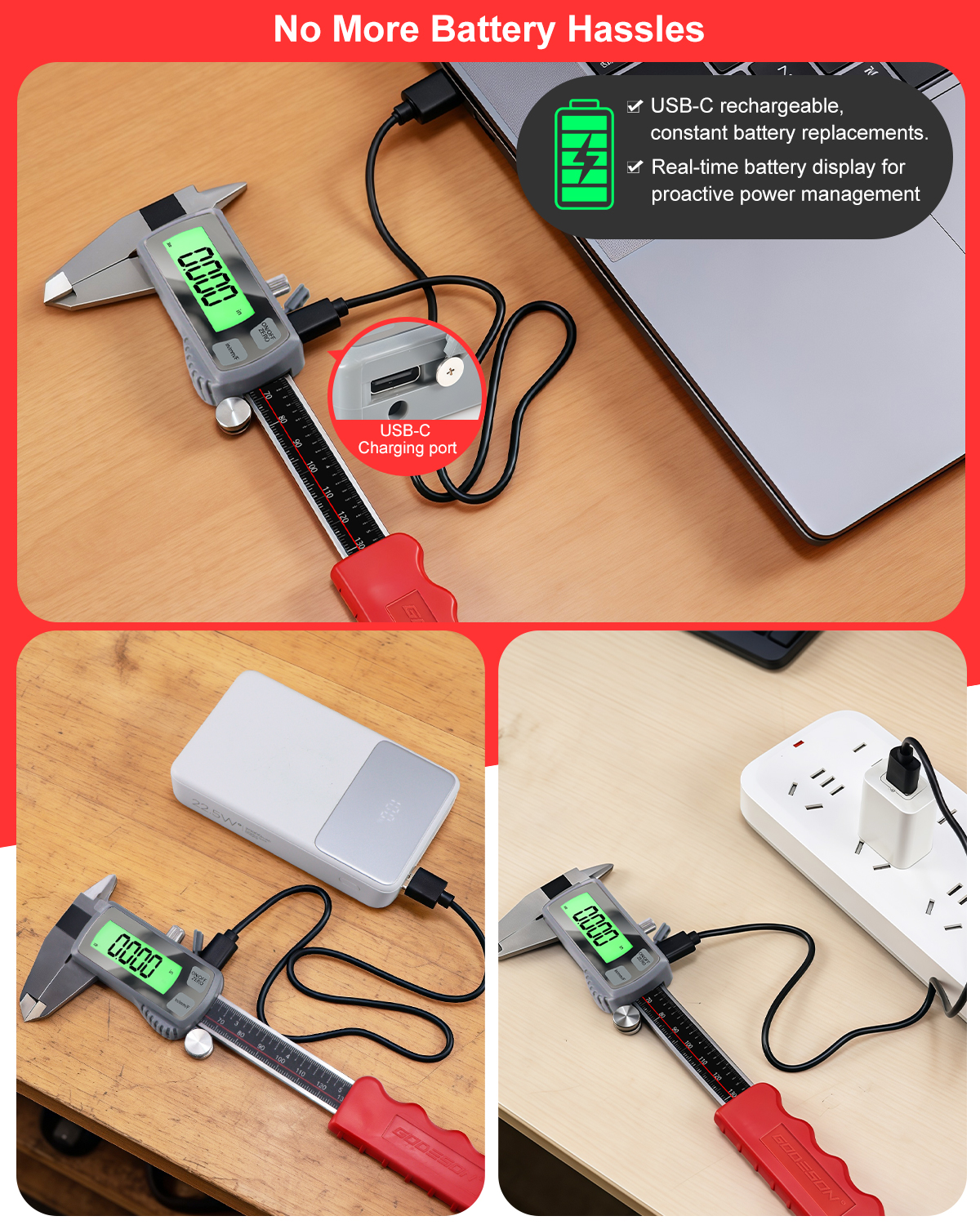
- USB charging instead of disposable batteries
The display bezel indicates dual-unit use, with mm and inch visible, and the packaging shows an IP54 rating. That is a practical combination for shop use. IP54 is not a license to treat the tool like a submerged handheld gauge, but it does suggest a degree of protection against dust and splashing that plain indoor instruments often do not emphasize.
Readability is the point, not decoration
A good digital caliper reduces friction in the measuring process. You place the jaws, read the number, and move on. That sounds simple, but anyone who has spent time around blueprints, fixture checks, or repair work knows how much time gets lost with poor contrast, cramped scales, or tiny controls.
This model’s black beam with white and red engraved markings is worth noticing. Even before the digital readout comes into play, a high-contrast mechanical scale helps when you want a quick visual reference. The silver jaws and round knurled thumb wheel also suggest a tool built for controlled sliding rather than a loose, toy-like feel. The red molded grip is not just cosmetic; on a bench full of similar-looking tools, a more visible handle is easier to identify and grab.
That said, the screen size and control layout matter as much as the body color. A large LCD is useful only if it remains legible under normal shop lighting and if the zero function responds predictably. Buyers sometimes fixate on display size and ignore the basics of feel and repeatability. That is backwards.
What the visible construction suggests
The exact material specification has not been confirmed, so it would be careless to state more than the evidence supports. Still, the visible construction points in a familiar direction: metal jaws and beam for rigidity, plastic housing for the electronics, and a molded grip for handling comfort. That is the usual architecture for a rechargeable digital measuring tool in this class.
For engineering and sourcing teams, the practical question is whether the construction supports everyday handling. A caliper is a measuring instrument, but it is also a hand tool. It gets set down on benches, slipped into cases, wiped down, and passed between operators. A matte or satin industrial finish usually hides minor wear better than polished surfaces, which is a modest advantage in a production environment. It also tends to feel less slippery when hands are oily or dusty.
The USB charging cable is another useful signal. Rechargeable tools eliminate one common maintenance item: the hunt for spare cells. On the other hand, rechargeable devices bring their own discipline. Someone has to remember to charge them. In a shared workshop, that small administrative detail can become the difference between smooth inspection and an annoyed operator staring at a dead screen.
Where a digital caliper fits best
This type of instrument is most persuasive when measurement tasks are repetitive and moderately precise, but not so critical that a specialized metrology setup is required every time. That includes many day-to-day jobs:
- checking shaft diameters and outside dimensions
- verifying hole sizes and internal widths
- measuring part thickness before machining or assembly
- checking step heights and shoulder features
- spot-checking incoming parts in inspection or kitting
In woodworking, it can help with hardware recesses, stock thickness, and turned parts. In metalworking and fabrication, it is often used for quick verification before a secondary process. In maintenance, it helps identify whether a worn component is still within an acceptable range or already outside practical use.
The key is to use it where a fast dimensional answer matters more than a ceremonial one. If a part needs true metrology-level traceability, this is not the only instrument on the table. But for a large share of real shop decisions, a reliable digital caliper is the right first tool.
Selection criteria buyers should actually care about
A lot of caliper buying advice is generic. It talks about precision in the abstract, then leaves the reader with no decision path. A better way to judge a tool like this is to ask a few blunt questions.
1. Is the size range enough for your parts?
The 0–200 mm / 8 inch range will suit many general-purpose applications. If your work regularly exceeds that span, you need to look elsewhere. It is better to buy the right measuring envelope once than to force a smaller tool into oversized work.
2. Is the display easy to read in the real environment?
Bench lighting, greasy fingers, and quick checks during production change the reading experience. A large LCD is helpful, but only if it stays visible without angling the tool every time.
3. Is charging convenient enough for shared use?
USB charging is a genuine convenience, especially where disposable batteries are a nuisance. But buyers should think about charging habits, not just charging technology. A rechargeable caliper only helps if it is actually kept ready.
4. Does the body feel stable in hand?
A caliper that flexes or feels vague in the slide will frustrate users, regardless of the display quality. The thumb wheel, jaw alignment, and general sliding action matter more than most spec sheets admit.
Common mistakes when choosing a caliper like this
One common mistake is assuming all digital calipers behave the same. They do not. The first thing buyers notice in real use is often not resolution, but ergonomics: how the beam slides, whether the zero setting is easy to reach, and whether the jaws close cleanly.
Another mistake is overreading the IP54 marking. It is useful, but it should not be treated as a blanket promise. A workbench measuring tool still deserves sensible care, dry storage when possible, and a wipe-down after dusty or coolant-heavy use.
A third mistake is buying for one inspection case and forgetting the larger workflow. If the tool will be shared across shifts, charging access, storage case quality, and legibility become much more important than many buyers expect at the quotation stage.
Practical buyer advice for sourcing and production teams
If you are evaluating a GODESON Digital Caliper for company use, the decision should be tied to how it will be deployed. For maintenance teams, portability and ease of use may matter most. For inspection stations, stable handling and screen clarity may carry more weight. For woodworking or fabrication shops, durability and fast zeroing may be the deciding factors.
It is also worth asking how the tool will be controlled internally. Will it be a shared asset or assigned to one operator? Will it live in a drawer, a tool crib, or a field kit? Will the charging cable be stored with the instrument or separately? These questions sound mundane, but they determine whether a good-looking digital caliper becomes a dependable one.
For buyers comparing options, the sensible shortlist is short: measurement range, readability, charging method, protective rating, and physical feel. Anything beyond that should be treated cautiously unless the supplier provides verified documentation.
FAQ
Is this caliper suitable for everyday shop use?
Yes, based on the visible features and intended form factor, it is aimed at routine dimensional checking in shop and maintenance environments.
Can it measure inside, outside, depth, and steps?
That is the standard function set indicated by the product description and the caliper format itself.
Is the tool waterproof?
No such claim should be assumed. The visible IP54 rating suggests limited protection against dust and splashing, not full waterproofing.
Does USB charging make it better than battery-powered models?
Not automatically, but it can be more convenient in a shared workspace if charging habits are managed properly.
What should buyers verify before placing an order?
They should confirm the required range, the units needed on the shop floor, the charging workflow, and any documentation they need for internal quality control.
Final buying takeaway
The appeal of a GODESON Digital Caliper is straightforward: it packages a familiar precision measuring format into a rechargeable, easy-to-read tool with a practical protective rating and a common 0–200 mm / 8 inch range. That makes it attractive for teams that want fast dimensional checks without the hassle of disposable batteries or hard-to-read analog scales.
If your work depends on quick, repeatable measurements and you value clean day-to-day usability over flashy claims, this is the sort of instrument worth putting on the short list. Before you buy, though, match the tool to the job, confirm the handling feel if possible, and make sure the charging and storage routine is realistic for the people who will actually use it.