


Dual Head Tire Pressure Gauges for Professionals: Reliable Readings, Faster Service
The Pressure Problem in Heavy-Duty Maintenance
In fleet garages and commercial service stations, mechanics face a recurring issue: limited valve access on dual tires and heavy vehicles. Single-head pressure tools often can’t reach inner valves, leading to uneven inflation or skipped checks altogether.
According to the National Highway Traffic Safety Administration (NHTSA), underinflated tires cause 33% of highway tire failures. This makes accurate and accessible pressure measurement critical — especially for logistics fleets and bus depots that handle multiple tire configurations daily.
Why Dual Head Design Solves a Real Industry Gap
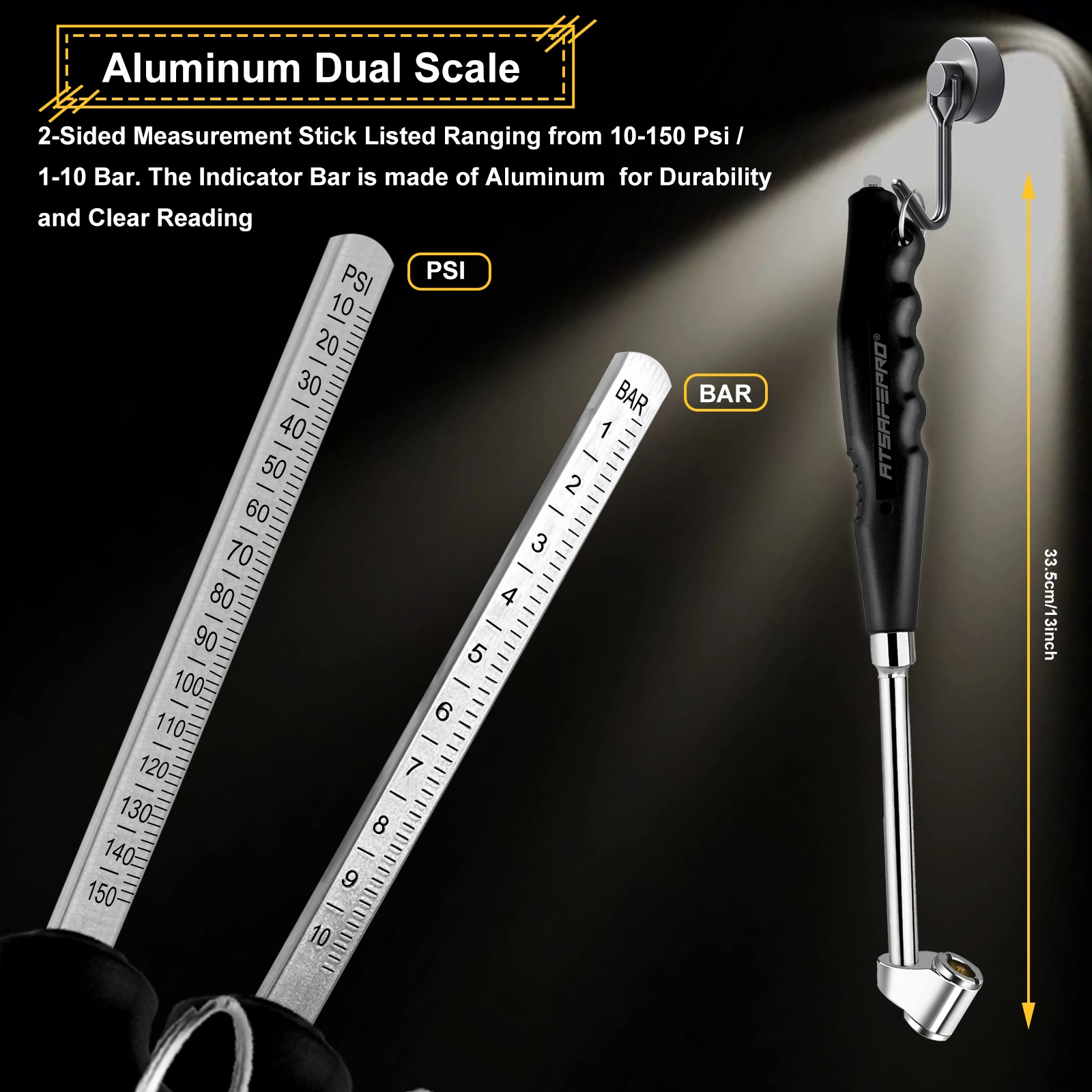
ATSAFEPRO’s dual head tire pressure gauges address this exact challenge. With a straight head and reverse-angle chuck, technicians can access both inner and outer valves without repositioning the tool.
Built from CNC-machined brass or stainless steel, the dual head configuration ensures a tight seal under high pressure (up to 160 PSI) and maintains calibration integrity over thousands of uses.
Key engineering highlights include:
-
Reinforced double chuck connection for inner and outer valve stems
-
Integrated bleeder valve for precise deflation control
-
High-contrast dial face for visibility under low light
-
Shock-absorbing rubber guard for durability in workshop conditions
| Specification | Single Head Gauge | Dual Head Gauge (ATSAFEPRO) |
|---|---|---|
| Valve Access | Limited | Inner + Outer |
| Operating Pressure | ≤120 PSI | ≤160 PSI |
| Durability | Medium | Heavy-duty |
| Accuracy | ±3% | ±1.5% |
| Service Application | Light vehicles | Trucks, buses, fleets |
Source: ATSAFEPRO in-house calibration test, 2025.
Built for Longevity and Consistent Accuracy
Each ATSAFEPRO dual head gauge is assembled under ISO 9001-certified production control. Precision-tested under variable temperatures and vibration, the tool maintains ±1.5% accuracy even in harsh environments.
Its brass core resists corrosion from compressed air moisture, while the internal piston design reduces drift over long-term use — a key factor for fleet workshops where tools operate continuously.
Real-World Applications Across Sectors
Dual head tire pressure gauges are used extensively in:
-
Fleet Service Workshops: Fast access to dual rear tires for consistent inflation control.
-
Truck & Bus Depots: Reduced service time with dual-side operation.
-
Agricultural Equipment Maintenance: Reliable for tractors and large off-road tires.
-
Commercial Vehicle OEMs: Integrated into post-assembly pressure inspection routines.
A bus maintenance center in Malaysia reported a 20% reduction in tire inspection time and fewer post-service pressure deviations after adopting ATSAFEPRO’s dual head models.
Choosing the Right Gauge Based on Usage and Environment
Different users require different tool specifications. Here’s how to identify the most suitable model based on working conditions and application intensity:
| User Type / Environment | Recommended Model | Key Features | Why It Fits |
|---|---|---|---|
| Fleet Mechanics & Truck Operators | Heavy-Duty Brass Dual Head Gauge | 0–160 PSI range, reinforced chucks | Handles high air volume and dual tire layouts |
| Automotive Service Centers | Digital Dual Head Gauge | Backlit display, quick response sensor | Ideal for fast-paced, precision-based inspections |
| Agricultural & Off-Road Equipment Maintenance | Stainless Steel Mechanical Dual Head Gauge | Corrosion-resistant body, wide pressure tolerance | Suitable for dusty, humid, or outdoor conditions |
| Individual Car Enthusiasts or Mobile Repair Vans | Compact Dual Head Gauge | Lightweight body, manual bleed valve | Portable and easy for roadside checks |
Tip: For workshops dealing with mixed fleets, pairing a dual head gauge with a digital inflator ensures consistent readings across all tire types.
Expert FAQs from Professional Users
Q1: Why is a dual head design important for trucks or buses?
Because it allows access to both inner and outer tire valves, reducing repositioning time and improving pressure uniformity.
Q2: Can dual head gauges be used on passenger vehicles?
Yes — they’re compatible with standard Schrader valves and work for all tire types.
Q3: How can I ensure calibration accuracy over time?
Keep the gauge clean and store it in a dry environment; schedule recalibration every 12 months.
Q4: Are ATSAFEPRO models compatible with compressed air systems?
Yes. Each model includes a standard NPT fitting and reinforced hose for pneumatic use.
Built for Professionals Who Value Precision
From logistics depots to mobile tire service vans, ATSAFEPRO dual head tire pressure gauges deliver the precision and accessibility professionals need to maintain fleet performance and road safety.
Their heavy-duty construction and dual-angle design redefine efficiency — one accurate reading at a time.
Explore more workshop-grade tire maintenance tools on our ATSAFEPRO Homepage or contact our team directly via Contact Us for bulk orders and OEM customization.





