1. What buyers usually want from an ATsafepro torque wrench
If you are looking at an ATsafepro torque wrench, you are probably not shopping for a generic hand tool. You are trying to control clamping force. That distinction matters more than many buyers admit at first. A fastener can feel tight long before it is actually tight enough, and it can also be easy to overdo it with a long handle in your hand and a job that “just needs to be finished.”
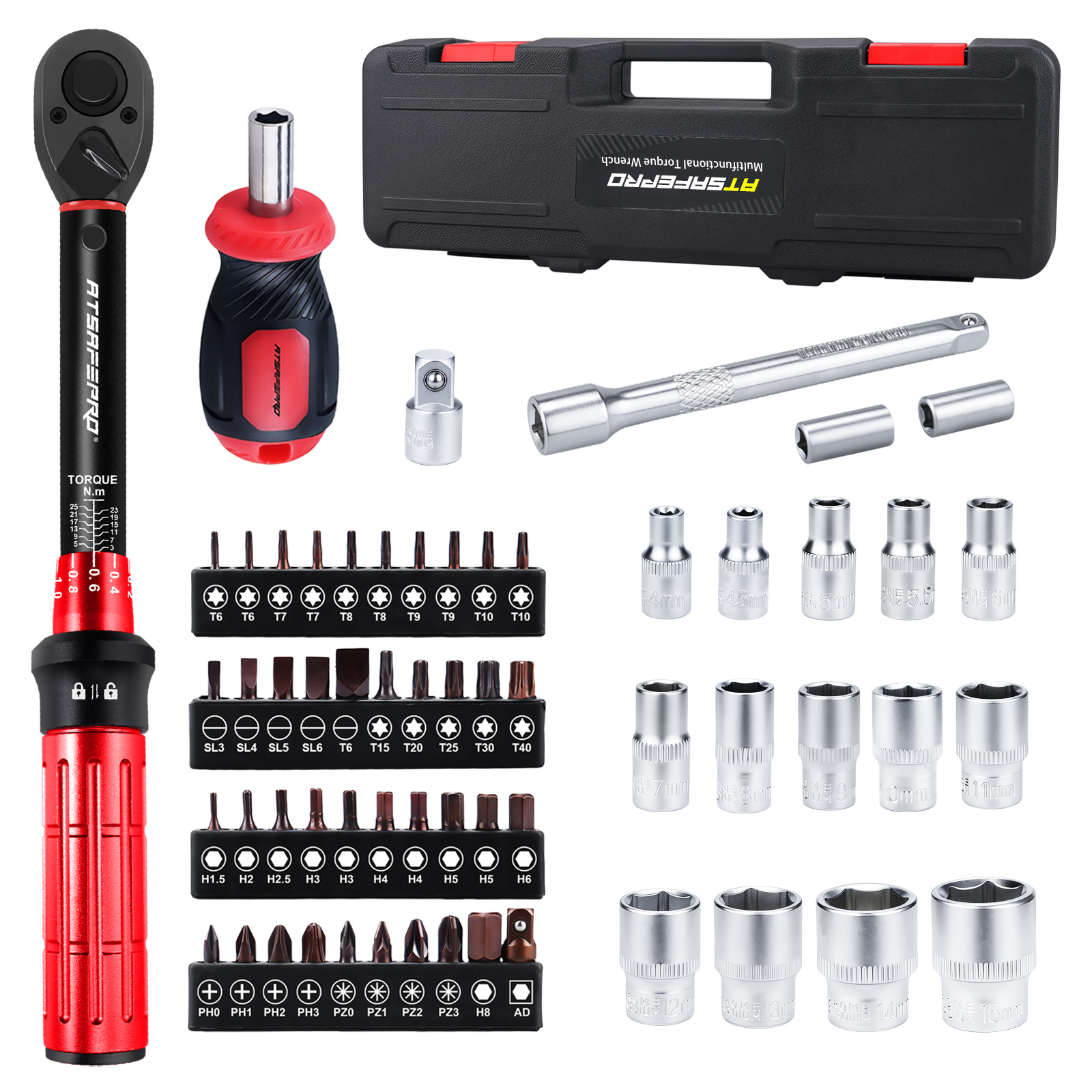
For automotive work, machinery assembly, bicycle maintenance, and general repair, the real question is not whether the wrench looks sturdy. It is whether the tool helps you tighten to a specified torque without guessing. This is where a mechanical torque wrench set earns its place in the toolbox. It gives the operator a settable range, a readable scale, and a controlled tightening action that is more repeatable than a standard ratchet or spanner.
2. Quick takeaways before you buy
- The visible torque range is 10–110 ft-lb, which covers many medium-duty fastening jobs.
- The drive size appears to be 3/8 in, a practical middle ground for workshop and maintenance use.
- The kit shown includes a hard case, extension/adapter pieces, and a calibration certificate.
- The printed certificate references ISO6789 and ASME B107.14M, but buyers should still check the exact paperwork included with the tool.
- This type of wrench is most useful when the fastening specification matters more than speed.
3. Why torque control matters in the real world
People tend to think of torque as a technical detail for engineers. In practice, it is a shop-floor issue. Under-torqued fasteners can loosen, leak, shift, or create noise. Over-torqued fasteners can stretch, distort mating parts, strip threads, or make later service a headache. On an engine cover, wheel assembly, or machine bracket, either mistake can become expensive.
That is why a tool like the ATsafepro torque wrench is more than a convenience item. It helps reduce variability between technicians, shifts, and repair jobs. It also makes quality control easier when a task needs to be checked, signed off, or repeated later. In a busy workshop, that consistency can matter as much as raw speed.
4. What the visible construction tells you
Long handle and marked scale
The wrench shown has a long handle with a clearly marked torque scale and a red adjustment section. That layout suggests a mechanical adjustable design that lets the user set a target torque value by rotating the handle collar or adjustment area. For buyers, the practical benefit is straightforward: the setting is visible and manual, so the tool does not depend on batteries or electronics.
Square drive head and accessories
The working end appears to be a 3/8 in square drive, which is a common size for medium-duty sockets. The included extension/adapter bar and chrome-finished socket adapters widen the tool’s usefulness. That is useful in the field, although buyers should still check exactly which pieces are in the shipped package rather than assuming every photo is a complete inventory.
Storage case and certificate
The hard plastic case is not a decorative extra. It matters because torque tools are easier to damage if they are tossed into a mixed toolbox. A storage case also makes it more likely the wrench will be kept near its intended setting and protected from knocks. The calibration certificate is another practical detail. It does not replace user care, but it does show that the tool has been individually verified rather than treated like a generic commodity wrench.
5. Where this kind of wrench fits best
- Automotive wheel and chassis fasteners
- Engine covers, brackets, and service assemblies
- Bicycle component installation and maintenance
- Workshop repair work where fastening specs are published
- General machinery assembly and light industrial maintenance
The 10–110 ft-lb range is broad enough for many everyday tasks, but it is not a universal solution. Very low-torque precision work and heavy-duty fastening usually need a different tool size or type. That is a normal limitation, not a flaw.
6. How to judge whether the torque range fits your work
One of the most common buying mistakes is choosing a torque wrench by price or length alone. The range should match the jobs on your bench. A wrench that operates near the middle of its range usually gives more comfortable handling and better repeatability than one constantly used at the extreme low or high end.
For this reason, the visible 10–110 ft-lb range is most attractive to users who do a lot of general maintenance, repair, and assembly. It is less attractive if your work sits consistently below 10 ft-lb or routinely above 110 ft-lb. If you are unsure, make a list of the actual fastener specifications used on your equipment. That sounds basic, but it is the fastest way to avoid buying the wrong tool.
7. Listicle: five practical buying points engineers and technicians should check
- Drive size. A 3/8 in drive is versatile, but only if it matches the sockets and fasteners you already use.
- Torque range. Make sure your most common specifications fall comfortably inside the working band.
- Adjustment method. The wrench should be easy to set, but not so loose that settings drift during use.
- Storage and protection. A case helps preserve the calibration-minded handling that torque tools need.
- Documentation. Calibration paperwork is useful, especially in repair environments that track tools or quality checks.
8. Common mistakes buyers still make
One mistake is treating a torque wrench like a normal ratchet. It is not. Using it for loosening, abusive leverage, or general prying can shorten its useful life and disturb the calibration. Another mistake is leaving the wrench set at a high value after the job is done. Good shop practice is to return adjustable torque wrenches to their lowest setting before storage, unless the manufacturer specifies another procedure.
A third mistake is assuming that the presence of a calibration certificate means the tool never needs checking again. In real service, repeated use, drops, and rough handling can all affect performance. A certificate is a starting point, not a forever guarantee. That is a subtle point, but one worth keeping in mind if the wrench is going into regular production or fleet maintenance work.
9. Mechanical click-type torque wrench sets: why buyers still choose them
Mechanical torque wrench sets remain popular for a reason. They are understandable. Operators can see the scale, feel the set action, and use them without power. That makes them useful in workshops where tools move from one bench to another and not everyone wants a battery-dependent device.
Compared with beam-style tools, a set like this is generally easier to use in routine work because it is quicker to read and handle. Compared with electronic tools, it is usually simpler to store and less dependent on firmware or display functions. Of course, the tradeoff is that the operator must pay attention to the setting and to proper use. No torque wrench is forgiving of sloppy technique.
10. A careful note on calibration and standards
The printed certificate shown with the wrench references ISO6789 and ASME B107.14M. That is useful information, but buyers should still read the certificate carefully and not assume more than what is actually printed. The key point is that the tool is presented as calibrated and verified, which is especially relevant for users who need traceability or who simply want more confidence before the first job.
If your procurement process requires specific documentation, ask for the certificate format, serial identification, and any verification details that match your internal receiving procedure. That is the practical side of buying precision hand tools: the product and the paperwork both matter.
11. Who should shortlist this tool, and who should keep looking
This wrench makes sense for technicians who need a medium-range tool for daily fastening work and appreciate a compact kit with a case and adapters. It also makes sense for buyers who value visible scale markings and mechanical simplicity.
It is less suitable for buyers who need only ultra-low torque work, very high torque jobs, or digital readouts with data logging. Those users should look at a different torque category. No single wrench covers every maintenance scenario, and it is better to admit that up front than to force one tool into every job.
12. Practical next step for sourcing teams
If you are evaluating an ATsafepro torque wrench for shop use or resale, start by matching the visible 3/8 in drive, the 10–110 ft-lb range, and the included accessories against your actual use cases. Then check the calibration certificate, the packaging list, and the handling instructions before placing the item into controlled service. That small bit of diligence saves more time than most buyers expect.
For teams comparing torque wrench kits, the decision usually comes down to fit: range, drive size, documentation, and how the tool will be stored and used day to day. Get those four things right, and the rest is mostly preference.