Precision or Downtime: The Challenge Every Workshop Faces
In modern automotive maintenance, precision determines both productivity and profit. A miscalibrated torque wrench or an underperforming pneumatic system can cause repair inefficiency, repeat work, and equipment fatigue.
According to the Automotive Engineering Council (2024), 38% of workshop downtime originates from tool misalignment or premature wear. Most shops still depend on low-grade imports that sacrifice calibration accuracy for price.
ATSAFEPRO approaches this problem differently—not as a tool vendor but as an engineering-driven workshop tools manufacturer, where every product is built around repeatability, stress endurance, and verified torque traceability.
Engineering Logic: How Tools Are Designed to Sustain Precision
A professional workshop tool is not defined by form but by how it maintains accuracy after repeated stress.
ATSAFEPRO employs finite element analysis (FEA) and multi-axis load simulation to identify points of torque fatigue and optimize stress distribution across handles, gear assemblies, and housings.
During R&D, every prototype undergoes:
-
Vickers hardness testing for wear resistance
-
Thermal expansion mapping for calibration stability
-
Dynamic fatigue testing for torque repeatability up to 50,000 cycles
This combination of simulation and verification ensures mechanical integrity even in continuous-use environments such as OEM service centers and fleet maintenance facilities.
Under ISO 6789:2017, torque deviation must remain within ±4% after 10,000 operations; ATSAFEPRO maintains ±2.5%, verified through in-house digital calibration rigs.
Precision in Practice: Modern Manufacturing vs. Traditional Toolmaking
| Aspect | Traditional Workshop Tools | ATSAFEPRO Advanced Engineering |
|---|---|---|
| Material Source | Generic carbon steel | Heat-treated chromium-vanadium alloy |
| Machining | Manual milling | CNC precision cutting ±0.02 mm |
| Calibration | Manual gauge check | Automated robotic calibration system |
| Surface Treatment | Zinc or painted coating | Dual-layer anti-corrosion (Ni-Cr + Black Oxide) |
| Product Traceability | Batch ID | Individual serial traceability certificate |
Unlike conventional manufacturers, ATSAFEPRO integrates a digital torque calibration station directly into its production workflow. Each tool is scanned, adjusted, and logged with real-time output data, creating a digital record accessible to service partners and OEM buyers.
This closed-loop calibration model bridges human craftsmanship and automated precision, ensuring tools are both mechanically sound and electronically validated.
Material Science: The Foundation of Endurance and Safety
Durability in workshop tools begins at the metallurgical level. ATSAFEPRO sources chromium-vanadium and nickel-chrome-molybdenum alloys, chosen for their tensile strength and corrosion resistance under oil, pressure, and vibration exposure.
Every mechanical component—from sockets to impact adapters—is induction-hardened at HRC 58–60 to sustain constant torque without deformation.
Critical contact surfaces receive micro-polishing and anti-galling finishes, reducing wear on high-friction zones like ratchet heads and pneumatic couplings.
In pneumatic and digital systems, reinforced piston chambers and precision-sealed air valves guarantee consistent airflow, preventing pressure drop during operation.
The result: a tool lifespan exceeding 30,000 verified torque cycles, even under industrial workloads.
Digital-Pneumatic Integration: Tools Built for the Next-Gen Workshop
Modern workshops demand hybrid systems that combine mechanical reliability with digital accuracy.
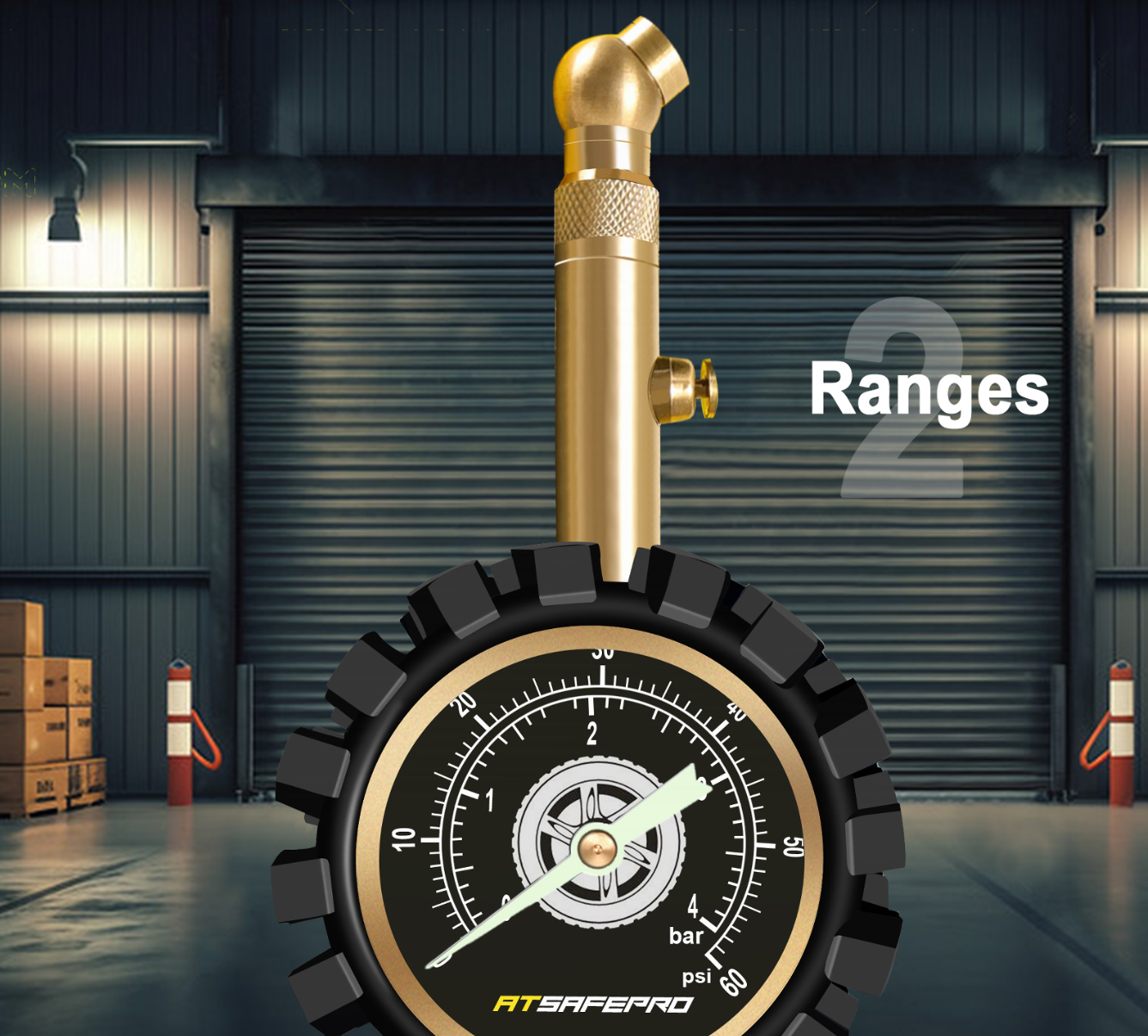
ATSAFEPRO’s product line integrates smart torque analyzers, digital pressure gauges.
This allows real-time performance monitoring, instant calibration verification, and predictive maintenance alerts.
In digitalized fleet garages and OEM assembly floors, this means:
-
Consistent torque across multi-operator setups
-
Automated record-keeping for quality audits
-
Reduction of calibration drift by up to 40%
By designing for both traditional pneumatic systems and connected Industry 4.0 platforms, ATSAFEPRO enables workshops to future-proof their operations.
Industrial Application Scenarios: When Engineering Meets Productivity
Fleet Maintenance Centers – Unified digital torque and inflator systems reduce tire pressure variation and inspection time by 25%.
OEM Service Facilities – Inline torque calibration tools ensure every assembly follows ISO/TS 16949 standards, improving warranty compliance.
Independent Repair Workshops – Modular, long-life tools with serial traceability reduce rework rates and extend tool replacement intervals.
Export Distribution Networks – Certified calibration data embedded in every shipment simplifies cross-market certification for resellers.
A European automotive network that standardized ATSAFEPRO tools across 15 service centers reduced annual recalibration costs by 30%, improving workflow stability and technician confidence.
Application-Focused Questions: Engineering Precision in Everyday Use
Q1: What distinguishes ATSAFEPRO’s tools from mass-market workshop equipment?
→ Each tool is individually calibrated on robotic benches following ISO 6789:2017 standards, ensuring torque repeatability and certified output data.
Q2: Can pneumatic and digital systems be integrated in one workflow?
→ Yes. ATSAFEPRO tools share calibration protocols and data formats, enabling cross-use without error stacking.
Q3: How is export consistency maintained across climate zones?
→ Tools are tested under thermal stress (-20°C to 70°C) and shipped in sealed, desiccant packaging to prevent material expansion or corrosion.
Q4: What recalibration support does ATSAFEPRO offer?
→ Global recalibration centers and on-site calibration kits are available for large workshop networks.
Q5: Do tools integrate with smart workshop systems?
→ Yes. Selected models feature IoT-ready modules compatible with workshop management software for data-driven maintenance.
Engineering Continuity: From Manufacturing Precision to Measurable Workshop Impact
Precision in automotive servicing isn’t a feature—it’s a system.
ATSAFEPRO’s approach as an auto workshop tools manufacturer merges mechanical design, material innovation, and automated calibration to build tools that survive stress, maintain accuracy, and deliver measurable ROI.
Every wrench, inflator, and gauge is born from controlled engineering—modeled digitally, machined by CNC, and verified by automated torque rigs.
This closed engineering loop is what transforms tools from consumables into calibrated instruments of productivity.
By connecting simulation-backed design and field-tested performance, ATSAFEPRO sets a benchmark for reliability in global workshop ecosystems.
Explore the complete line of professional-grade automotive tools at the homepage, or contact our engineering team via the contact page for OEM and export collaboration.