Why a tire tread gauge still matters in a shop full of sensors
A GODESON tire tread depth gauge looks like a simple hand tool, but in practice it solves a problem that keeps coming back for every shop, fleet manager, and careful driver: how do you know when a tire is still serviceable, and when it is quietly moving toward replacement? Tread wear does not announce itself all at once. It creeps in through rotations skipped too long, alignment drift, seasonal mileage, and the kind of uneven use that shows up only when someone finally measures it.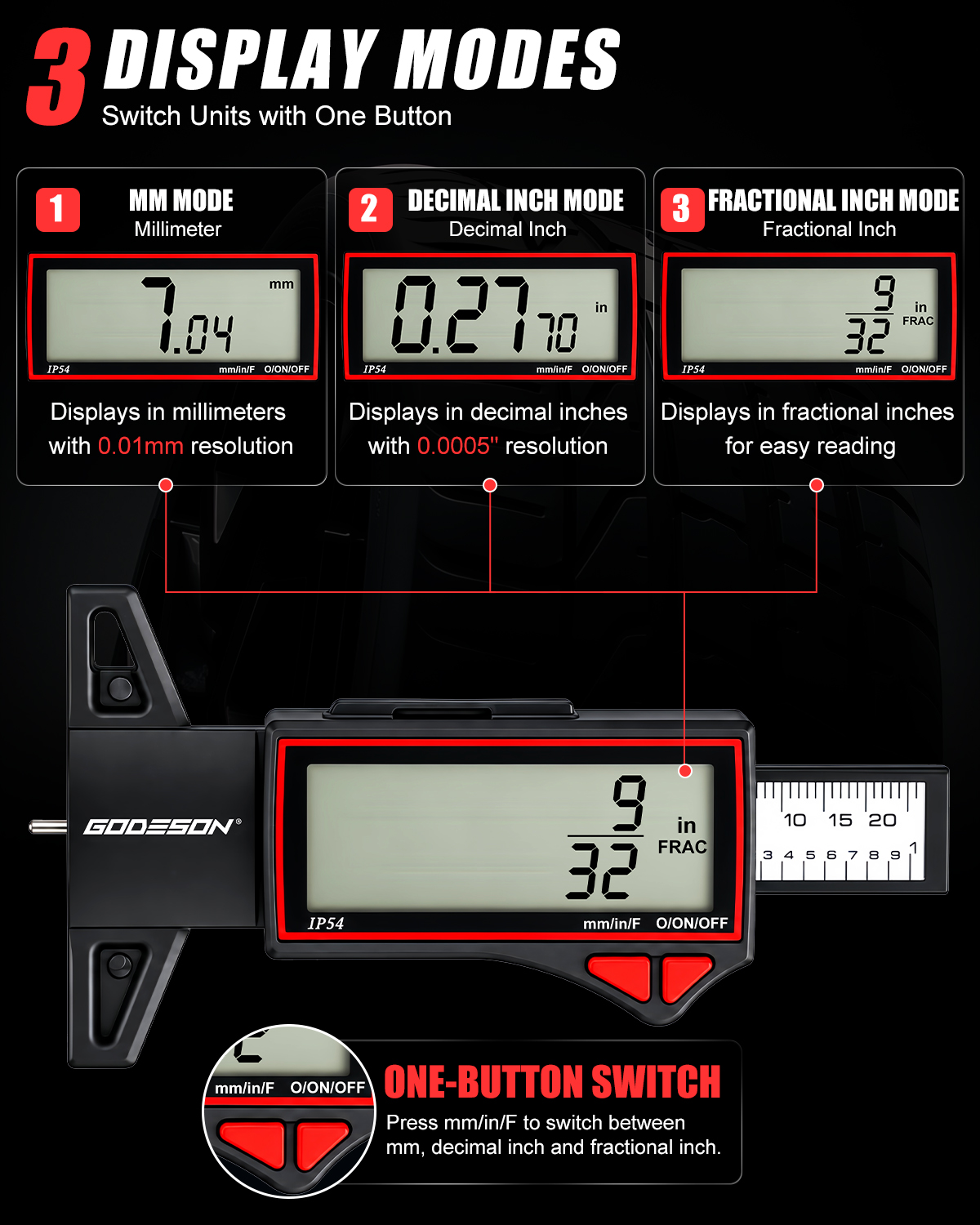
For engineers and sourcing teams, that matters because tire condition is not just a maintenance issue. It affects safety, braking performance, customer satisfaction, warranty conversations, and inventory planning. A digital tire tread depth gauge gives a fast, repeatable reading at the point of inspection, which is often what a workshop needs most. The value is less about novelty and more about removing uncertainty.
What this type of gauge is designed to do
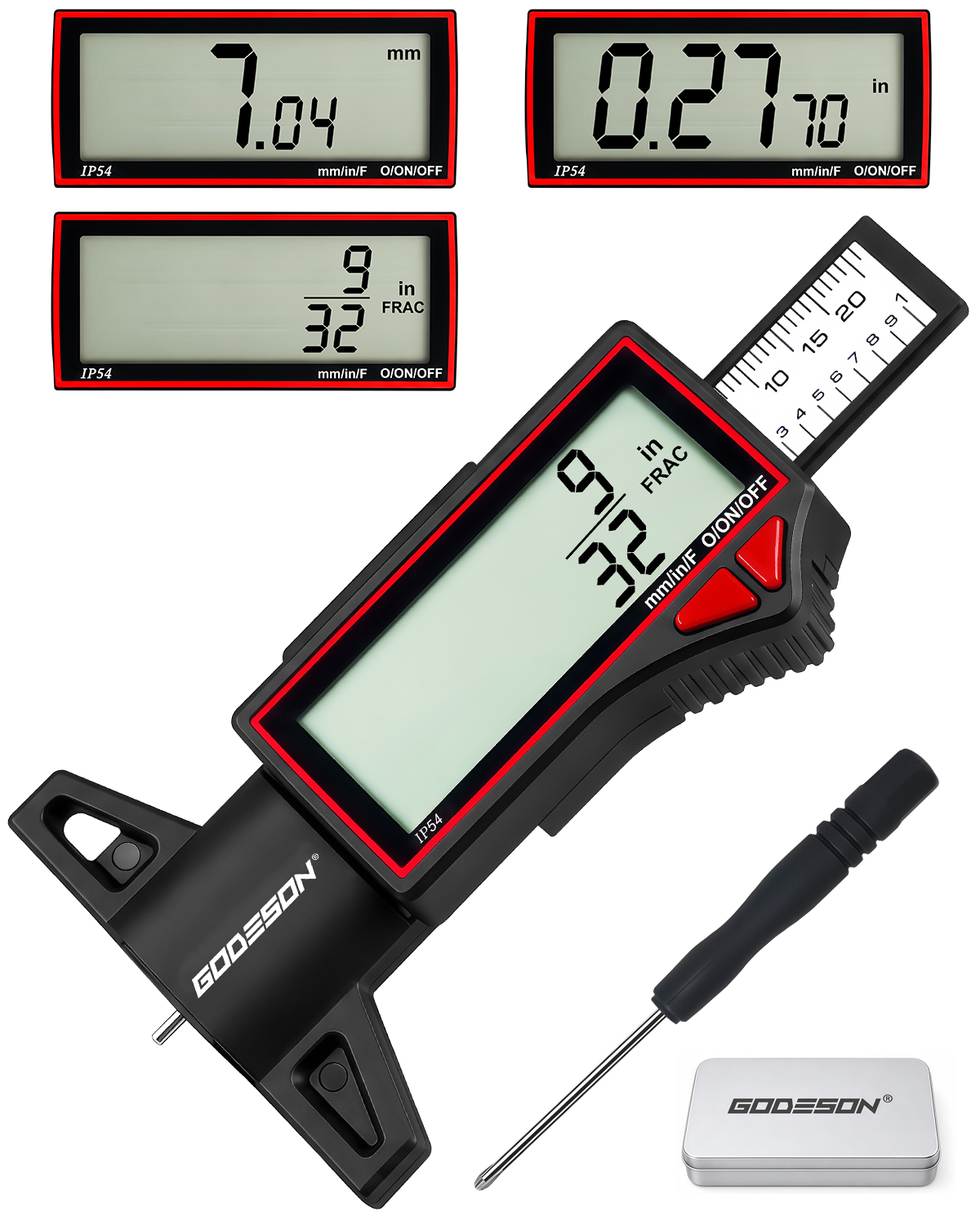
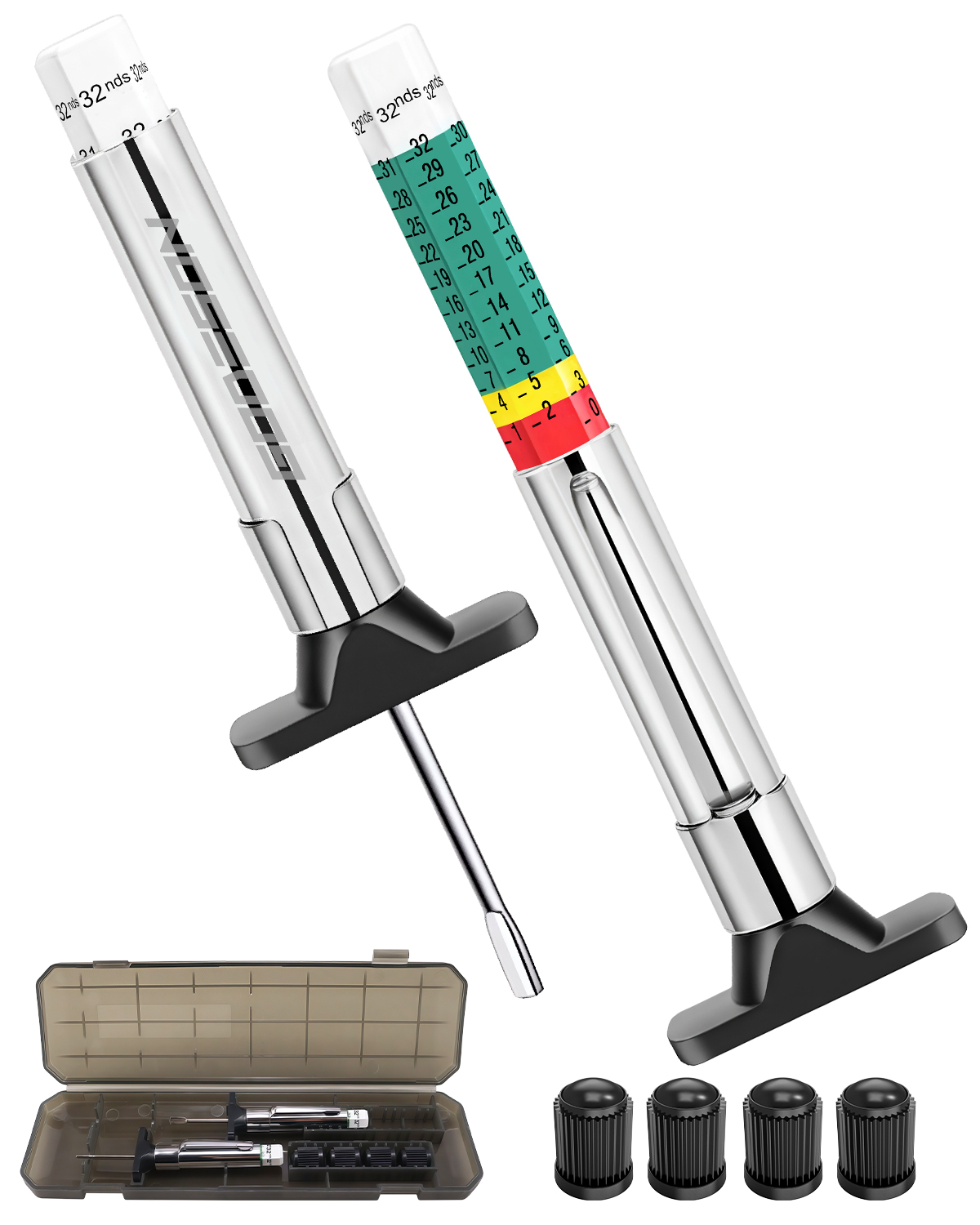
The product shown is a digital tire tread depth gauge kit. The core tool is a compact handheld gauge with an LCD display, a metal probe, a black plastic housing with red trim around the display, and a tire-contact bracket or foot on the left side. It is supplied with a small screwdriver, a user manual, and a metal storage box with rounded corners.
The visible specifications are straightforward and useful. The measurement range shown is 0.00 mm to 25.4 mm. Resolution is listed as 0.01 mm, with accuracy shown as ±0.1 mm. The display supports mm, inches, and fractional inch mode. Power comes from a CR2032 battery. The unit is shown with IP54 water resistance and an operating temperature range of 0°C to 50°C.
That is enough information for most buyers to judge whether the tool fits workshop use, fleet checks, or everyday vehicle maintenance. It is not enough to treat it like laboratory equipment, and it would be a mistake to assume more than the visible specifications support.
Why tread depth measurement affects more than tire replacement timing
Tread depth is one of those numbers that sounds narrow until you connect it to real operating decisions. A tire that is wearing evenly but approaching its lower limit may still be acceptable for one route and a liability for another. Wet-road grip changes as tread wears. So does the tire’s margin for channeling water away from the contact patch. In fleet work, this affects uptime and standardization. In retail service, it affects whether a customer is being advised too early, too late, or just in time.
A practical buyer-facing point: a tread gauge is useful not only when a tire is ready for replacement, but also when the wear pattern itself is the clue. Uneven readings across the tire can indicate alignment issues, inflation problems, suspension wear, or a rotation schedule that has slipped. In other words, the gauge is both a threshold tool and a diagnostic aid.
What to look for in a digital tire tread depth gauge kit
Measurement range and resolution
The visible 0.00 mm to 25.4 mm range covers the normal territory needed for passenger car tires and many light-duty applications. The 0.01 mm resolution is finer than most end users will ever need in routine inspection, but it does help when a team wants a clean, easy-to-read digital display. One caution: high resolution is not the same thing as high field reliability. Buyers should still weigh the tool’s overall build, zeroing behavior, and consistency in everyday use.
Readability and unit switching
The LCD display is a meaningful advantage in busy inspection work. Shop staff do not want to decode a scale when they are moving quickly between vehicles. Unit options in mm/in/FRAC make the gauge more flexible, especially in environments where technicians, service writers, and customers may prefer different units. Fractional inch mode is a small detail, but in the field these small details save time.
Housing, probe, and handling
The body appears to be molded plastic, with a metal measuring probe. That combination is common for a reason: it keeps the device light and easy to handle while preserving a rigid contact point where measurement happens. The lower grip area also suggests the tool is meant to be used one-handed. For a workshop, that matters because inspections rarely happen on a clean bench. They happen between rotations, on a lift, in a lane, or at the curb.
Protection and storage
The included metal storage box is a sensible touch. Small measuring tools tend to disappear into drawers, toolboxes, and glove compartments, where they get nicked or bent. A dedicated tin helps preserve the probe and makes the kit more presentable for customer-facing environments. IP54 protection is also worth noting, though it should be understood in the usual practical sense: helpful against dust ingress and light splashes, not an invitation to leave the gauge in the rain.
Where this gauge fits best in real operations
In a dealership or independent repair shop, the tool is useful during tire rotation, seasonal changeover, pre-delivery inspection, and routine service upsells. It gives the service advisor a number rather than a vague impression.
For fleet maintenance, it supports repeatable checks across a large vehicle pool. That is often where digital tools earn their keep. A fleet manager does not want guesswork; they want a fast method to compare tires, spot outliers, and decide when a vehicle needs attention.
DIY users also benefit, especially drivers who want to track tire wear before long trips or before changing winter and summer tires. The gauge’s compact dimensions matter here. The tool measures about 4.57 in long and 2.36 in high, while the storage box is roughly 5.12 in by 3.15 in. That is small enough for a glove box or drawer without much fuss.
Selection criteria buyers should not skip
If you are sourcing tread measurement tools for a workshop, the price tag should not be the only filter. Check whether the display is easy to read in poor light. Check whether zeroing is simple. Check whether the probe and foot sit cleanly on the tread surface. These are small usability points, but they determine whether the tool gets used correctly.
Also consider how the instrument will be cleaned and stored. Tire inspection tools see dust, rubber residue, and occasional moisture. A light-duty electronic gauge can perform well if treated properly, but it should not be expected to survive careless handling indefinitely.
For procurement teams, it is also worth asking whether the intended use is internal maintenance or customer-visible inspection. That changes the bar. A tool used for quick workshop checks may only need practical consistency. A tool used in front of customers should feel more polished, easier to explain, and more credible in the hand.
Common mistakes when using tread depth gauges
One common mistake is measuring only one point on the tire and assuming the result tells the full story. Tread wear often differs across the center, shoulders, and inner edge. Another is pressing the probe unevenly or placing the foot on a damaged section of tread. That can distort the reading just enough to matter.
A second issue is forgetting that tread depth is only one part of tire condition. Age, cracking, sidewall damage, and heat history also matter. A tire can still show useful tread and be unfit for service for other reasons. That is especially relevant for fleet and safety-focused maintenance.
There is also the human factor. Digital displays can encourage overconfidence because the number looks precise. Precision on the screen does not remove the need for good technique. In workshop terms, the tool is only as good as the person placing it.
Practical buyer advice for sourcing teams
If your team is evaluating a digital tread depth gauge for multiple locations, think in terms of workflow rather than features alone. Ask whether the tool is intended for technicians, service writers, or drivers. A tool that is technically capable but awkward to use will quietly end up unused.
It is also sensible to standardize the unit format your team prefers before deployment. Mixed units can create confusion, especially if some people think in millimeters and others in fractions. The visible mm/in/FRAC flexibility is useful, but consistency inside the organization is better.
One small caveat: because the exact internal sensor and calibration method are not visible here, buyers should avoid assuming lab-grade metrology. For routine tire wear checks, the visible specifications are strong enough to be attractive. For regulated inspection programs or highly controlled validation work, the buyer should request the relevant documentation before making assumptions.
FAQs buyers tend to ask
Is a digital gauge better than a manual tread depth gauge?
Often yes, for speed and readability. A digital display can reduce interpretation errors and is easier to communicate in service settings. Manual gauges still have a place, but digital units tend to feel more approachable for mixed user groups.
Can it be used on motorcycles, trucks, and fleet vehicles?
Yes, the intended use cases include passenger vehicles, trucks, motorcycles, and fleet applications. The key is matching the tool to the tire profile and inspection procedure.
Does IP54 mean it is waterproof?
No. IP54 suggests protection against limited dust ingress and splashing water, not full immersion or rough outdoor exposure.
Why does the storage box matter?
Because small gauges get lost, bent, or contaminated easily. A metal case improves organization and helps keep the probe protected between uses.
What this kind of tool helps a buyer decide
In the end, a GODESON tire tread depth gauge is less about the novelty of a digital readout and more about making tire inspection quick enough to do consistently. That is the real decision point for most buyers. If a measurement tool is too slow, too awkward, or too hard to read, it will be skipped. If it is compact, clear, and easy to store, it becomes part of the daily routine.
For shops, fleets, and maintenance teams, that routine is where tire safety and cost control start to align.
Next step
If you are comparing tread depth gauges for shop use or fleet maintenance, review the visible specification sheet against your inspection workflow, unit preference, and storage needs. Then test whether the tool fits the people who will actually carry it, zero it, and trust it every day. That is usually where the real buying decision gets made.