Why a controlled torque tool matters before the job gets expensive
The ATsafepro torque wrench sits in a category every shop eventually trusts more than it admits: the hand tool that prevents a fastener from becoming a comeback. Whether the task is wheel lug nut service, light machinery assembly, or routine vehicle maintenance, a controlled tightening tool helps the operator stop at a specified torque instead of guessing by feel. That sounds simple, but in practice it is the difference between a joint that stays put and one that loosens, stretches, or distorts under load.
The appeal of the ATsafepro torque wrench is that it is presented as a practical kit rather than a single tool. The main wrench has a long red metal handle, a black textured grip, and a ratchet head with an adjustment dial and locking feature. In the same case you can see deep sockets, an extension or adapter, and a compact storage box. For buyers, that combination matters because the real cost of a torque solution is rarely just the wrench itself; it is the time saved when the right socket and the right setup are already in the case.
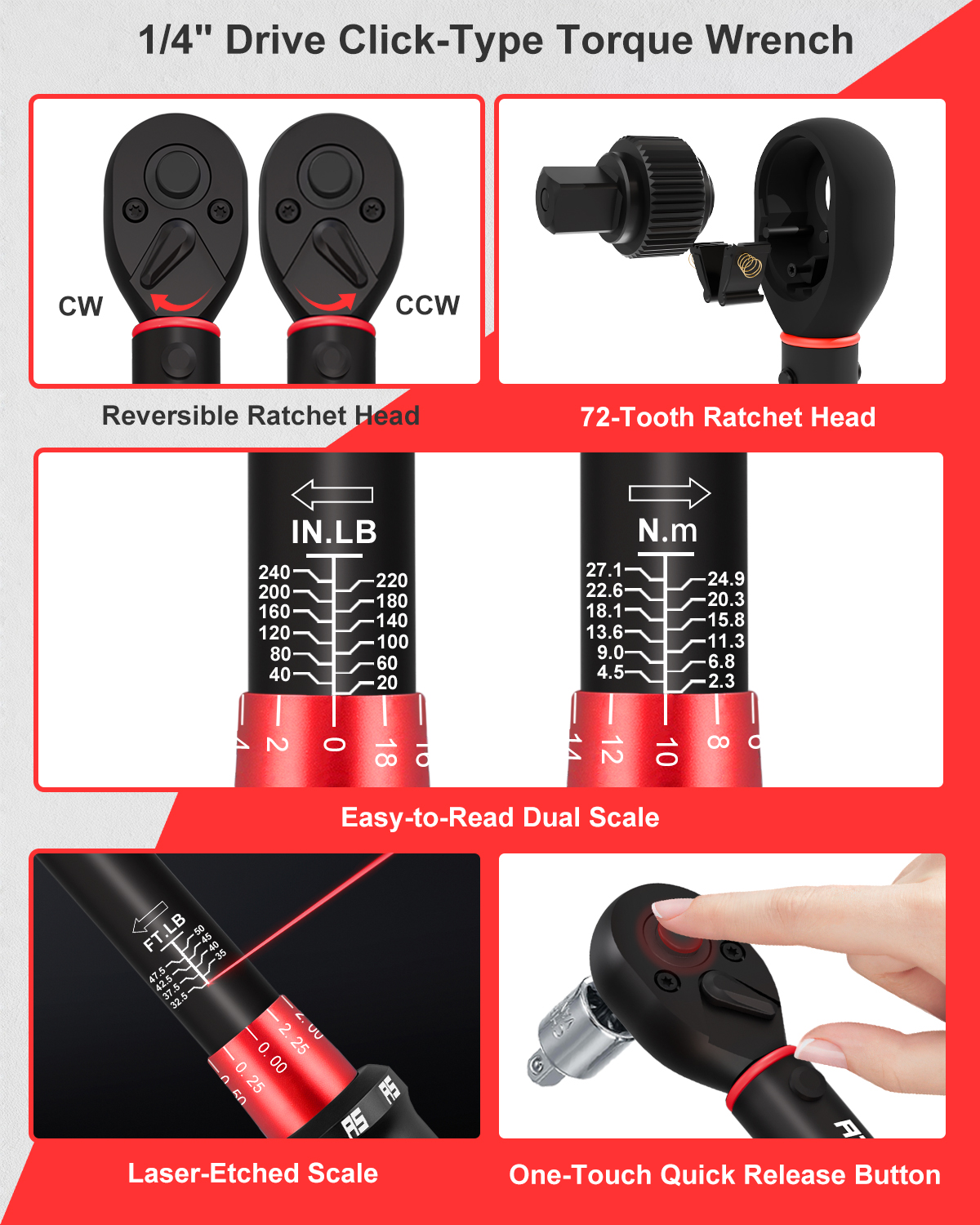
Still, torque tools deserve a careful look. The photo shows useful features, but it does not confirm the exact torque range, accuracy class, or calibration status. That is not a flaw in the product description so much as a reminder for buyers to separate what is visible from what still needs verification before procurement.
What the kit appears to include
Based on the product images, this is a handheld adjustable click-type torque wrench kit intended for tightening nuts and bolts to a specified torque. The wrench body is metal, with a visible torque scale printed along the shaft. The handle is long, which should help with leverage and controlled application, while the black grip area adds texture for better hand contact during use.
The kit also appears to include multiple deep impact-style sockets labeled CR-MO 17 mm, 19 mm, and 21 mm, with color-coded finishes in blue, yellow, and red and black lower collars. That color coding is a small detail, but in a working shop it helps. Sockets get mixed up constantly, especially when a crew is moving between service bays or working with a fleet that uses mixed fastener sizes.
A chrome extension or adapter and a small square drive adapter are also visible, along with a hard plastic storage case. For field work, that case is not just packaging. It keeps the tool from rolling around in a drawer, and it lowers the odds that the sockets disappear before the next job.
Where a torque wrench earns its keep
There are plenty of fastening jobs where “tight enough” is not enough. Wheel service is the obvious one. Lug nuts need to be tightened evenly and to a controlled value so the wheel seats properly and the fastener is not over-stressed. Over-torque can distort components or make future removal harder than it should be. Under-torque can create loosening, vibration, and noise, which is the kind of issue that usually returns after the vehicle leaves the bay.
Machinery assembly is another area where a torque-controlled approach is more than a formality. Brackets, covers, frames, and service components often rely on consistent clamp load. If one fastener is significantly tighter than the rest, load distribution can shift in a way that is not obvious at first glance. In maintenance work, that sort of mismatch tends to show up later as wear, movement, or uneven sealing.
For sourcing managers, the question is not simply whether a wrench can tighten a bolt. It is whether the tool helps standardize workmanship across shifts and across operators. That is where an adjustable click-type torque wrench becomes useful: it gives the shop a repeatable method instead of depending entirely on hand feel.
How this style of torque wrench typically works
An adjustable click-type torque wrench is built to alert the user when the preset torque target is reached. The operator sets the desired value on the shaft or adjustment mechanism, locks the setting, and then tightens the fastener. When the tool reaches the selected torque, it signals the user mechanically. That signal is the point; it reduces the temptation to keep pulling once the joint has already reached specification.
The ratcheting head shown on the ATsafepro torque wrench suggests faster working in tight spaces, where removing the tool after each stroke would be inconvenient. In service work, that matters. A technician does not want to fight the tool more than the fastener.
One practical note: any click-type wrench is only as trustworthy as the user’s handling and the tool’s condition. Pulling too quickly, using it as a breaker bar, or storing it under load can compromise performance over time. Buyers often know this in theory, but it still gets overlooked in busy shops.
Selection criteria buyers should not skip
If you are evaluating the ATsafepro torque wrench or a similar kit, start with the job, not the brochure. The first question is whether the visible socket sizes and drive accessories match the fastening work you actually perform. The included 17 mm, 19 mm, and 21 mm sockets point toward automotive wheel service and similar tasks, but that does not automatically make the kit suitable for every maintenance department.
Next, verify the torque range and accuracy information directly from the seller or technical sheet. The image shows a printed scale, but the exact range is not readable and should not be assumed. If your application needs a narrow range or a formal calibration record, that information matters far more than the color of the handle.
Also check the finish and socket material against the environment. The sockets are marked CR-MO, which generally signals chrome-molybdenum construction suited to higher-stress use. That is useful for impact-style or service-heavy applications, but the exact alloy grade and surface treatment are not confirmed here. In other words, the material cue is promising, yet still worth validating if the tool will see daily industrial use.
Finally, consider ergonomics. A long handle with a textured grip is helpful when repeated tightening is part of the job. It reduces hand fatigue and can improve control, especially when the operator is wearing gloves. Small detail, yes, but small details are what make a hand tool pleasant to use or irritating by lunchtime.
Common mistakes with torque tools
One of the most common mistakes is using a torque wrench for final tightening after a fastener has already been aggressively snugged with another tool. That can distort the reading and make the click feel less meaningful. Another is treating a torque wrench like a general-purpose ratchet. It is a measuring tool first and a hand tool second.
Another issue is assuming the same fastener size always needs the same treatment across materials or assemblies. That is rarely true in actual production or service environments. Joint design, lubrication, thread condition, and component material all influence the final result. A technician who understands that will use the tool better than one who relies on memory alone.
There is also the matter of storage. If the kit includes a case, use it. Keep the wrench clean and dry, and do not leave the setting dialed in under tension unless the manufacturer specifically says otherwise. That caution is basic, but it is still one of the easiest ways to extend the life of a torque tool.
Practical buyer advice for sourcing teams
For sourcing and product teams, the ATsafepro torque wrench is best viewed as a kit platform rather than just a single wrench SKU. The visible add-ons suggest a package designed to support common service work right out of the box. That can simplify purchasing because fewer accessory orders are needed later, and fewer mismatched components end up in circulation.
Ask for the details that are not clear in the image: confirmed torque range, drive size, calibration or verification documentation if needed, and any service guidance for the ratchet mechanism. If the tool is headed into a production or fleet maintenance setting, standardization matters more than novelty. You want a wrench the team will actually use, not one that stays in the drawer because the accessories are inconvenient.
It is also worth deciding whether the intended user is a technician, a maintenance mechanic, or an occasional operator. A tool can look robust and still be the wrong fit if the workflow is light-duty, infrequent, or highly controlled. Conversely, a straightforward kit with a case and clearly labeled sockets may be exactly what a mobile service unit needs.
FAQ
Is the ATsafepro torque wrench suitable for wheel service?
Based on the visible socket sizes and the adjustable torque wrench design, it appears well suited to wheel lug nut service and related automotive fastening tasks. The final answer still depends on the confirmed torque range and drive specifications.
Does the kit look ready for field use?
Yes, in a practical sense. The hard case, color-coded sockets, and visible adapter pieces suggest a kit built for transport and organization. That said, field readiness also depends on calibration, durability, and whether the included sizes match the job.
Can the visible scale be relied on as a specification?
No. The torque markings are visible, but the exact calibration range is not fully readable in the image. Buyers should request a clear technical sheet before placing an order for controlled fastening work.
What should buyers verify before approval?
At minimum: torque range, drive size, accuracy or verification status if required, included accessory list, and whether the socket set matches the application. If any of those are uncertain, ask before you buy rather than after the tool arrives.
What this kit is really offering
The ATsafepro torque wrench appears to be aimed at users who want a straightforward fastening kit with useful accessories, not a bare-bones tool. The red-handled wrench, ratcheting head, printed scale, and labeled CR-MO sockets point toward a service-oriented package with an emphasis on convenience and controlled tightening. For many buyers, that is enough to make it worth a closer look.
If you are comparing options, the next step is simple: confirm the technical data that cannot be read from the image, then match the kit to the fastening work you actually do. That one extra check usually saves more trouble than any last-minute bargain ever will.